
12 Biographies That Everyone Should Read Once
12 Lives That Explain Civilization

Most biographies are sold as stories of success, but the best ones do something deeper. They take famous names out of marble and return them to danger, fatigue, doubt, hunger, pride, faith, failure, and decision. A civilization is carried by lives of great men. These twelve biographies should be read because they train the reader to study human beings at full scale. They show talent under pressure. They show how character either strengthens a gift or corrupts it. They show that beauty, courage, law, faith, and memory survive because some people carried them when it was costly.

1. Leonardo da Vinci by Walter Isaacson
Walter Isaacson’s Leonardo da Vinci belongs first because it shows genius as a disciplined form of wonder. The book is based on thousands of pages from Leonardo’s notebooks, which means the reader does not meet Leonardo as a polished museum icon, but as a restless mind at work. He studied anatomy, fossils, birds, the heart, optics, botany, geology, flying machines, and weaponry with the same hunger that shaped The Last Supper and the Mona Lisa.
Leonardo’s art cannot be separated from his science. His creativity came from the way he crossed boundaries most people keep apart. He looked at light, muscle, water, machines, faces, and movement until each subject began speaking to the others. His Vitruvian Man became the perfect emblem of the human body standing at the crossroads of mathematics, beauty, proportion, and mystery.
Leonardo proves that creativity is not just talent. It is curiosity trained into vision. He was illegitimate, left-handed, easily distracted, unconventional, and often outside the normal categories of his age. Yet that misfit quality helped him see what others missed. His life teaches a simple lesson: the world opens itself to the person who refuses to look at it lazily.
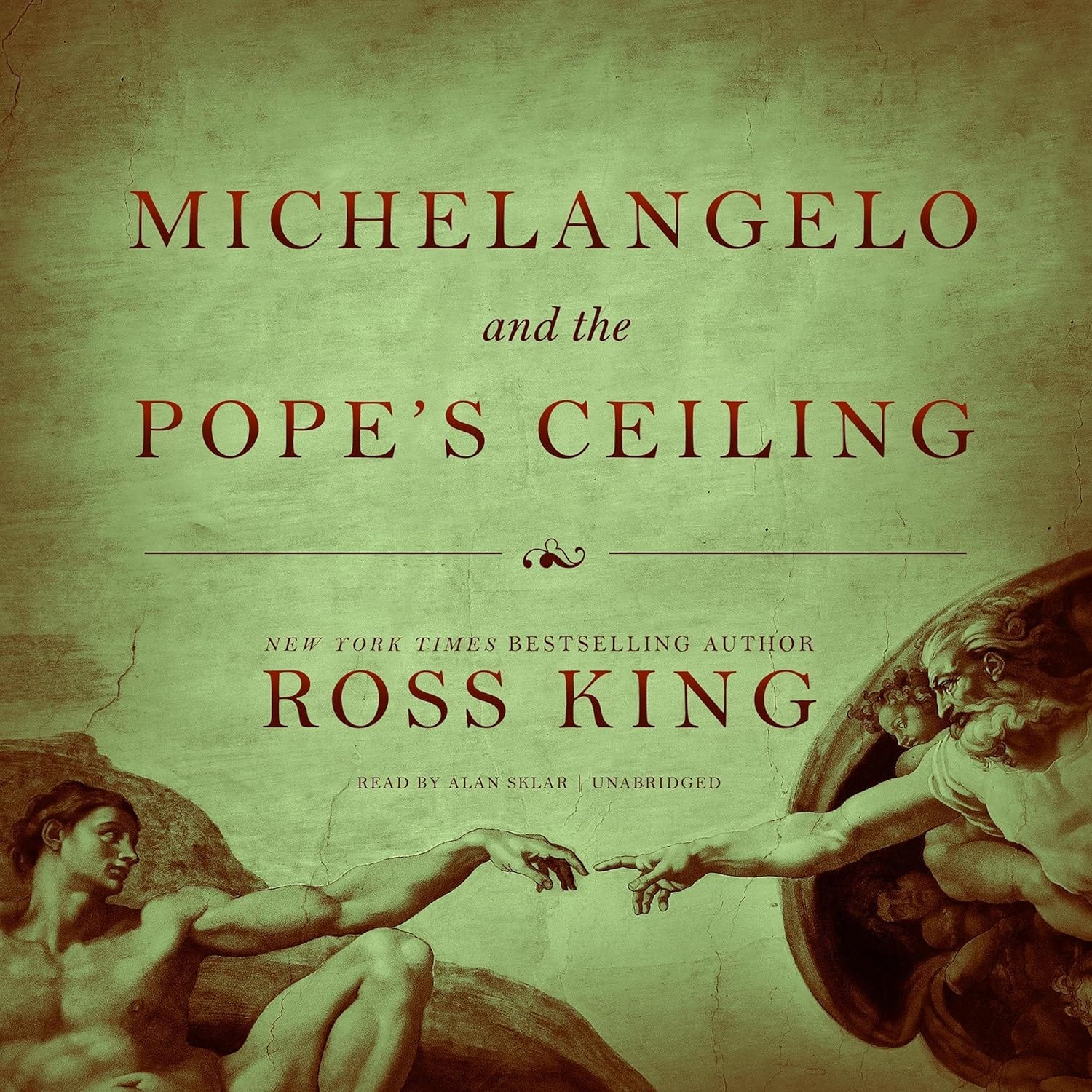
2. Michelangelo and the Pope’s Ceiling by Ross King
Ross King’s Michelangelo and the Pope’s Ceiling rescues the Sistine Chapel ceiling from the calm silence of tourism and returns it to the brutal conditions that produced it. In 1508, Pope Julius II commissioned Michelangelo Buonarroti to paint the ceiling of the newly restored Sistine Chapel, despite Michelangelo’s own doubts and advice from others against the project.
For four years, Michelangelo labored over roughly 12,000 square feet of ceiling while Rome and Italy shook with rivalry, ambition, family pressure, papal impatience, and financial strain. He had limited experience with fresco, battled illness and discomfort, and worked not by lying flat on his back, as legend claims, but with his body bent backward in punishing strain. King shows art as history in motion. The ceiling was not born from peaceful inspiration. It emerged from power politics, theological imagination, workshop struggle, artistic pride, and the will of a pope who wanted Rome to speak in stone, paint, and glory.
Michelangelo’s prophets and sibyls also reveal a deeper Christian vision large enough to absorb the ancient world, placing Hebrew prophecy and pagan foreknowledge inside one vast sacred drama. This biography teaches that beauty often arrives through conflict. The Sistine ceiling is not only a masterpiece of Renaissance art. It is the record of a man pushed past his limits until suffering became form, color, muscle, judgment, and awe.

3. Benvenuto Cellini’s Autobiography
Benvenuto Cellini’s Autobiography is the wildest book on this list because Cellini gives the Renaissance with the mask removed. A sculptor, goldsmith, writer, self-promoter, and deeply unstable witness to his own greatness, he was admired and resented in the courts and workshops of Florence, Rome, and Paris. He was also a murderer, braggart, adventurer, prisoner, court favorite, and shameless self-mythologist.
That is what makes the book so valuable. It does not present the Renaissance as a peaceful age of polished genius. It gives us innkeepers, prostitutes, kings, cardinals, soldiers, artists, patrons, sword fights, prison cells, papal threats, royal praise, and constant danger. His autobiography has the movement of a picaresque novel, but the shock is that much of this world was real. Cellini’s Europe is violent, theatrical, corrupt, funny, and half-mad, closer to Don Quixote than to the quiet halls where Renaissance art is now displayed.
Cellini reminds us that civilization has always been built beside brutality. The same world that produced Michelangelo and the Medici also produced vendettas, prison escapes, street fights, and artists whose egos could barely fit inside their own lives. Cellini is not a moral model. He is a witness. His life shows the Renaissance with its blood, pride, humor, skill, and danger still intact.
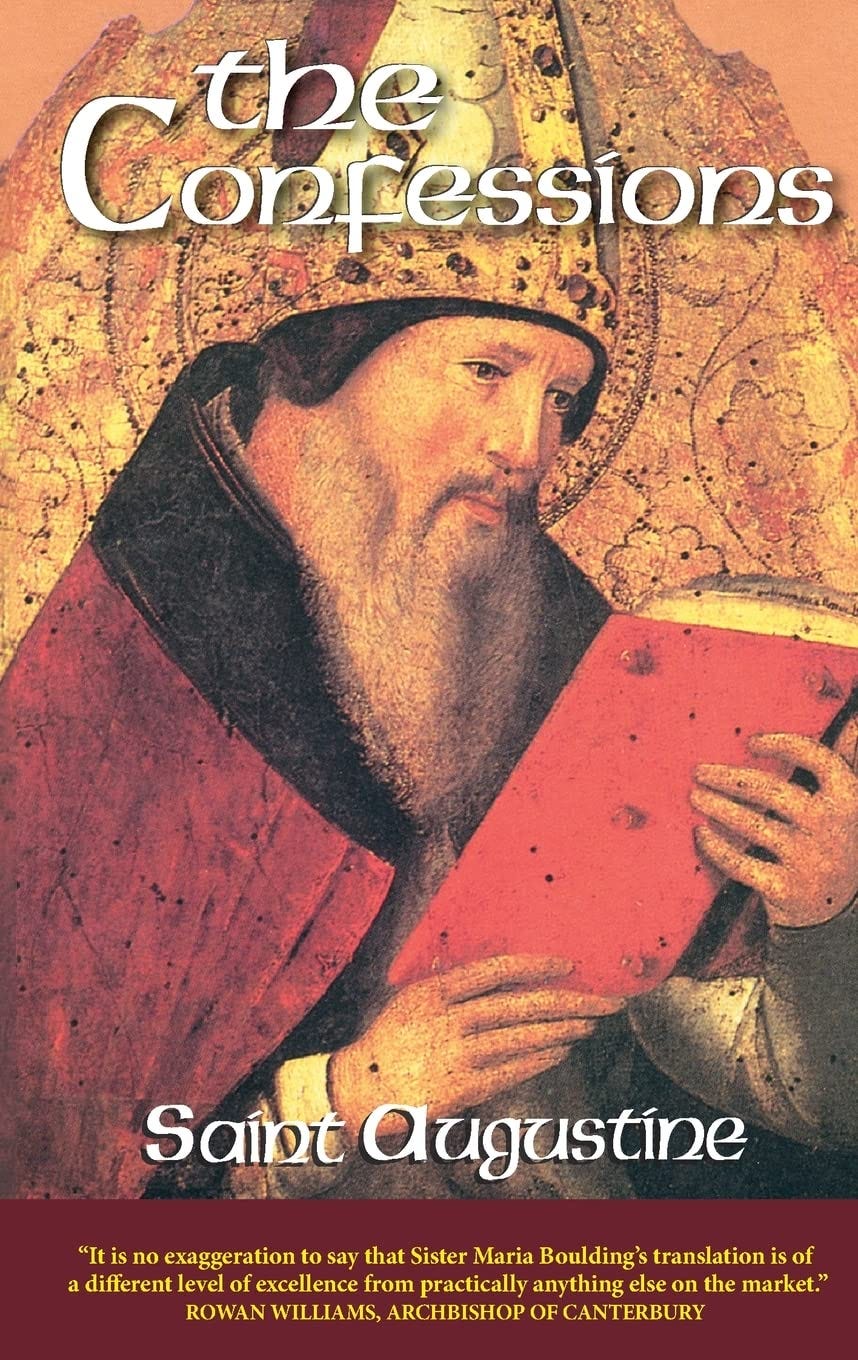
4. Confessions by Saint Augustine
Saint Augustine’s Confessions is one of the greatest biographies of the inner life ever written. Augustine began the work around the age of forty-three, after ten years as a baptized Catholic, six years as a priest, and only two years as a bishop. His earlier life still raised questions. Was his conversion real? Had the ambitious young man who chased status, pleasure, rhetoric, and restless desire truly become a servant of God?
Confessions answers that question in a form unlike almost anything before it. It is an extended prayer, poetic, intimate, passionate, and severe. Augustine turns his own memory into a courtroom, a chapel, and a mirror. He examines childhood, ambition, lust, grief, friendship, pride, sin, and grace with a force that still feels painfully modern. The Psalms and Scripture run so deeply through his voice that they almost become his native language. The translation keeps the prose clear and fluid while preserving the sense that Augustine is not merely explaining his life, but praying through it.
Augustine belongs on this list because he proves that civilization does not begin only in buildings, laws, and armies. It begins in the soul’s order. A society that cannot understand desire cannot understand decline. A person who cannot examine himself becomes easy prey for appetite, status, and illusion. A culture that cannot examine desire cannot understand disorder. A man who cannot confess himself cannot be free.

5. Maimonides: The Life and World of One of Civilization’s Greatest Minds by Joel L Kraemer
Maimonides was one of the rare minds who shaped several worlds at once. Born in Muslim-ruled Spain in 1135, Moses Maimonides came of age inside a Mediterranean civilization where Jewish, Muslim, and Christian traditions clashed, borrowed, argued, and learned from one another. He was deeply formed by Arabic philosophy and literature, yet became one of the greatest interpreters of Jewish law and practice before he was thirty.
In Egypt, his medical skill brought him into the orbit of Sultan Saladin’s court, while his writings traveled far beyond his own community and influenced generations of Jewish, Christian, and Muslim thinkers. Kraemer’s biography does not shrink Maimonides into a narrow religious category. It presents him as philosopher, physician, jurist, exile, scholar, and public man. His intellectual range was astonishing. In medicine, he belongs in the long tradition associated with Hippocrates. In philosophy, he stands in conversation with Aristotle, Plato, Spinoza, and Kant. In religion and law, his authority helped shape Jewish civilization for centuries.
Maimonides shows what happens when tradition meets disciplined reason without surrendering its soul. He lived in a world of conflict, migration, and religious pressure, yet turned that pressure into clarity. His life teaches that civilization survives when its greatest minds can translate inheritance into law, thought, medicine, and moral order.

6. Joan of Arc: A History by Helen Castor
Helen Castor’s Joan of Arc strips away the frozen icon and gives us Joan before history knew what she would become. She was the peasant girl from Domrémy who said she heard voices from God, entered the crisis of fifteenth-century France, helped lead French forces against the English, was burned at the stake for heresy, and later became a saint.
But Castor’s great strength is that she tells the story forward, not backward. She places Joan inside a world where princes, bishops, soldiers, peasants, and Joan herself did not know the ending. That matters because it restores the danger. Joan was a living girl caught inside war, faith, doubt, prophecy, politics, and a brutal civil conflict among the French themselves. Her fight against the English also meant taking sides in a divided kingdom where loyalty could become deadly.
Joan’s biography reveals the strange force of conviction before it becomes respectable. Every age praises courage once it is safely in the past. Joan forces us to face courage while it is still disruptive, embarrassing, threatening, and impossible to control.

7. Narrative of the Life of Frederick Douglass, an American Slave by Frederick Douglass
Frederick Douglass turned his own life into one of the great moral documents of American civilization. His first autobiography, Narrative of the Life of Frederick Douglass, an American Slave, was published in 1845, seven years after his escape from slavery. It answered those who could not believe that so powerful an orator and writer had once been enslaved.
The book is short, compressed, and devastating. It exposes the cruelty of Maryland plantation slavery while showing how literacy became Douglass’s path toward freedom. In My Bondage and My Freedom, published in 1855, Douglass expands the story with greater psychological depth, showing how slavery corrupted not only bodies, but speech, family, memory, religion, and the moral senses of both master and slave. It also includes parts of his speeches, including the scorching “What to the Slave Is the Fourth of July?” In Life and Times, first published in 1881 and later revised, Douglass looks beyond escape and abolition into Reconstruction, equality, diplomacy, and the unfinished meaning of American freedom.
Douglass proves that language can become an instrument of liberation. He did not merely survive oppression. He mastered the written and spoken word so completely that he forced a nation to hear the truth it had tried to bury. His life teaches that civilization depends on human dignity, and dignity often begins when a man finds the words no power can take from him.

8. The Life of Samuel Johnson by James Boswell
The Life of Samuel Johnson is one of the great turning points in the history of biography. First published in 1791, it gave English literature one of its most vivid portraits of a human being: Samuel Johnson, the essayist, poet, critic, lexicographer, Christian moralist, and wounded genius behind A Dictionary of the English Language. Boswell first met Johnson in 1763, when Boswell was twenty-two and Johnson was fifty-three, and that Boswell kept records of Johnson’s conversations through his own shorthand system.
Boswell does not present Johnson as a cold monument of intellect. He gives us the living man: brilliant, irritable, devout, melancholic, funny, anxious, tender, severe, and full of contradictions. The book is built from conversations, anecdotes, arguments, meals, journeys, remarks, habits, illnesses, jokes, and moments of private emotion. That is why it feels so modern. Boswell helped move biography away from dry public record and toward intimate character study.
Johnson’s greatness emerges through speech, friendship, moral struggle, literary judgment, religious seriousness, and the daily friction of personality. Johnson shows that civilization is carried through language and conversation as much as through buildings and laws. A culture with thin speech becomes thin in thought. Boswell’s Johnson reminds us what happens when language carries memory, wit, moral weight, and the full difficulty of being human.

9. Washington: A Life by Ron Chernow
George Washington is too often respected without being understood. He has become a marble figure in the American imagination: honorable, distant, silent, and dull. Chernow restores the living man. Washington emerges as a tall, athletic, emotionally guarded figure who was a skilled horseman, elegant dancer, tireless hunter, and man of strong moods beneath severe self-control.
The biography follows him from a troubled boyhood to the French and Indian War, Mount Vernon, the Continental Army, the Constitutional Convention, and the first presidency. It also brings out the private tensions that shaped him: his difficult relationship with his mother, his youthful attachment to Sally Fairfax, his marriage to Martha, his complicated family life, and his morally troubling role as a slave master.
Yet the heart of the book is Washington’s genius for restraint and institution-building. He gathered around himself figures like James Madison, Alexander Hamilton, John Adams, and Thomas Jefferson, then helped guide their rival energies into the creation of a working federal government. Washington understood that founding a nation required self-command, dignity, political judgment, and the ability to turn personal authority into lasting institutions. His greatness lies not only in what he won, but in what he refused to become.
Washington understood the danger of power in a young republic. Many men win battles and become smaller afterward. Washington won authority and then accepted limits. That act shaped the American imagination more than any statue can explain. His life teaches that civilization needs self-command at the top. Without it, victory curdles into vanity.

10. Napoleon: A Life by Andrew Roberts
Napoleon Bonaparte was not merely a military genius. He was one of history’s great soldier-statesmen, a man whose battles at Austerlitz, Borodino, and Waterloo still define the scale of military history, but whose influence reached far beyond the battlefield.
Roberts’s biography draws on the publication of Napoleon’s thirty-three thousand letters, which gives the reader a more intimate view of his character, motives, habits, tenderness, vanity, impatience, and contradictions. He appears here as a restless human being: brilliant, disciplined, theatrical, often forgiving, often ruthless, capable of reform and capable of destruction. He carried a personal library on campaign, believed in merit over aristocratic privilege, supported legal equality for Jews and Protestants, and reshaped Europe through administration, law, propaganda, and war.
Yet the same man also undermined women’s freedoms after the Revolution, placed family members in power despite his stated belief in merit, and let ambition outrun judgment. Roberts shows the Napoleonic paradox clearly: the revolutionary who became emperor, the meritocrat who practiced nepotism, the lawgiver who broke rules when they obstructed him, the modernizer who left much of Europe exhausted.
Napoleon reveals the terrifying double edge of greatness. Civilization is not only shaped by saints, artists, and philosophers. It is also seized by men who understand power, symbols, institutions, and memory better than their age can resist. Napoleon teaches a hard lesson: brilliance can build institutions and still leave ruin behind. Talent needs moral limits. Ambition without inward restraint becomes a machine that consumes nations, friends, enemies, and finally itself.

11. The Last Lion by William Manchester and Paul Reid
Churchill’s life shows what language, memory, and courage can do when a civilization feels close to collapse. The book spans 1940 to 1965, beginning just after Churchill became prime minister, when Britain stood almost alone against Nazi Germany. France had fallen, much of Europe was under Hitler’s control, America remained hesitant, and Britain faced invasion across the Channel.
Churchill did not win the war by speeches alone, but his words gave Britain a moral spine when surrender had begun to sound practical. Manchester and Reid show him organizing Britain’s defense, pressing Franklin Roosevelt for support, and carrying the “never surrender” spirit through the darkest year of the war. The book also gives the wider machinery of survival: the Battle of Britain, radar, RAF command, aircraft production, Dunkirk’s shadow, North Africa, El Alamein, and the long strain of alliance politics with Roosevelt and Stalin. After victory, Churchill’s story does not simply end in triumph. He was driven from office, warned about Soviet power, returned to 10 Downing Street, and spent his final years still chasing one last diplomatic goal: a summit that might reduce the danger of another world war.
Churchill understood that civilization is defended by memory, speech, stubbornness, historical imagination, and the refusal to let fear choose the future.

12. Edmund Burke: The First Conservative by Jesse Norman
Edmund Burke was an eighteenth-century Irish philosopher, statesman, and one of the sharpest defenders of the Anglo-American constitutional tradition. He fought arbitrary power, defended the rights of the American colonies, argued for responsible government in India, supported Catholic relief in Ireland, and stood ahead of many in his age on questions of slavery, empire, liberty, and civic duty.
Yet his deepest importance lies in his understanding of society. Burke did not see civilization as a contract between isolated individuals chasing private gain. He saw it as a covenant between generations: the dead, the living, and the unborn. That one idea explains why he matters so much now. He warned against ideological extremism, the arrogance of revolutionary politics, and the fantasy that a society can be torn down and rebuilt from theory alone. His attack on the French Revolution was a defense of inherited wisdom against political vanity.
Burke belongs on this list because he gives language to the defense of continuity. Tradition, in Burke’s vision, is accumulated judgment. It is what a civilization remembers after paying the cost of its mistakes.
Biographies bring civilization back down to the human face. We often speak of cultures as if they rise and fall through systems alone, but every system eventually depends on character. A library survives because someone preserves it. A law endures because someone refuses to bend it. A painting reaches us because someone suffered long enough to finish it. A nation holds together because someone chooses restraint when vanity would be easier.
Great biography teaches us to look for that hidden pressure inside history. Talent is never enough. Power is never neutral. Beauty demands discipline. Freedom needs memory. And every civilization eventually depends on people who carry its inheritance when others are ready to spend it.
That is the real reason to read these lives. You are not only studying the dead. You are learning what kind of person keeps the living world from becoming smaller.
I would add also the Plutarch's Lives. It is a collection of greatest biographies of antiquity. Plutarch as a philosopher tried to paint each man through moral lense. Must read for everyone.
I am piqued that you write, "A civilization is carried by lives of great men." Your list does, in fact, include one woman. Dig deep and see if you can find 10 more women's biographies to recommend.