

12 Must-Read Books from Eastern Literature
The Essentials of the Eastern Canon

The Western canon often teaches us how to admire the individual who stands against fate, law, empire, or God. The Eastern canon asks a more unsettling question: what if the self is not the hero of the story, but the thing that must be disciplined, stripped, humbled, or overcome?
That question belongs to every civilization that has watched desire ruin judgment, pride destroy families, and beauty vanish while people pretend it will last forever. The greatest Eastern works of fiction endure because they test the self. They show kings learning limits, warriors trapped by duty, lovers wounded by illusion, and entire houses collapsing under the weight of their own habits.
The Eastern canon gives fiction a severe moral task. It asks what a person’s desires are doing to him, what he must surrender before he can see clearly, and whether power, beauty, loyalty, and longing can survive contact with time.
These twelve works remain alive because they turn that question into story.

1. The Epic of Gilgamesh
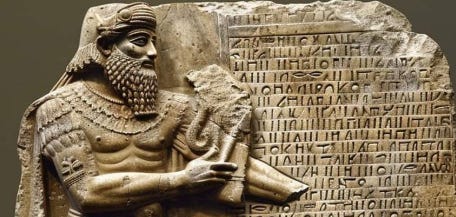
Gilgamesh is the first great literary warning that power cannot save a man from death. The epic follows a young king of Uruk whose strength has made him dangerous, restless, and unjust. Then Enkidu enters his life. Their friendship humanizes him, and Enkidu’s death wounds him so deeply that Gilgamesh runs toward the edge of the world looking for immortality. What he finds is harsher and more useful: death cannot be conquered, but life can still be ordered, governed, built, and remembered. The poem’s force comes from this return. Gilgamesh leaves the city as a terrified man and comes back able to look at its walls with new eyes.
That is why the epic still feels alive after thousands of years. It does not give us a hero who wins by killing a monster. It gives us a hero who loses the argument with mortality and becomes wiser for it. The work is described as the first epic handed down by history, with its oldest surviving written version dating to around 1750 BC, older than Homer by more than a millennium. It has psychological depth as it moves from selfishness toward civic life. Gilgamesh earns its place at the beginning because it understood, before almost anyone else, that civilization begins when strength learns limits.

2. The Mahabharata
The Mahabharata is what happens when a civilization refuses to make morality easy. The plot centers on the Kurukshetra War, a conflict between the Pandavas and Kauravas, two branches of the same royal family. But the war is only the visible wound. The real drama lies beneath it: kinship turns poisonous, ambition hides behind law, duty becomes unbearable, and righteousness forces men into choices that stain them. The epic contains famous works and episodes such as the Bhagavad Gita, Damayanti, Shakuntala, Savitri and Satyavan, and many others, which makes it less like a single book and more like a moral manual.
Its scale matters, but scale alone would not make it great. The longest version contains more than 100,000 verses and roughly 1.8 million words, making it one of the longest epic poems known. Yet the achievement is not merely size. The Mahabharata created a world where nearly every major figure can defend himself, and that is what makes it so disturbing. Duryodhana is not a cartoon villain. Yudhishthira’s righteousness becomes dangerous when law loses contact with mercy. The epic shows a terrifying truth that a society can know the language of duty and still walk itself into ruin.

3. The Ramayana
The Ramayana turns virtue into a journey, and that is why it has moved across languages, religions, kingdoms, stages, temples, and households for centuries. The story follows Rama, prince of Ayodhya, who is sent into fourteen years of exile. Sita and Lakshmana go with him. Sita is later abducted by Ravana, king of Lanka, and the story drives toward rescue, war, return, and kingship. On the surface, it is a heroic tale of exile and restoration. Underneath, it asks what happens when obedience, love, and public duty pull against each other.
The work is traditionally attributed to Valmiki and contains about 24,000 verses divided into seven books. Its influence reached beyond India into Southeast Asian traditions, including Cambodian, Malay, Thai, Lao, Burmese, Nepali, Vietnamese, and other versions. That wide transmission matters because Rama and Sita became more than literary figures. Rama became an image of rule under moral law. Sita became an image of endurance under unbearable testing. The Ramayana survives because it forces readers to ask whether righteousness can remain pure once it enters the world of power.
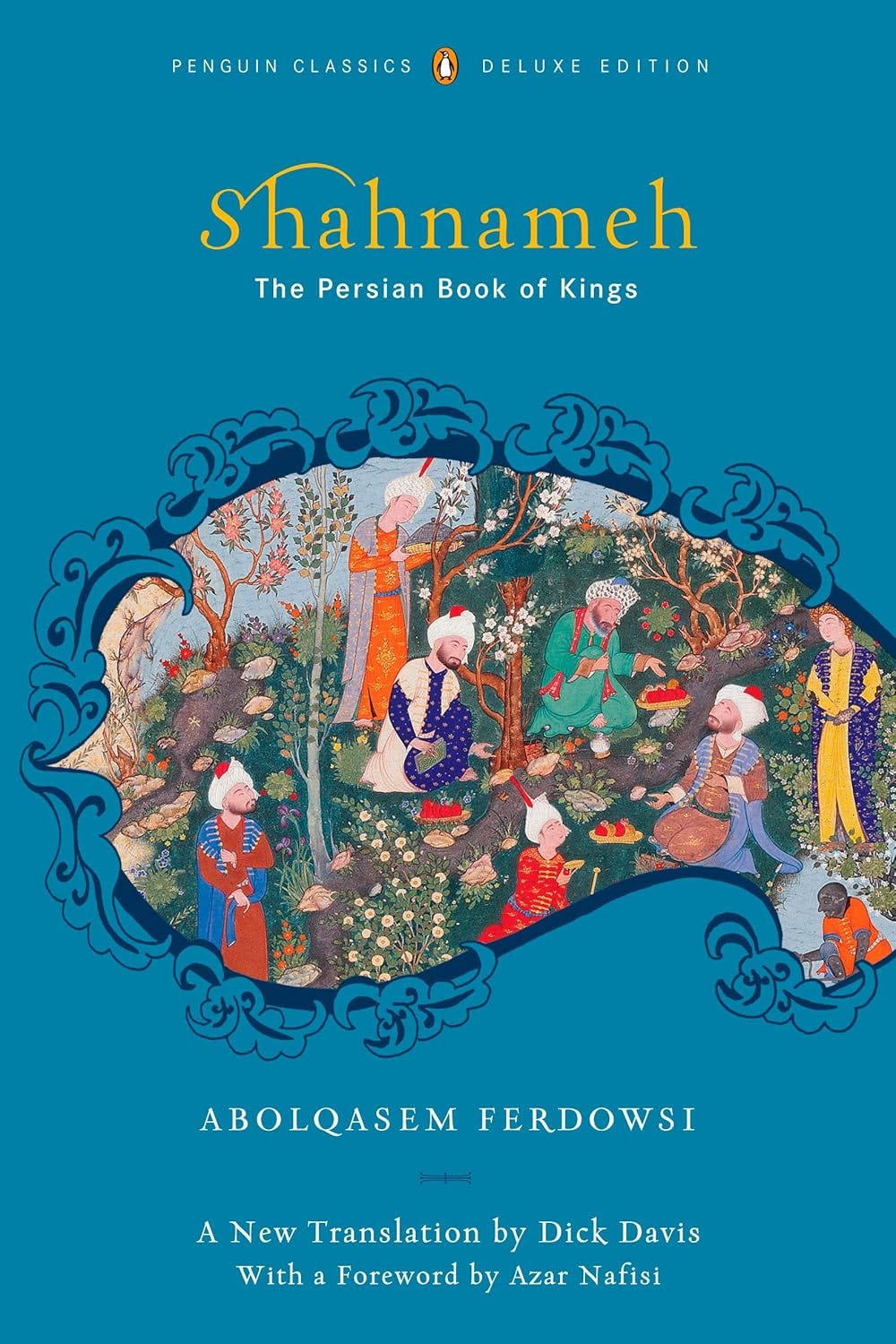
4. The Shahnameh by Abolqasem Ferdowsi
The Shahnameh is the memory palace of Persia. Ferdowsi’s epic begins with the creation of the world and the arts of civilization, then moves through kings, heroes, monsters, betrayals, wars, loves, revolts, and national catastrophe, ending with the Arab conquest. Its deepest subject is Iran itself: a civilization trying to remember its face after conquest, humiliation, and religious transformation.
Rostam gives the poem its heroic center. His birth is magical, aided by the Simorgh after his mother struggles to deliver him. As a child, he kills a runaway elephant. As a man, he becomes the defender of kings he often knows to be foolish, vain, or morally weak. That tension gives the Shahnameh its power. Rostam serves a fragile order that often disappoints him. The same epic also gives Persia the revolt of Kava the blacksmith, who raises his leather apron as a banner against Zahhak, a monstrous king whose serpents feed on the hearts of the young. That image alone explains why myth can outlive armies. A people can lose a dynasty and still carry a banner in memory.
The Shahnameh became the treasure of private libraries, the delight of village storytellers, and a recurring source of Persian identity. The work recounts Iran’s history from cosmic beginning to political catastrophe, but its lasting image is continuity. Ferdowsi gave Persia a way to remember itself when power had changed hands. That is the highest work an epic can do.

5. One Thousand and One Nights
One Thousand and One Nights makes storytelling a matter of life and death. Shahryar, betrayed and embittered, marries and kills a succession of women. Scheherazade enters this machinery of death and survives by telling him a story each night, stopping before the end so that curiosity postpones execution. The frame is brutal, but its meaning is brilliant. A story can delay violence, reshape desire, and teach a tyrant to listen.
The collection was gathered over centuries across West Asia, Central Asia, South Asia, and North Africa, with roots in Arabic, Persian, Mesopotamian, and Indian materials. Its tales include love stories, tragedies, comedies, historical tales, jinn, sorcerers, legendary places, embedded stories, and story-cycles such as Sinbad. The structure matters as much as the content. A tale opens into another tale, which opens into another, until the reader enters a literary labyrinth where survival depends on continuation. The Nights belongs in the canon because it understands something every storyteller knows but few say so clearly: power fears boredom, and imagination can keep death waiting outside the door.

6. The Masnavi by Rumi
Rumi understood something most moral teachers forget. People rarely change because they are given an argument; they change when a story exposes them.
Rumi writes like a man who has watched pride, greed, lust, fear, vanity, and false holiness ruin people from the inside. So, he turns those failures into stories. A merchant traps a parrot and learns what freedom costs. A king’s desire leads him toward suffering. Moses rebukes a shepherd for praying in simple language, only to learn that love can reach God through broken speech. An elephant is touched in the dark by men who each mistake one part for the whole. Again and again, Rumi shows how easily human beings confuse a fragment for truth.
That is why the Masnavi is more than just spiritual poetry. Rumi’s stories do not let the reader feel wise from a safe distance. They keep turning the mirror back. The fool is not always someone else. The hypocrite may be us. The seeker may love the idea of truth more than truth itself.
Its great claim is simple. The soul does not become free by getting everything it wants. It becomes free when it learns which desires have been keeping it trapped.
Rumi’s ability to turn storytelling into a form of spiritual honesty earns him a place in the Eastern Canon.

7. The Conference of the Birds by Farid Attar
The Conference of the Birds is one of the most perfect allegories ever written about the distance between desire and transformation. Attar begins with a gathering of birds who need a king. The hoopoe tells them to seek the Simorgh. The birds agree, then begin making excuses. The nightingale has his rose. The parrot wants immortality. The peacock remembers paradise. Others are trapped by habit, fear, comfort, pride, love, status, or small satisfactions.
That is the genius of the poem. Attar shows that wanting something higher is easy. Actually leaving your old life behind is much harder.
The birds all agree that they need the Simorgh. But once the journey becomes real, each one finds a reason to stay where it is. They do not lack a goal. They lack the courage to give up the habits keeping them small.
As the journey continues, their separate excuses become one larger truth: the search for the Simorgh is really a search for the self after pride, fear, and comfort have been burned away. When the surviving birds finally arrive, they realize the Simorgh was not a distant ruler they had to find. The journey had changed them. What they were searching for was only visible after pride, fear, and comfort had been stripped away.
Attar’s point is sharp. The road does not prove what you say you want. It proves what you are willing to lose.

8. The Tale of Genji by Murasaki Shikibu
The Tale of Genji proves that an empire can be revealed through glances, poems, jealousies, silences, and rooms where no battle is fought. Murasaki Shikibu wrote from inside Heian court culture, and her novel turns that world into a psychological examination. Genji is beautiful, gifted, privileged, wounded, reckless, charming, selfish, and often morally evasive. The women around him carry the emotional intelligence of the book. Their voices, poems, fears, desires, and restraints give the novel its depth.
The Tale of Genji changed what fiction could notice. It showed that a whole society can be understood through small gestures: a poem sent at the wrong moment, a sleeve damp with tears, a visit made too late, a woman left waiting behind screens while men turn desire into privilege. Its fifty-four chapters move across generations, but the real drama is often quiet. People reveal themselves through taste, timing, jealousy, restraint, and the pain they are trained not to say aloud.
That is why the novel still matters. Murasaki Shikibu gave emotional life the weight usually given to war and politics. She showed that civilization is also formed by manners, courtship, memory, beauty, and the rules that decide who may speak, who must wait, and who gets hurt in silence. Genji belongs here because it made inner life large enough to carry a world.

9. The Tale of the Heike (Translation by Royall Tyler)
The Tale of the Heike is the sound of power learning that it cannot last. It recounts the struggle between the Taira and Minamoto clans during the Genpei War at the end of the twelfth century. Its famous mood is impermanence. The proud fall. The brilliant vanish. The warrior’s name becomes a chant, then a memory, then a lesson. Few works make glory feel so close to grief.
Its greatness lies in the way it turns military history into spiritual pressure. The battles matter, but the book is not merely a record of combat. It became part of Japan’s way of preserving national history through the military tale, or gunki monogatari, a form that recorded conflicts, skirmishes, and individual contests across generations. The Kakuichi text from 1371 is described as a fictional dramatization of the Genpei War, focused less on warriors as they actually were than on the ideal warrior imagined by oral singers. That phrase matters. The Heike is not just about what happened. It is about what later generations needed those warriors to mean. Its lesson is cold and beautiful: every house that rises should already hear the bell that will announce its fall.

10. Journey to the West by Wu Cheng’en
Journey to the West turns discipline into one of the most entertaining adventures ever written.
Sun Wukong, the Monkey King, is the reason the book still feels alive. He is born from stone, learns magic, master’s seventy-two transformations, steals immortality, fights heaven, and mocks every authority that tries to contain him. He has power, intelligence, and courage, but no self-control. That is the problem. He can defeat monsters, but he cannot govern himself.
The genius of the novel is that it does not make Sun Wukong boring in order to make him wise. After Buddha traps him under a mountain, he is released to protect the monk Xuanzang on the journey to India for Buddhist scriptures. Alongside Zhu Bajie, Sha Wujing, and the White Dragon Horse, he faces demons, false kingdoms, temptations, tricks, hunger, fear, and humiliation. Each trial forces the same question: what is strength for? Sun Wukong becomes great because his wild gifts are finally placed in service of something higher than his own pride.
The book claims that freedom without discipline turns into chaos, but discipline without spirit becomes dead obedience. Journey to the West gives us something better: a rebel strong enough to kneel, then rise with purpose.

11. Romance of the Three Kingdoms by Luo Guanzhong
Romance of the Three Kingdoms shows what happens when a great political order breaks and every ambitious man calls his own hunger restoration.
The novel begins with a famous pattern: the empire, long divided, must unite; long united, must divide. That is the engine of the whole book. The Han dynasty is collapsing. Rebels rise. Warlords gather armies. Eunuchs, ministers, generals, and provincial rulers all claim to be saving the realm, but almost everyone is also measuring how much power he can seize before the old order dies.
That is why the book still feels modern. Cao Cao has brilliance, courage, and administrative genius, but his suspicion poisons everything around him. Liu Bei carries the language of legitimacy and virtue, but virtue alone cannot hold a fractured empire together. Guan Yu becomes the image of loyalty, yet even loyalty can become fatal when pride enters it. Zhuge Liang is the great mind of the novel, but even strategy has limits when history moves against you.
The book’s most famous scenes work because they turn political ideas into unforgettable moments. The Peach Garden Oath makes brotherhood feel stronger than blood. The Battle of Red Cliffs shows how intelligence, timing, weather, and nerve can overturn numerical power. Zhuge Liang’s empty fort trick shows that reputation itself can become a weapon. Again and again, the novel asks a hard question: when the state collapses, what still deserves loyalty?
That is the greatness of Romance of the Three Kingdoms. It does not reduce politics to good men against bad men. It shows a world where courage, talent, loyalty, and wisdom all matter, but none of them can fully escape ambition, timing, betrayal, and decline.
Its claim is sharp: power does test the wicked, it tests the virtuous too. And when an empire begins to break, even noble men can become instruments of ruin.
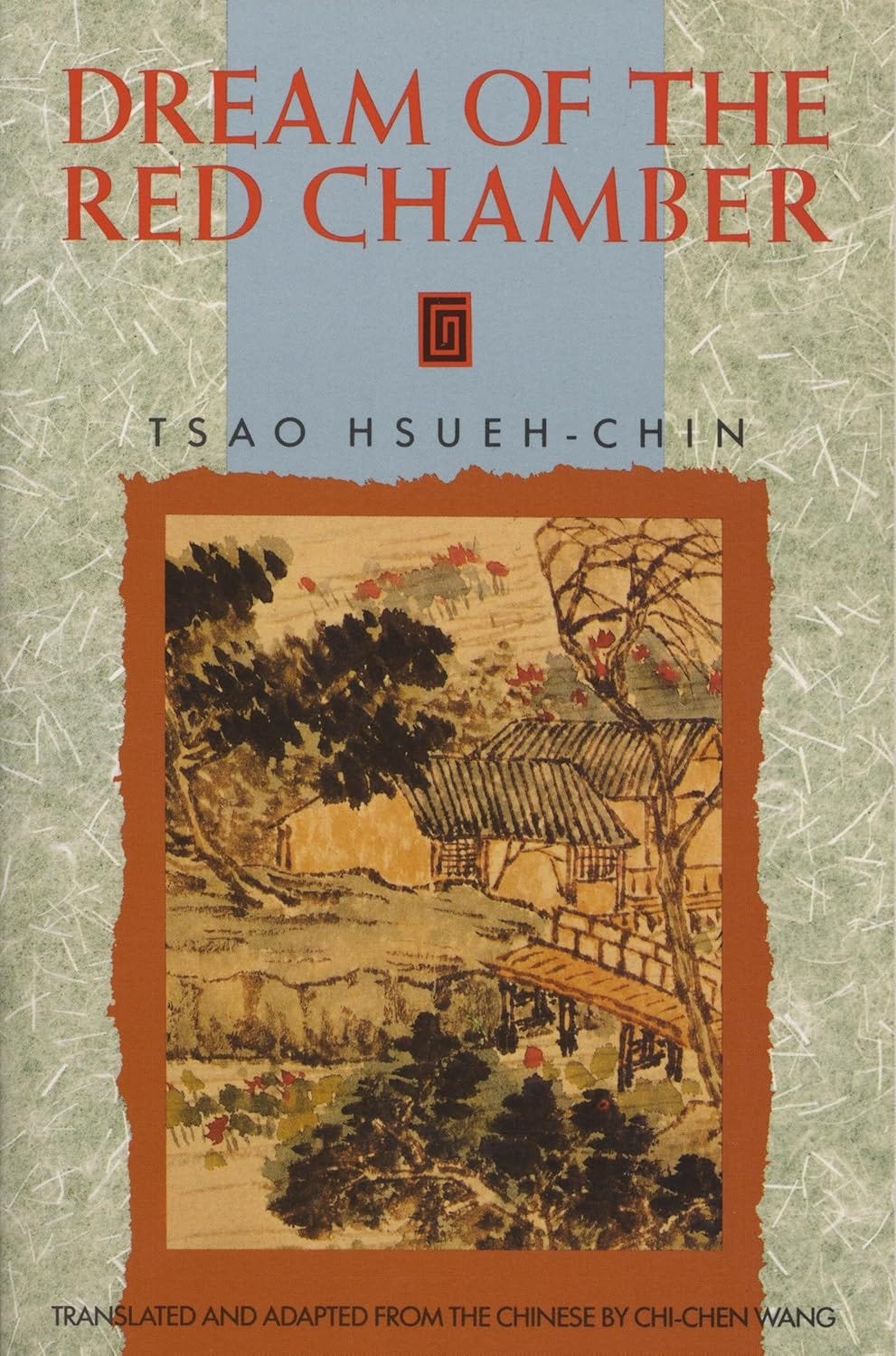
12. Dream of the Red Chamber by Tsao Tsueh-Chin
Dream of the Red Chamber is a Chinese Romeo-and-Juliet love story and a portrait of one of the world's great civilizations.
Cao Xueqin does not need an invasion or a battlefield to show collapse. He places it inside the Jia household, where wealth, ritual, debts, and gossip keep the old family looking secure long after its foundations have started to crack. The tragedy often arrives quietly. A poem exchanged, a marriage arranged, a servant humiliated, a girl ignored, a sickroom left behind, and a garden that once felt alive slowly becoming a memory.
Baoyu, Daiyu, and Baochai give the novel its emotional center. Baoyu wants a life shaped by feeling and beauty, but he belongs to a family that treats marriage as strategic. Daiyu’s sensitivity makes her unforgettable, but also vulnerable in a world that has little mercy for fragile souls. Baochai is graceful, intelligent, and socially perfect, yet even perfection becomes another form of captivity. The women of the novel are the moral center of the book.
The novel shows how a whole way of life can die while everyone inside it keeps performing manners. The Jia family collapses because status has replaced love, and beauty has become powerless against social machinery.
The novel’s central premise is devastating. A house can still be full of music, poetry, silk, and ceremony after the soul has already gone out of it.
The Eastern canon refuses to flatter the reader. It asks whether we have learned to govern the desires that govern us. That is why these books endure.
These works give us kings, lovers, warriors, monks, birds, monkeys, ghosts, families, and ruins. But their real subject is the human being under pressure. What does power do to him? What does longing make him betray? What does beauty hide from him? What does duty demand from him? What does death finally teach him?
A civilization does not fall only from invasion. It also falls when people lose judgment and start calling their chains freedom. That is why these works should be read now, in an age that often teaches people to defend the self before they have learned how to examine it.
Read them because they leave the reader with a harder standard: do not ask only what you want from life; ask what your desires are turning you into.
I don't know if this is true, but I heard that Epic of Gilgamesh confirmed the Noah's ark and story.
No The Water Margin? Very sad.
Some of the most incredible storytelling