


Judah Halevi understood a truth that still cuts today: a tradition can keep its language, symbols, and prestige while losing the force that once made it live. That is why he still matters. He saw that a civilization begins to weaken when it preserves the appearance of tradition after losing the way of life behind it.
Judah Halevi was born around 1075. In his own lifetime he was praised with unusual intensity by Andalusian contemporaries, and later generations came to regard him as one of the greatest Hebrew poets of all time. He wrote dazzling secular and religious poetry, and his philosophical work, the Kuzari, completed in the late 1130s, became one of the central works of medieval Jewish thought. Then, in 1140, he left behind an enviable life as a poet, physician, merchant, scholar, and theologian and set out for the Land of Israel. He was willing to leave comfort to pursue a pilgrimage to the holy land.
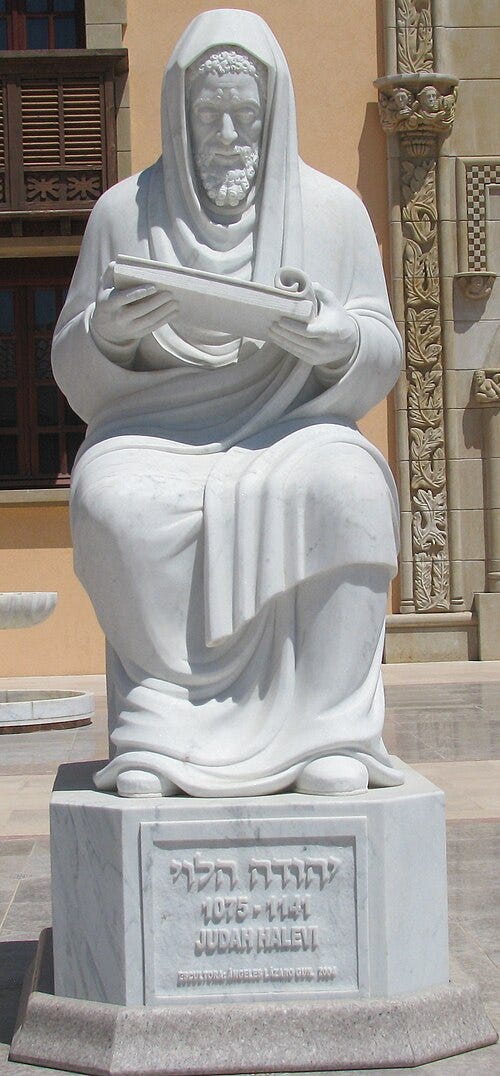
The world that formed him was brilliant. Muslim Spain gave him refinement, argument, literary culture, and access to serious philosophy. Yet that same world also exposed the weakness of brilliance without anchor. A Cairo Geniza letter suggests that Halevi first wrote an earlier version of the Kuzari in response to a Karaite from Christian Spain, then later distanced himself from that first effort. The detail is worth noticing because it shows a writer unwilling to settle for a weak formulation. Halevi was not merely joining the religious arguments of his age. He was trying to build a firmer defense of tradition against the pull of philosophy, sectarianism, and inherited confusion.
Rabbinic Judaism says the written law cannot be separated from the oral tradition preserved in the Talmud, while Karaism says the written text itself is primary and later rabbinic tradition is not binding in the same way. In Halevi’s account, that difference mattered a lot because he thought Karaism put too much weight on private judgment and not enough on inherited authority.
