


Maimonides understood that a people does not stay alive through memory alone. It stays alive when its truths are clear enough to be taught, carried, and lived, and that is exactly why his Mishneh Torah still matters.
Passover begins with liberation, but it does not end there. Freedom opens a door. A people still have to learn how to live. That is the lesson that makes Maimonides so important. He understood that a nation remains alive when its truths can still be taught, carried, and practiced in an ordered way.
That conviction stands behind Maimonides’ Mishneh Torah, his great code of Jewish law. He wrote it because Jewish law had become too vast and too scattered for many ordinary Jews to hold together with confidence. His solution was immense. He gathered the Oral Law into one structured book so that a reader could move from the Written Torah into an ordered life.
The ambition of the Mishneh Torah still shocks. Maimonides was building a complete framework for Jewish life. He spent about ten years on the work. He drew from the Babylonian Talmud, the Jerusalem Talmud, and other legal traditions, then arranged the whole into fourteen books. The structure itself teaches.
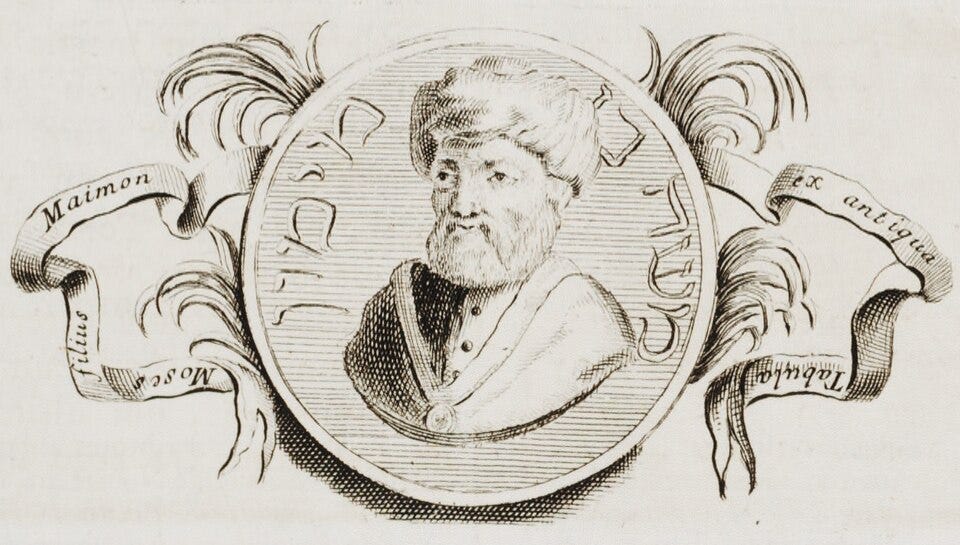
He begins with the Book of Knowledge, placing first principles at the front: God, Torah, and the foundations of belief. From there he moves to prayer and devotion, sacred times, marriage and family, vows, holiness, agriculture, sacrifices, purity, damages, commerce, justice, judges, kingship, and the messianic future.
That order reveals his mind. He believed a serious life needs structure. Thought must be sound. Worship must be regular. Family must be governed. Trade must be just. Courts must be trustworthy. Public life must rest on law. He was not arranging information. He was shaping a civilization.
The first great lesson in the Mishneh Torah is that clarity preserves inheritance. A tradition weakens when it becomes too hard to navigate. People still respect it, but fewer people can live it in full. Some inherit fragments. Some learn habits without reasons. Some rely on specialists for every question. Maimonides saw this danger clearly. He wanted Jewish law to be accessible without making it shallow. He wanted people to know what they were doing and why they were doing it. That is why the Mishneh Torah matters so much. It turns a sprawling inheritance into a livable order. That lesson reaches beyond Judaism. Every civilization faces the same problem. Wisdom can accumulate until it becomes too heavy to carry. At that point, preservation requires more than reverence. It requires form.
Continue reading the next five lessons by becoming a paid subscriber today.
