

Adam’s Fall Was the Birth of Human Freedom
Iqbal’s daring argument that Adam’s first disobedience made genuine goodness possible.

Muhammad Iqbal saw Adam’s disobedience as the moment human beings acquired the dangerous freedom required for genuine goodness.
Humanity became capable of goodness only when it became capable of disobedience.
The Quranic Adam begins in a garden where he experiences no hunger or nakedness, and the sun causes him no discomfort. His needs are met. His world places few demands upon him. Then he approaches the forbidden tree, becomes conscious of his nakedness, tries to cover himself, and moves into the difficult conditions of earthly life. Muhammad Iqbal saw this moment as the beginning of human moral history.
Most readings concentrate on what Adam lost. Iqbal asks us to examine what Adam gained. Before his disobedience, Adam lived in a condition close to instinctive innocence. After it, he possessed a conscious self, capable of choosing, failing, regretting, learning, and beginning again. The price of this freedom was severe, but without it, Adam could never become morally responsible.
The account in Genesis presents the serpent, the woman taking the fruit, the curse upon the ground, painful childbirth, physical toil, and expulsion from Eden. The Quran gives the event a different emotional center. Satan tempts Adam and his spouse. Both eat. Both become conscious of their nakedness. Adam then receives words from God, repents, and is guided. The earth has already been described as humanity’s dwelling place and source of provision. Human life on earth becomes the setting for responsibility, work, knowledge, and moral growth.
Iqbal pays close attention to these details in his lectures compiled into The Reconstruction of Religious Thought in Islam.1 He argues that the story describes humanity’s transition from simple consciousness to self-consciousness. Adam becomes aware that several courses of action are open to him. He chooses one. The decision is wrong, but the ability to decide reveals something immense: Adam now possesses a free personality.
This creates the central problem of the story. Could God have created human beings who always behaved correctly? Certainly. Such creatures would follow their nature as fire produces heat or a planet follows its orbit. Their conduct would carry no moral weight because goodness requires a real choice.
A locked door prevents theft. Honesty appears when an unlocked door remains untouched. A person who returns a lost wallet while being watched has responded to pressure. A person who returns it alone, with cash inside and no chance of recognition, has made a moral decision. The act matters because another choice was possible.
Iqbal therefore connects freedom with risk.
“That God has taken this risk shows His immense faith in man; it is for man now to justify this faith.”
This may be one of Iqbal’s most daring claims. Human freedom reveals God’s confidence in human potential. The freedom to choose justice includes the ability to commit cruelty. The capacity for loyalty also permits betrayal. God grants humanity enough independence to make goodness real, even though this freedom allows human beings to cause terrible harm.
The Quran presents this freedom as a trust so heavy that the heavens, the earth, and the mountains declined to carry it. Humanity accepted it. Iqbal interprets this trust as the burden of free personality. A human being can form intentions, direct action, change the surrounding world, and become accountable for the results. Every person carries the consequences of their own moral decisions.
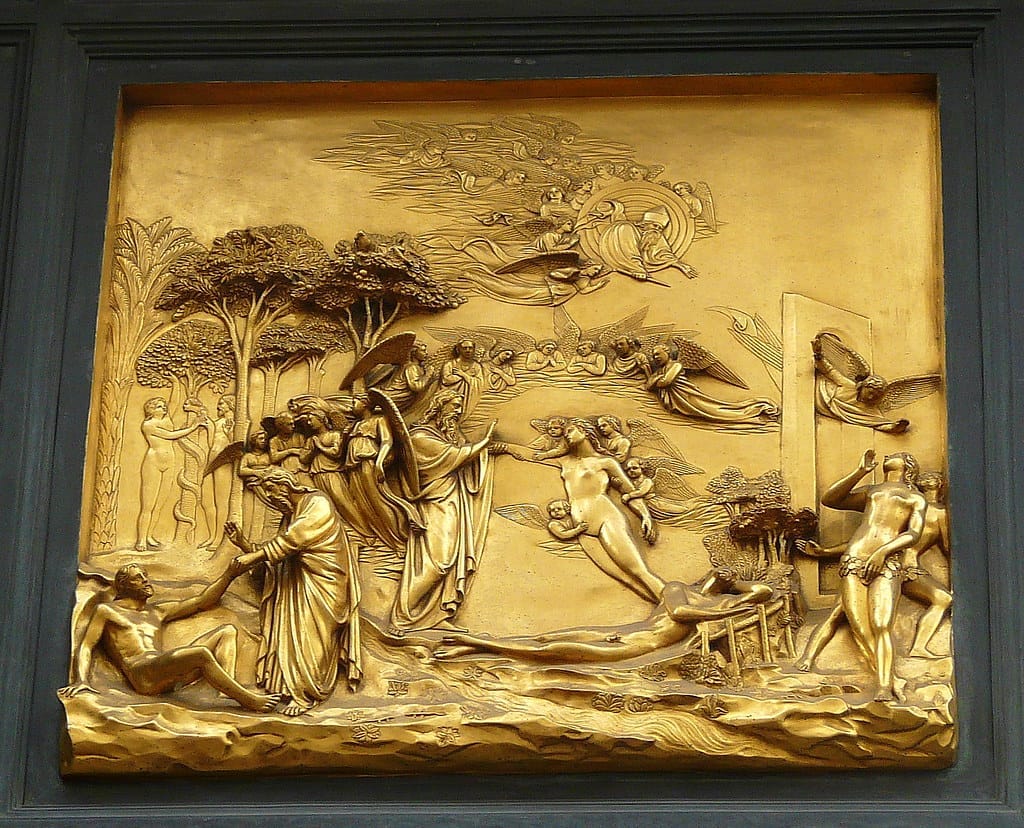
The story also begins with knowledge. Before the garden episode, God teaches Adam “the names of all things.” The angels cannot name them, but Adam can. Iqbal understands naming as the ability to form concepts. When we name something, we distinguish it, examine it, and bring it within the range of thought. This capacity gives humanity a unique power over the observable world.
Yet the desire for knowledge comes with impatience. In Surah Ta Ha2, Satan offers Adam “the tree of eternity” and a kingdom that will never decay. The temptation appeals to two powerful human desires: knowledge without long effort and life without death. Adam wants permanence and mastery before he has developed the judgment required to possess them.
Drawing on ancient interpretations of the tree as a symbol of concealed knowledge, Iqbal presents Adam as a creature looking for a shortcut. The Quran elsewhere describes the human being as hasty. Adam reaches for immediate possession when genuine knowledge requires observation, patience, experiment, and correction.
Earth becomes the environment suited to developing these abilities. Crops require cultivation. Illness demands investigation. Shelter has to be built. Natural forces must be studied before they can be directed toward human purposes. Knowledge arrives through contact with a world that resists us.
A student today can generate a polished paper in seconds. The finished page may appear before the student has struggled with a single difficult idea. The shortcut produces text, while intellectual growth still requires questions, rejected arguments, revised sentences, and the uncomfortable discovery that your first answer was weak. Iqbal would recognize Adam’s temptation in the desire to possess the answer without undergoing the experience that produces understanding.
Scientific discovery follows the same difficult path. When Alexander Fleming returned to his laboratory in 1928, he found that mold had contaminated one of his bacterial cultures. A careless observer could have thrown the dish away. Fleming noticed that bacteria around the mold had died. Years of further work by Howard Florey, Ernst Chain, and their colleagues turned that observation into a usable treatment. An apparent error became valuable because human beings examined it, learned from it, and continued working.
Iqbal calls trial and error indispensable to the growth of human experience. A finite mind develops by testing possibilities. It encounters resistance, discovers limits, corrects its methods, and tries again. Adam’s error therefore belongs to a larger account of how human beings learn. The act remains a failure, but failure can become material for judgment and growth.
This is also why repentance occupies such an important place in the Quranic account. Adam’s story continues after his disobedience. He receives words from God. God accepts his repentance, chooses him, and guides him. Freedom allows a person to take the wrong path, while repentance permits a conscious return. The ability to recognize a failure and change direction becomes part of moral maturity.
A person with no freedom needs programming. A free person needs guidance.
Dostoevsky explored the burden of this freedom in the “Grand Inquisitor” chapter of The Brothers Karamazov. In the story, Christ returns during the Spanish Inquisition and is arrested by an elderly cardinal. The Inquisitor accuses Christ of expecting too much from ordinary people. Human beings, he argues, would surrender freedom in exchange for certainty and material security. His institution offers fixed answers and relieves people of the burden of moral judgment.
The Inquisitor understands something real about human nature. Freedom can be exhausting. It leaves room for uncertainty, guilt, and regret. Many people would gladly allow a ruler, religious authority, political movement, or social group to make their most difficult decisions. Obedience feels safer because someone else carries the blame.
Iqbal sees this surrender as a rejection of human purpose. His wider argument about the finality of prophethood follows the same line. With the completion of prophecy, claims of new supernatural authority lose their power over the Muslim conscience. Human beings must examine nature, study history, use reason, and judge claims by their consequences. Revelation gives humanity principles and direction, while each generation remains responsible for applying them to its own conditions.
Adam’s freedom and the finality of prophethood therefore belong to the same account of human maturity. God provides guidance, yet human beings must think, decide, and act. They cannot transfer their full moral responsibility to a priest, ruler, ancestor, or institution.
This makes Iqbal’s interpretation relevant to education. Parents often try to protect children by controlling every decision. Schools can reward quiet compliance while giving students few opportunities to exercise judgment. Such systems may reduce immediate mistakes, but they can leave young people unprepared for the first serious choice they must make alone.
A young person develops judgment by making decisions whose consequences matter. They choose whether to tell the truth after breaking something. They decide whether to include a classmate whom others have rejected. They learn whether money should be spent immediately or saved for a larger purpose. Advice still matters, but character forms when the choice becomes personal.
The same principle applies to religious education. Memorizing rules can establish boundaries. Moral understanding grows when a person learns why an action matters, how it affects others, and what kind of self, repeated action creates. Iqbal describes deeds as either strengthening or weakening the ego. Every choice contributes to the person one is becoming.
Some readers may worry that this interpretation gives disobedience too much dignity. Iqbal treats Adam’s decision as a genuine failure with real consequences. His praise belongs to the human capacity to accept responsibility, seek forgiveness, learn, and choose more wisely. Freedom gains its value through the moral effort required to use it well.
Innocence carries beauty, but innocence without choice remains fragile. The first serious temptation can destroy it. Virtue has greater strength because it has encountered alternatives and consciously chosen the good. A person who has never faced fear may appear brave. Courage becomes visible when fear is present and the person still acts rightly.
Iqbal’s Adam leaves the garden with freedom, responsibility, and the possibility of growth. He enters a world where knowledge must be earned and goodness must be chosen. God continues to guide him, but Adam must now participate in shaping his own character and the world around him.
The Fall, in Iqbal’s reading, was the first chapter of human moral history. Adam left the garden carrying the trust that the heavens and mountains had declined. Every free choice since then has been part of humanity’s answer to one enduring question:
Was God right to trust us?

Muhammad Iqbal, The Reconstruction of Religious Thought in Islam, ed. M. Saeed Sheikh (Lahore: Institute of Islamic Culture, 1986), 68.
The Quran.