

Did the Medici Buy the Renaissance?
The family that turned banking into beauty, and beauty into power

The Renaissance began with money moving through ledgers, contracts, letters of credit, and family ambition. That sounds less romantic than the usual story, but it explains Florence better. Botticelli still needed vision, Michelangelo needed discipline, and Brunelleschi still needed nerve. Yet genius alone does not build a city, feed an artist, protect a workshop, finance marble, commission altarpieces, or turn private talent into public memory.
The Medici understood this before almost anyone else. Giovanni di Bicci de’ Medici founded the Medici Bank in 1397; by the time of his death in 1429 he had left an estimated 180,000 gold florins. His son Cosimo inherited not just capital but a financial machine that soon became the largest and most respected bank in Europe. Once that wealth accumulated, the family spent it, lavishly and strategically, on churches, palaces, paintings, sculptures, libraries, processions, medals, and architectural projects. Florence became their stage. Art became their argument. Beauty became proof that their wealth deserved respect.
That is the uncomfortable truth behind the Renaissance. We like to imagine it as a spontaneous explosion of human genius, as if Florence woke up one morning and found Leonardo da Vinci, Sandro Botticelli, Michelangelo, Raphael, Donatello, and Brunelleschi waiting in the streets. History works through harsher mechanics. Artists needed patrons and patrons needed prestige. Cities needed visible signs of greatness. The Medici saw that triangle clearly and used it with ruthless intelligence.
They did not buy genius in the crude sense. No banker can purchase a Michelangelo off a shelf. What the Medici bought was time, safety, status, and opportunity. They made it possible for certain artists to work, study, compete, and be seen. They placed art inside the civic and religious bloodstream of Florence. A painting in a chapel, a dome over a cathedral, a palace on a public street, a saint bearing the face of a family patron. These were cultural acts with political consequences.
So, the real question is sharper than “Did the Medici buy the Renaissance?” They bought the conditions that allowed the Renaissance to become visible. They turned money into patronage, patronage into public beauty, and public beauty into lasting power. That is why their story still matters. It forces us to ask what wealth is for, and why some fortunes leave behind cities while others leave behind little more than names on buildings.
Giovanni di Bicci laid the foundation. His son Cosimo inherited a tool of social ascent. The Medici were merchants in a city that still valued old status, religious legitimacy, and civic reputation. Banking made them rich, but art helped make them acceptable.
Cosimo understood the danger of naked wealth. Florence had no patience for a man who looked too much like a prince. It was a proud republic, suspicious of obvious tyranny. Cosimo’s genius came from restraint. He dressed plainly, spoke carefully, cultivated humility, and presented himself as a servant of the city. Then he spent heavily on projects that made Florence more beautiful while making the Medici impossible to ignore.
Seven years after Cosimo’s death, his grandson Lorenzo recorded that the family had spent more than 600,000 florins on public works, charity, and taxes since 1434, an astonishing sum that “casts a brilliant light upon our condition in the city.” That is the first lesson of Medici patronage. They did not simply collect art for private pleasure. They used public beauty to make private power look like civic virtue.
Cosimo’s patronage of San Marco is one of the clearest examples. The convent was a religious space, but it also carried Medici meaning. Fra Angelico’s San Marco Altarpiece placed Saints Cosmas and Damian in the foreground, with Saint Cosmas subtly linked to Cosimo himself. Other saints echoed Medici family names. The painting invited viewers into a sacred scene while quietly reminding them whose money made the sacred space possible.
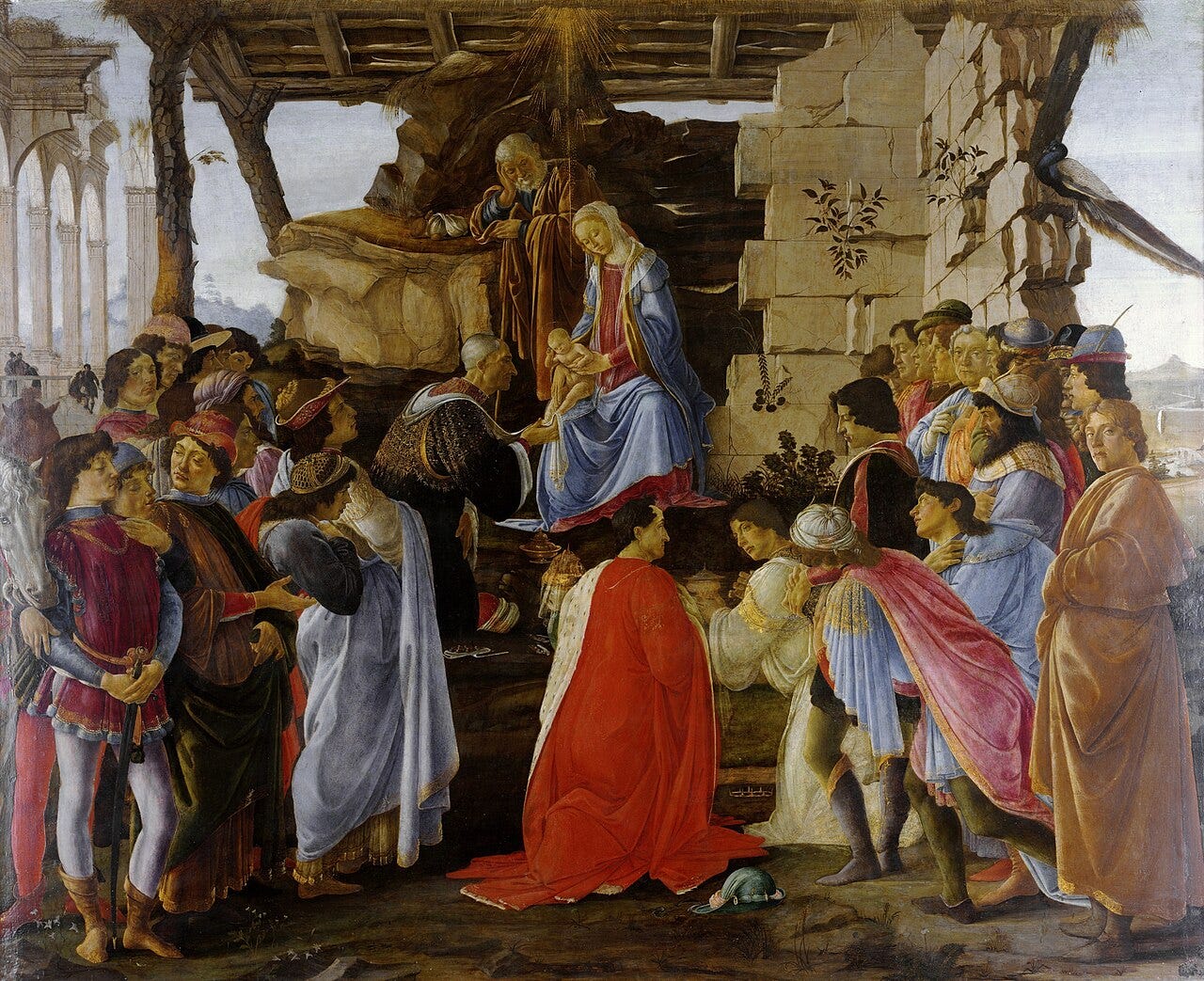
This was subtle power. The Medici let symbols, saints, processions, and commissions did the work for them. In the Adoration of the Magi, begun by Fra Angelico and completed by Fra Filippo Lippi, the biblical procession mirrored the public processions of the Compagnia de’ Magi in Florence, which the Medici funded. The Magi were perfect symbols for the family: wealthy gift-bearers who approached Christ with splendor and reverence. The message was clear to anyone who knew how to read images. The Medici were rich, pious, generous, and destined to remain.
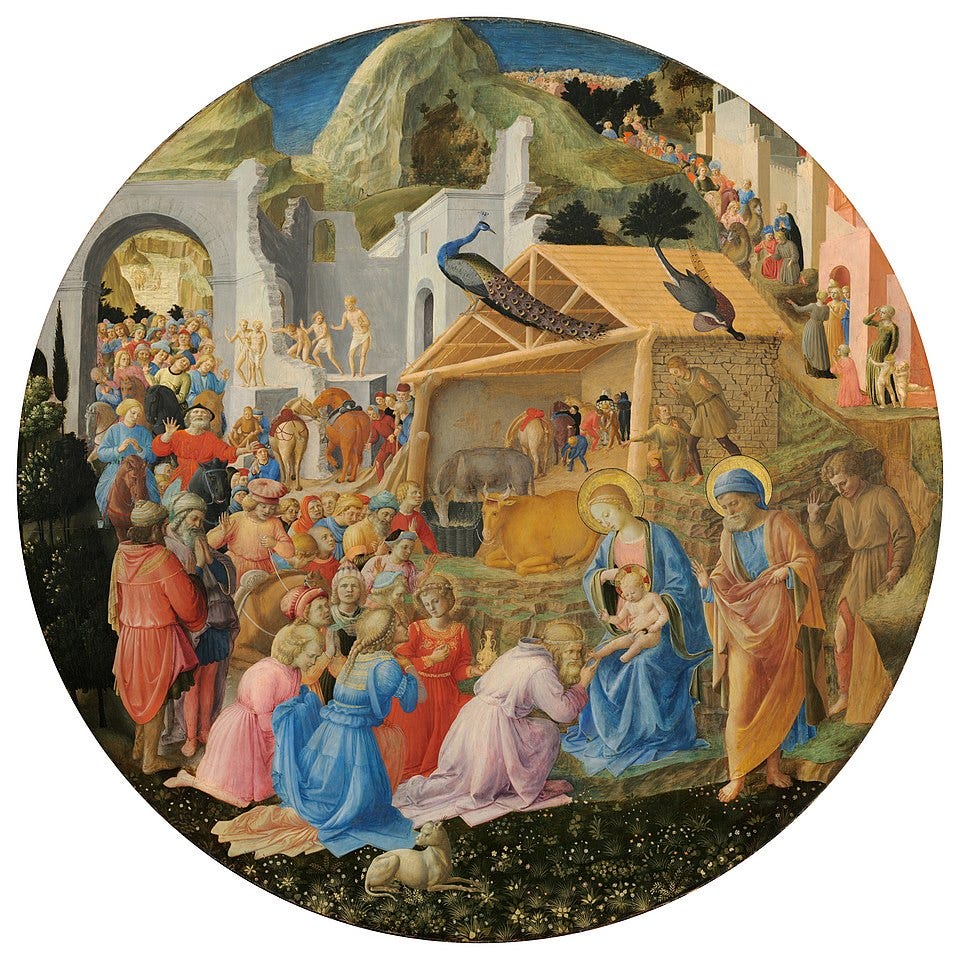
Renaissance art spoke through saints, emblems, coats of arms, classical references, city symbols, and biblical scenes. Today, viewers often stand before these works and see only beauty. Florentines saw beauty, status, family ambition, religious devotion, and political messaging at the same time. A chapel could praise God and advertise a family. A painting could tell a biblical story while placing the patron inside the moral center of the city.
Piero de’ Medici continued this family habit through medals, antiquity, and dynastic imagery. After Cosimo’s death, a medal honored him as “Father of the Country.” The reverse showed Florence personified as a woman, linking Cosimo’s image to the city itself. This was not a random tribute. It framed Cosimo as a civic father, a man whose fortune had become inseparable from Florence’s identity. In a republic, that was a dangerous claim. In art, it looked graceful.
Lorenzo de’ Medici pushed this strategy further. His birth was marked by a lavish childbirth tray showing the Triumph of Fame. Most birth trays served a practical domestic purpose, but this one became a dynastic announcement. Fame stands armed and elevated, surrounded by noble figures. On the reverse, Medici symbols appear again: the diamond ring, ostrich feathers, and the word “semper,” meaning “always.” Even a birth object became a political prophecy. Lorenzo arrived wrapped in images of endurance.
By the time Lorenzo became “Il Magnifico,” Medici patronage had turned into a complete cultural system. He supported artists, writers, scholars, and poets. He promoted Florence as a cultural capital. He helped elevate Dante Alighieri, Francesco Petrarch, and Giovanni Boccaccio as emblems of Florentine greatness. He gathered talent around him because he understood that a city wins memory through the people it protects. Military victories fade. Account books disappear. Great art keeps speaking.
Botticelli’s world cannot be understood apart from this atmosphere. Paintings like The Birth of Venus and Primavera were commissioned for the villa of Lorenzo’s cousin Lorenzo di Pierfrancesco de’ Medici, yet they emerged from the broader cultural climate Lorenzo cultivated. His circle gave artists access to poetry, philosophy, mythology, and humanist thought. The old story that Renaissance artists simply “rediscovered antiquity” misses the practical engine behind that rediscovery. Manuscripts had to be collected, scholars had to be funded, and artists had to be trained. Patrons had to want pagan beauty in Christian Florence and possess enough confidence to display it.
Michelangelo’s story shows the same pattern with greater force. As a young artist, he entered the Medici orbit and studied in the garden of San Marco, where Lorenzo gathered ancient sculpture and supported artistic training. That mattered. Michelangelo did not become Michelangelo because a rich man liked marble. He became Michelangelo through terrifying talent, intense labor, and exposure to a culture that treated ancient form, Christian meaning, and human anatomy as worthy of serious study. Patronage gave him access to the world his genius needed to wrestle with.
Brunelleschi’s dome also proves the point, though the story reaches beyond one family. The dome of Santa Maria del Fiore became one of the great acts of human confidence in stone. Its construction had long ties to Florence’s guild culture and civic ambition, with the wool guild bearing much of the cost of the cathedral over two centuries. Yet Medici-linked patronage of architecture, especially through Cosimo’s support of Brunelleschi and San Lorenzo, shows how building became an act of social transformation. A merchant family could cross toward aristocratic stature by attaching its name to spaces that shaped the city’s religious and civic life.
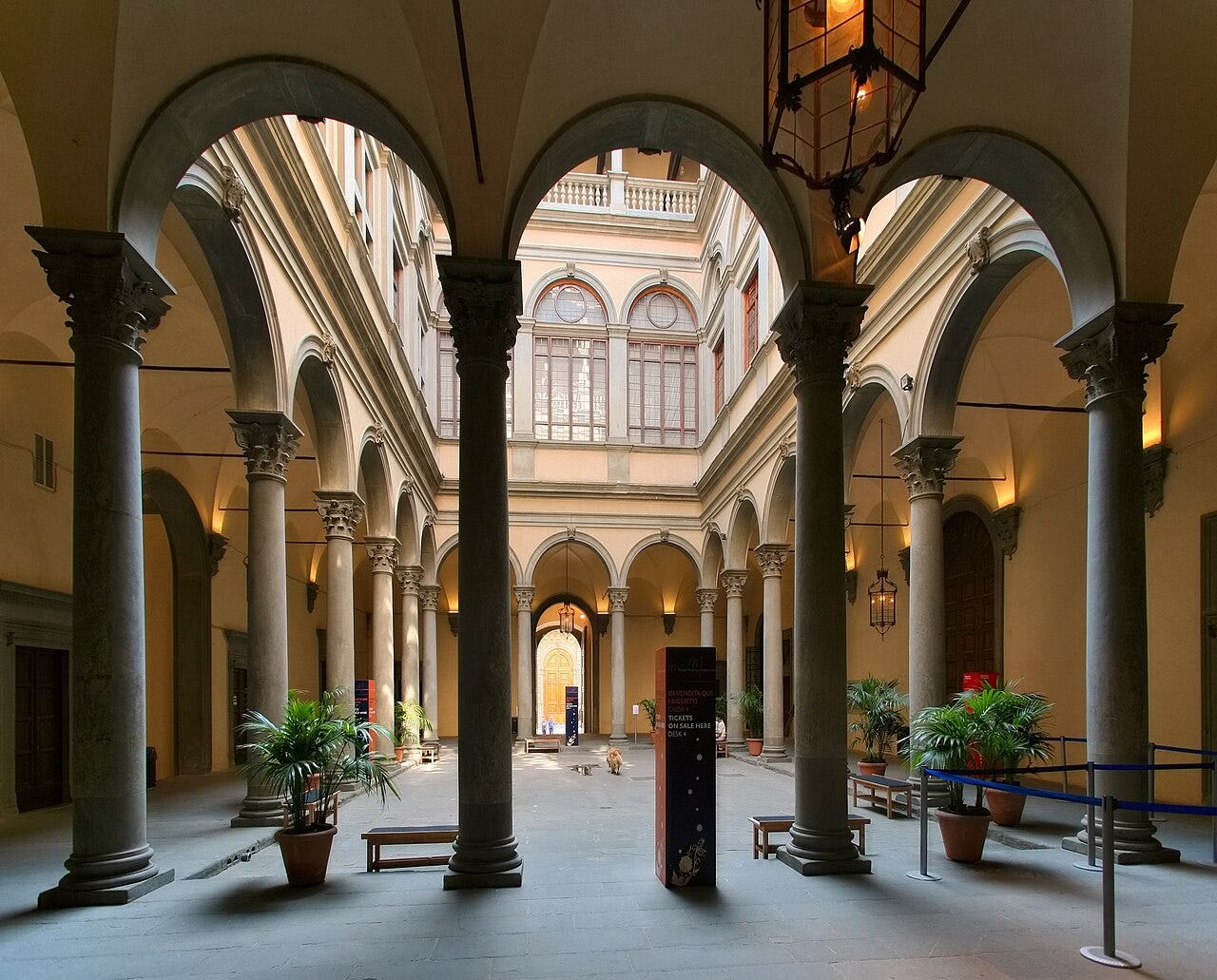
This is where the phrase “buying the Renaissance” becomes useful, as long as we handle it carefully. The Medici did not create the Renaissance alone. The Church, guilds, republic politics, trade, humanism, universities, workshops, rival families, and older artistic traditions all mattered. The popes remained major patrons. Guilds funded churches and hospitals. Other families such as the Strozzi (who built the monumental Palazzo Strozzi), Sassetti, Tornabuoni, and Rucellai also commissioned chapels, palaces, and frescoes that enriched Florence’s visual life. The Medici became dominant because they fused money, taste, religion, symbolism, and political calculation better than their rivals and on a larger scale.
Their wealth also carried a moral problem. The Church condemned usury, and banking always lived under suspicion. The Medici needed ways to make wealth look pious, useful, and worthy. Patronage helped solve that problem. Funding monasteries, churches, sacred art, libraries, and public works allowed a banking family to present itself as a guardian of Christian and civic life. Beauty became a kind of social absolution. The same money that created discomfort could be transformed into altarpieces, convents, chapels, and public memory.
That tension gives the Medici story its human interest. They were bankers who understood sin, reputation, and power. They wanted influence. They wanted Florence to see them as necessary. They also loved art, learning, and the prestige of beauty. Human motives rarely arrive cleanly separated. In the Medici case, devotion, vanity, fear, taste, guilt, civic pride, and political hunger often worked together.
That mix produced extraordinary results. While artists still operated within guild systems and contractual obligations, Medici patronage helped elevate their social visibility and gave them greater creative scope. Their commissions made reputation portable. An artist attached to a powerful patron could gain access to other elite circles. Contracts, workshops, and patron demands still shaped the work, sometimes harshly. The patron held money and leverage. Yet the system also gave artists room to attempt more ambitious work, experiment with perspective, study anatomy, explore ancient models, and place human experience at the center of art.
This does not make patronage pure. Patrons controlled subject matter, materials, timelines, placement, and often the meaning of the work. Many Renaissance masterpieces were born from negotiation rather than free expression. Artists answered to contracts. Workshops handled commissions. Patrons chose themes that advanced their own status. That is part of the story, and it makes the Renaissance more interesting. Great art did not emerge from total freedom. It emerged from pressure, rivalry, money, belief, and ambition.
Florence became the perfect furnace for that pressure. It was wealthy, competitive, religious, literate, politically tense, and intensely proud of itself. Families competed through palaces and chapels. Guilds competed through public works. Churches competed through commissions. Artists competed for reputation. Patrons competed for memory. In that environment, beauty became a public contest. The city itself turned into a scoreboard.
Modern people often separate art from power because we prefer cleaner stories. Florence makes that impossible. The Renaissance shows that culture needs material support. It needs patrons who care about more than immediate profit. It needs institutions that train talent. It needs cities willing to put beauty where ordinary people can see it. It needs elites who understand that wealth without public form dies quickly.
That is the strongest argument for why the Medici still matter. Their money was imperfect. Their motives were mixed. Their politics could be ruthless. Yet they left behind a city that millions still travel to see. They understood that power becomes more durable when it builds something people can love. A bank account can buy influence for a generation. A dome, a chapel, a library, or a painting can carry a name for centuries.
So, did the Medici buy the Renaissance? They bought its conditions. They paid for its time, space, materials, and visibility. They turned private wealth into public culture and made Florence the place where ambition learned to speak through beauty. The Renaissance still required genius, discipline, faith, rivalry, and luck. But without patrons willing to spend fortunes on art, many of its greatest names would have remained smaller, poorer, less protected, and less visible.
The final lesson is simple. Civilizations remember the rich who build memory into the world. The Medici understood that money alone makes a family powerful, but beauty can make it unforgettable.
The Medici did not just fund artists. They understood something most modern creators forget. Great work needs a system behind it.
That is the idea behind Create, Publish, Profit.
From May 4th to May 23rd, Art of Purpose is running a 20-day live creator sprint designed to help you build a complete publishing, growth, and monetization system in real time.
This is a creator mastermind of live and recorded courses where serious builders learn how to publish consistently, sharpen their ideas, grow their audience, and turn attention into opportunity.
This is the same sprint I took and used to build a 215,000-follower brand on X and grow my Substack to 13,000 subscribers.
This May, I’ll be teaching two sessions inside the sprint and showing creators how to build memorable content, grow a serious audience, and turn a niche publication into paid subscribers.
On May 12th, we’ll break down “Write to Be Remembered: The Art of High-Standard Content” — how to create work that people remember, share, and return to.
On May 19th, we’ll cover “How to Turn a Niche Publication into Paid Subscribers” — how a focused idea, a clear audience, and consistent trust can become a real publishing business.
The Medici article showed how one sharp question can open a bigger story about money, power, beauty, patronage, and the systems that allow culture to flourish.
That is what CPP is built to teach creators: how to stop guessing, build a real operating system, and publish with purpose.
You’ll get live sessions, recordings, feedback, private Discord access, growth frameworks, monetization strategy, and direct guidance from creators who have built serious online audiences.
If you want to stop treating content like random posts and start building it like a real asset, join Create, Publish, Profit.
Spots are limited. The 20-day sprint begins May 4th.

I would love a similar essay on the funding behind classical music. Aristocracy plus church?
A valuable lesson of when wealthy elites choose to pursue their ambitions by more virtuous means.