

Every Civilization Believed Order Had a Cost
Article 5 of The Arc of Belief and Meaning Series

In the last article, I argued that secular law does not exist. Every legal system, ancient or modern, rests on a deeper moral order it did not invent. From Hammurabi to Moses to medieval charters, law always claimed authority from something higher than human power.
But there was a problem hidden inside that logic. If law reflects a higher order, and if humans constantly break that order, then something has to absorb the damage. Guilt has to go somewhere. Disorder has to be paid for.
That is where sacrifice enters the story.
Every civilization believed the same unsettling thing: order has a price, and someone has to pay it. From blood-soaked altars in Mesopotamia to fire rituals in Vedic India, from Abraham’s raised knife to Aztec temples stacked with hearts, people treated sacrifice as the currency that kept the world from falling apart. Blood wasn’t spilled because ancient people were cruel; rather because they believed chaos would return if it wasn’t. Long before theology and philosophy, humans negotiated with the divine using the only thing they thought truly mattered: life itself.
They saw sacrifice as maintenance because the world felt fragile. Floods, plagues, famine, and war came without warning. Death felt arbitrary. Ritual sacrifice created the sense that catastrophe could be delayed if something costly enough was offered in return. The deeper belief was moral and psychological. Order required loss. Stability required payment. Guilt had to go somewhere and blood, terrifying and sacred, became the medium that carried it.
Across civilizations, blood was never treated as just a bodily fluid. It was treated as life itself, something dangerous, sacred, and transferable. In ancient Mesopotamia, kings poured animal blood on temple altars to renew covenants with the gods. In early Israel, blood sealed agreements, marked doorposts at Passover, and symbolized atonement on Yom Kippur. Even in pagan Europe, warriors offered blood before battles to secure victory. The logic was the same everywhere: life had to be given back to the powers that governed life. Blood became a currency. People were trying to stabilize a terrifying world that felt constantly on the edge of collapse.
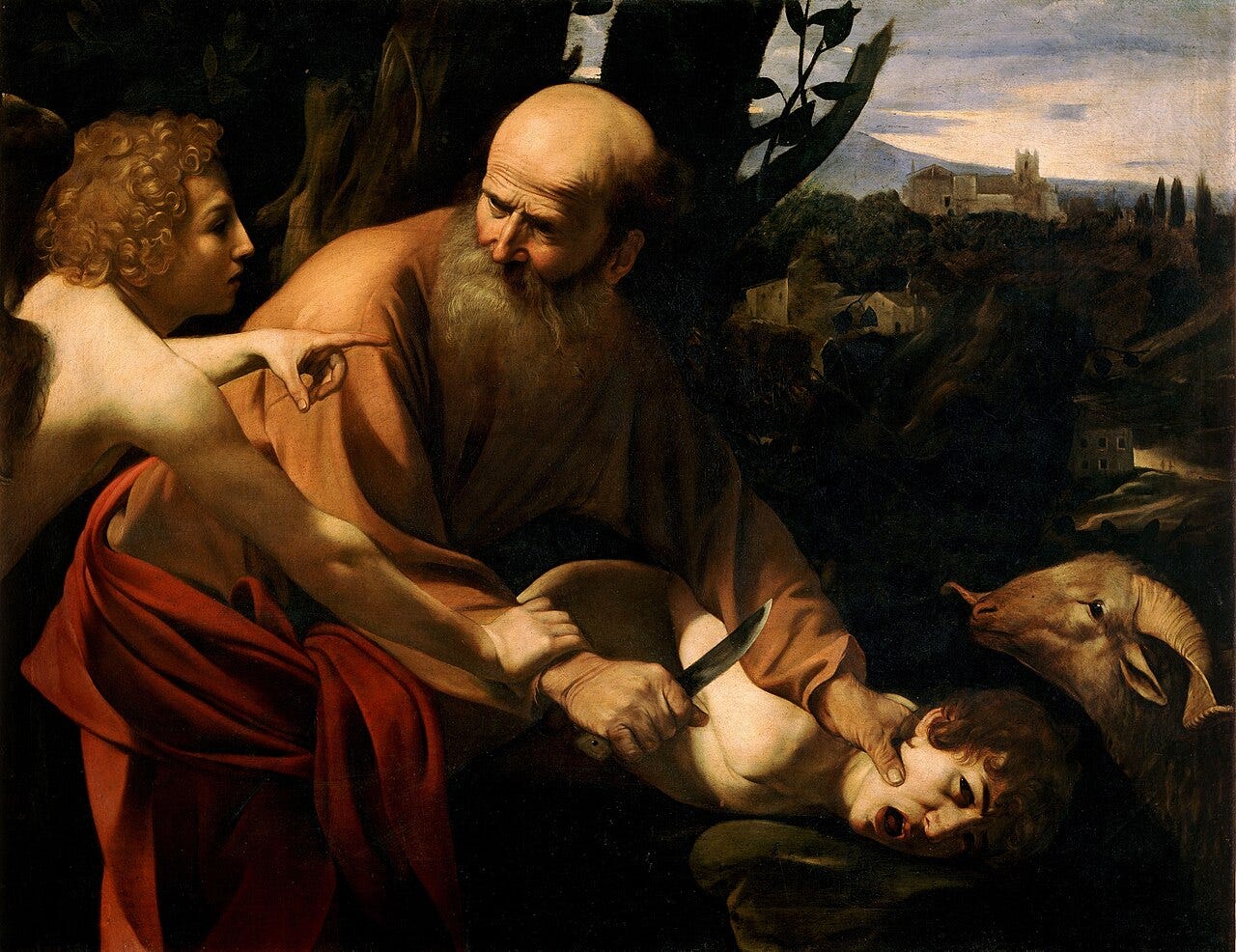
The story of Abraham and Isaac or Ishmael depending upon the version isn’t about a violent God demanding a child’s death. Abraham is asked to surrender the very future God promised him. The test forces a choice between inheritance and obedience, between biological continuity and trust in a higher order. When Abraham raises the knife and is stopped, the message is not subtle: God does not actually want child sacrifice. The ram caught in the thicket replaces Isaac or Ishmael, marking a turning point in the ancient Near Eastern world where child sacrifice was not uncommon. The story reframes sacrifice from bloodlust to obedience. What God demands is allegiance, not slaughter. The killing stops, but the cost remains real.
If order still had a cost, and blood was no longer always the answer, then what exactly did the universe demand in return?
Every civilization that followed tried to answer that question in its own way. Some turned sacrifice into cosmic maintenance. Some turned it into terror. Some tried to spiritualize it. And one tradition tried to end it altogether. That story unfolds next.
The rest of this essay traces how different civilizations answered the same unsettling question Abraham left behind from Vedic fire rituals and Aztec temples to the crucifixion and the modern world’s hidden sacrifices.
If you want to follow the Arc of Belief and Meaning as it unfolds, the full continuation is available to paid subscribers.
