

Hades and Persephone: Rape Myth or Ancient Power Couple
Why this ancient story still divides the modern world?

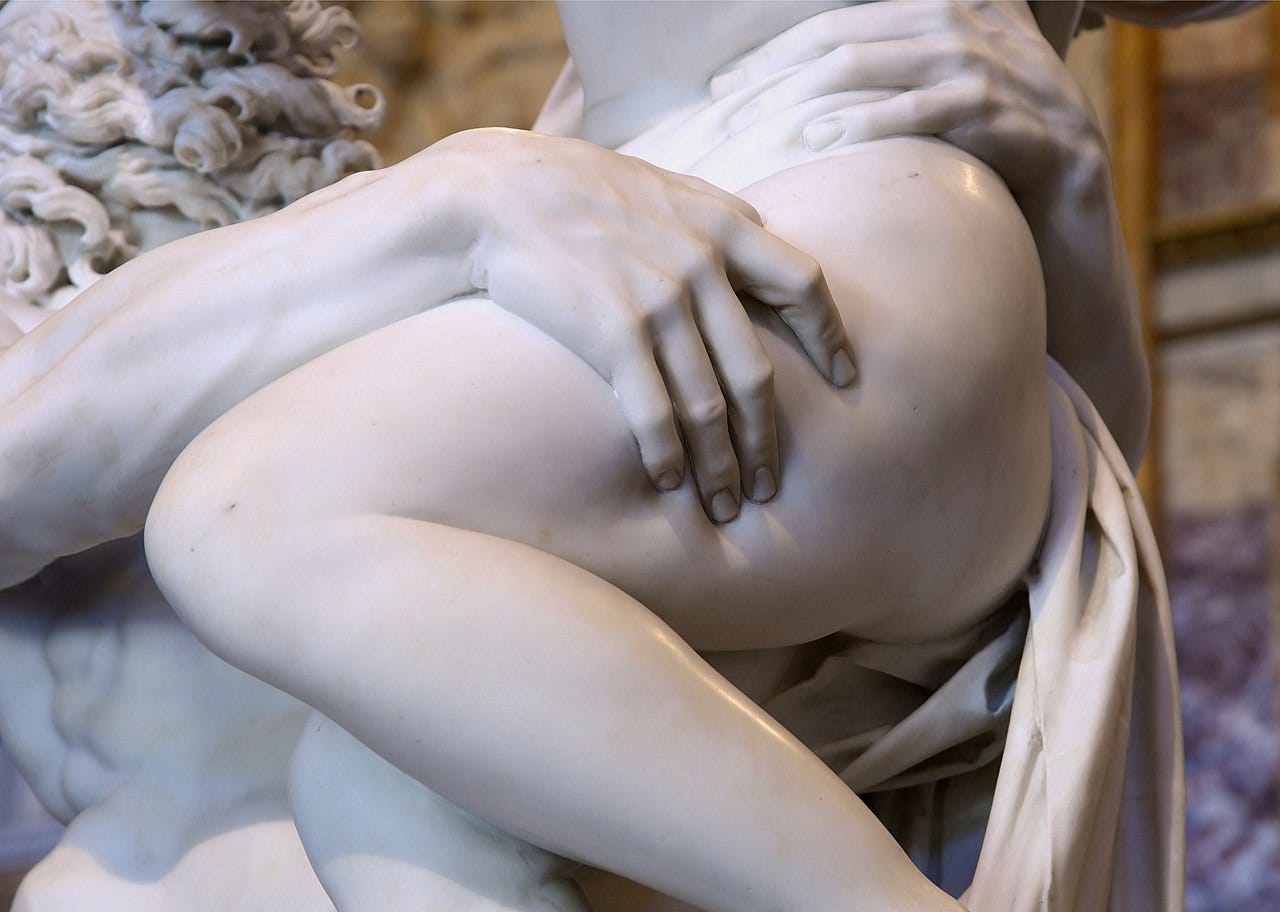
At twenty-three, Bernini carved Hades and Proserpina in marble so vividly that his fingers seem to sink into her flesh, and in doing so he captured the question that still divides readers today. Was this the birth of mythology’s darkest love story, or the moment later ages learned to disguise abduction as romance?
Gian Lorenzo Bernini carved one of the most unsettling scenes in classical mythology into marble. In The Rape of Proserpina, Hades does not look like a husband greeting his queen. He looks like a man seizing a woman who is trying to break free. Her body twists away. His hand presses into her thigh. The whole sculpture is built on force. That is what makes the myth so hard to domesticate. If one of the greatest sculptors in history saw the center of this story in the violence of the taking, why do so many modern readers keep calling Hades and Persephone an ancient power couple?
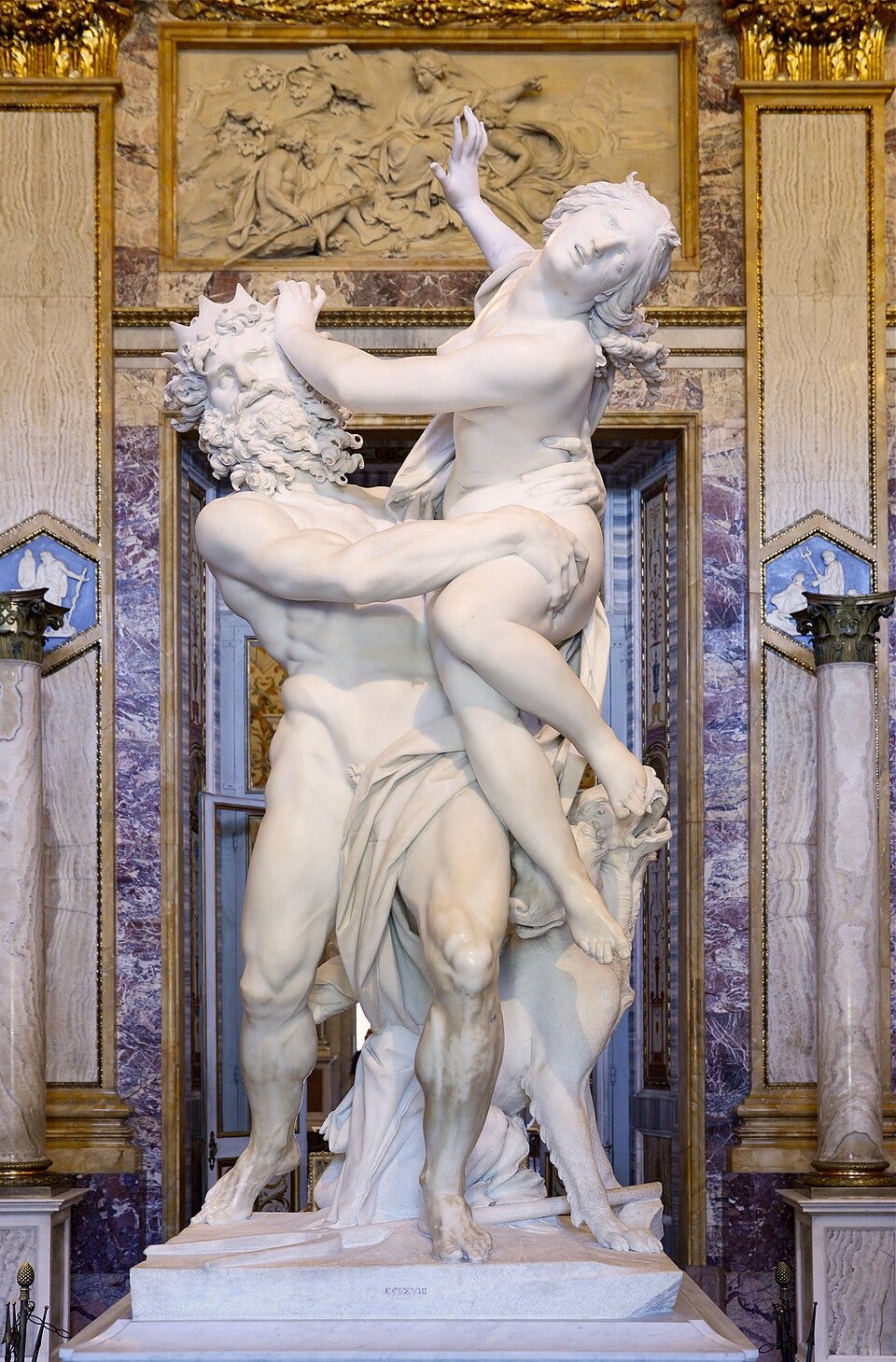
The answer is that two different stories have been fighting inside this myth for a very long time. One is the older and harsher story, where a girl is taken, her fate is negotiated by others, and the language of marriage is used to cover an act of domination. The other is the later story, where that same girl becomes queen of the underworld, gains symbolic depth, and is slowly reimagined as a figure of mystery, power, and even consent. The debate turns into which story has the stronger claim on the evidence.
The first reason to favor the kidnapping reading is the oldest surviving version itself. In the Homeric Hymn to Demeter, Persephone is lured away, carried off against her will, and later says that Hades made her eat the pomegranate by force. When Hermes comes to retrieve her, she does not hesitate like a conflicted bride. She rejoices.
That detail ruins the idea that the myth begins in mutual attraction. It begins in seizure, fear, and compulsion. Even later discussions that try to parse marriage language in the poem still come back to the same hard fact. Persephone’s consent is absent at every decisive point.
The second reason is that the story is political before it is romantic. Zeus approves the union and Hades enforces it, while Demeter protests it. Persephone is the person whose life is being decided, yet her own will carries the least weight. From the masculine point of view, the event can be framed as a wedding; from the feminine point of view, it is rape.
Ancient cultures often allowed those two categories to sit dangerously close together. We see the same logic elsewhere in Mediterranean tradition. The story of the Sabine women also begins with violent abduction and ends with legally recognized marriage. That shows how often force was seen in the language of order.
The third reason is that the visual tradition closest to antiquity does not behave as if it is illustrating romance; rather, it behaves as if it is illustrating rupture. A famous wall painting from fourth-century BC Vergina shows a distraught Persephone lunging out of Hades’ grip. Her body reaches outward. His body drives forward. The contrast is the point. He is aggressive and immovable. She is terrified and powerless.
That same instinct survives much later in Bernini. He did not choose to sculpt the calm dignity of a queen on a throne. He chose the instant of capture. Artists usually know where the true drama lies. For centuries, what they kept seeing in this myth was not harmony, but force.
Those three reasons make the kidnapping reading stronger. The earliest text, the power structure of the myth, and the oldest artistic logic all lean in the same direction. But the other side survives for a reason, and its case is not empty.
The first reason people keep defending the power-couple reading is Ovid. He does not erase the violence, but he softens its meaning by framing it through desire rather than cold seizure planned in advance. Pluto is overtaken by desire. The act is framed less as a cold seizure planned in advance and more as a sudden eruption of passion.
More importantly, Ovid shifts the pomegranate. Instead of making the fruit purely a forced trick, he presents Proserpina as eating it herself, without understanding what it will cost. That one change opened the door for centuries of reinterpretation. Once the fruit becomes something she consumes rather than something simply forced upon her, later writers can imagine curiosity, temptation, divided feeling, even a dark attraction to the underworld.
The second reason is Persephone’s transformation. She does not remain only a crying girl in cultural memory. She becomes queen of the underworld, and later writers keep returning to that fact because it gives her a second life beyond victimhood.
Modern poets especially have pulled the myth away from simple labels. Rita Dove turns it into a drama of mother and daughter. Louise Glück treats the abduction as violence that leaves an invisible scar yet also gives Persephone a voice that the older myth largely denies her. A.E. Stallings uses conflicting perspectives to expose how smooth language can hide domination. These writers do not try portraying the original story as secretly romantic, they show why later generations resist leaving Persephone trapped inside a single role.
The third reason is that modern retellings actively rewrite the myth. In recent adaptations, Persephone is often given agency, Hades is made patient rather than predatory, and the relationship is rebuilt on mutual consent and emotional equality. In that form, the old rape myth becomes something closer to a feminist love story.
That helps explain why so many readers now romanticize the pair. It also explains why online audiences often defend them by comparison. Against Zeus and Hera, almost anyone looks stable. Against Zeus’ serial betrayals, Hades can look restrained. But that is a weak defense, in myth or in life. A relationship is not healthy just because it looks better than the worst couple in the room. “Better than Zeus” is an embarrassingly low bar.
That, in the end, is why my take comes down more on one side of the debate than the other. The oldest evidence supports kidnapping more strongly than romance. The power-couple reading is later, softer, and more revisionary. It tells us what later readers wanted from Persephone. They did not want a goddess defined only by being taken. They wanted a queen, a survivor, a woman with inner life, a figure who could move between worlds without being reduced to a victim. That desire is understandable. It has produced some of the most interesting art and writing around the myth. But a better ending does not erase a brutal beginning.
So, the question remains exactly where Bernini left it, in the grip of that marble moment. Do we judge the relationship by how it began in the oldest story, or by what it became in later imagination?
If you choose the first, you are refusing to let later beauty cover the violence at the beginning. If you choose the second, you are trusting transformation to redeem force.
That is why Hades and Persephone still trap readers. They force you to decide what love, power, and memory can actually excuse.

Personally I prefer one of the modern retellings where Persephone was never kidnapped but instead wished to actually have a relationship with Hades. That said, it is vitally important to remember the original telling to remind us of the cruelty that comes from letting desire supercede respect.
Were the Greeks descendants of the Yamnaya? If so that could explain a lot. DNA shows that the men were warrior invaders, the women were abducted. That could leave a lasting impression in the collective memory.