How Bernini Turned Caricature into a Weapon Against Power
Bernini Before Memes

A ruler can survive criticism, but he has a harder time surviving the picture that makes people laugh before they bow.
That is the real power of caricature. It does not need a long argument or a speech. It takes a public figure and forces people to see the weak point at once: the heavy jaw, the stiff neck, the tired eyes, the pinched mouth, the false dignity, the nervous pride. In one image, authority becomes a human face with habits, flaws, and vanity.
Gian Lorenzo Bernini understood this long before anyone had a feed, a meme page, or a viral screenshot. He lived in Rome among popes, cardinals, princes, and noble families. These were people surrounded by ceremony. They had titles, chapels, palaces, processions, and portraits that made them look permanent. Bernini gave them something far more dangerous. He gave them a few quick pen lines that made them recognizable and ridiculous.
That comes as a surprise because Bernini was the great artist of Baroque grandeur. He carved Pluto and Proserpina with fingers pressing into marble flesh. He made the bust of Scipione Borghese look as if the cardinal had just turned his head and begun to speak. He built religious spaces where sculpture, light, and architecture worked together on the viewer’s nerves. This was a man who knew how power wanted to look. Controlled, sacred, rich, alive, and beyond ordinary judgment.
Then he picked up a pen and stripped all of that away.
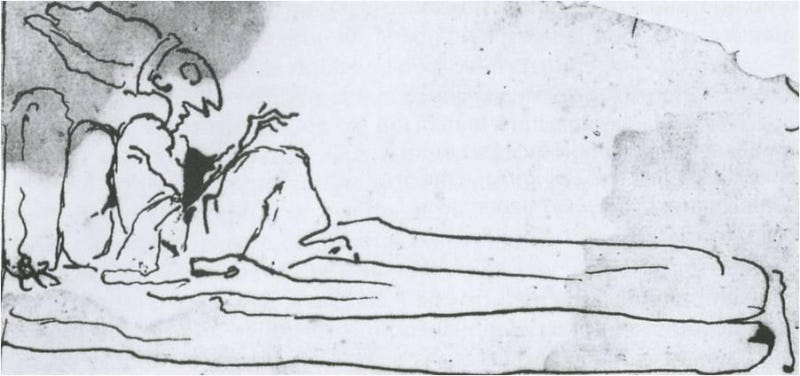
One of the boldest examples came near the end of his life. Bernini drew Pope Innocent XI, born Benedetto Odescalchi, in a small caricature made with a few quick lines. Bernini was seventy-eight when Odescalchi became pope in 1676. The drawing was tiny, barely the size of a small sheet scrap, yet it made a large claim: even the pope could become a face on paper. Irving Lavin treats this drawing as a turning point because it appears to be the first surviving true caricature of a pope, and because it shows a new kind of social satire taking shape inside high European culture.