

How Islamic Architecture Evoked the Infinite
What Modern Mosques Get Wrong About Form and Meaning

Islamic architecture solved one of the hardest problems in religious art. How can a building evoke an infinite and unrepresentable God without giving Him a human image?
Its answer lay in geometry, light, pattern, and calligraphy. Geometry gave the building order while allowing the pattern to continue beyond any single panel. Light changed the appearance of walls throughout the day. Repetition encouraged the eye to move across the surface instead of settling on one dominant image. Calligraphy gave revelation a visible presence through the words of the Quran.
These elements performed the work that sacred figures performed elsewhere. They directed attention, created emotional intensity, and helped worshippers sense an order larger than themselves. A mosque could communicate divine unity without attempting to place God within a physical form.
This theological problem shaped some of the greatest buildings in Islamic history. It also explains why their meaning reaches far deeper than their domes, minarets, arches, and tiles.
How Belief Shaped Space
The concept of tawhid, the unity of God, gave Islamic architecture its central intellectual challenge. Since God has no physical limit, equal, or human form, an architect therefore had to produce a sense of divine presence through relationships between light and surface, proportion and movement, repetition and variation.
Geometric design served this purpose especially well. A star pattern can expand from a small center into an intricate network of lines. Every shape belongs to a larger order. Each part remains distinct while participating in a unified whole. The pattern appears capable of continuing beyond the wall that contains it.
This quality made geometry useful for expressing an infinite reality. The pattern has a visible boundary because the building has a boundary, yet its internal logic suggests continuation. The worshipper encounters order without encountering an image of God.
Repetition created a similar effect in space. Rows of columns, repeating arches, patterned carpets, and lines of worshippers diminished the importance of the isolated object. They produced rhythm and collective orientation. In congregational prayer, individual bodies form ordered rows facing the same direction. The architecture reinforces this movement toward unity.
Light added change to that order. A geometric screen looks different at sunrise, noon, and late afternoon. Light passes through openings, moves across the floor, and alters the intensity of color. The building remains stable while its interior continues to change. Islamic architects turned that natural process into part of the religious experience.
The Prophet’s Mosque: Purpose Before Monument
The first great lesson of Islamic architecture comes from a building of extreme simplicity.
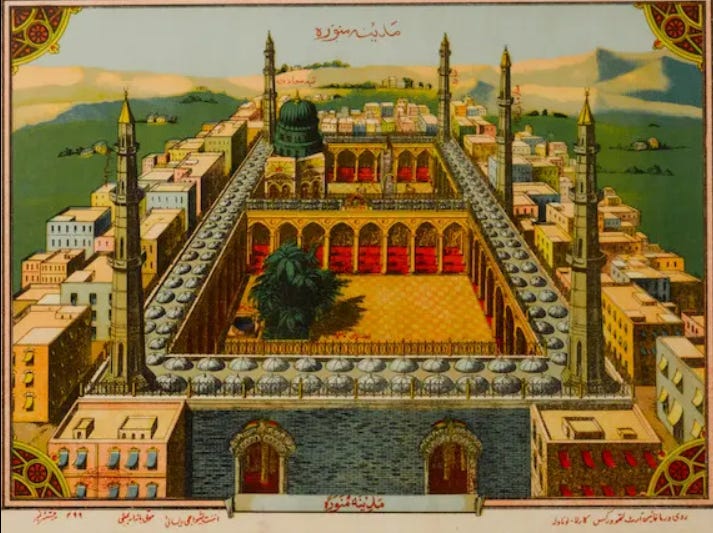
The Prophet’s Mosque in Madinah was built in 622 after Prophet Muhammad’s migration from Makkah. Its early form consisted of an enclosure made from mud brick. Palm trunks supported a roof of palm leaves and mud. Much of the space remained open to the sky.
Its materials came directly from the local environment. The structure answered the climate and the resources available to the community. Every part served a clear need.
Yet the mosque became the center of the new Muslim society. People gathered there for prayer, education, consultation, public decisions, and the reception of visitors. It helped organize charity and communal affairs. The building’s importance came from the life taking place inside it.
As the community grew, the mosque changed. It was enlarged. A pulpit was introduced. Oil lamps provided illumination. Each addition answered a practical need created by the expanding society. The mosque evolved with the people who used it.
This remains one of the clearest models for Islamic architecture. The building began with local materials, served the needs of its users, and acquired its meaning through worship and community life. Monumentality came later.
The Prophet’s Mosque also established the mosque as an institution rather than a room reserved for prayer. Its purpose extended into education, justice, public welfare, and social organization. Architecture gave those activities a shared home.
When contemporary mosques provide a grand prayer hall but give little space to learning, counselling, community service, or youth activities, they preserve part of the institution while weakening the rest.
