

How Pregnancy Became a Sacred Passage in Ancient Greece
Where Fabric Became Faith.

Imagine walking into the halls of the Acropolis Museum and stopping before a small marble relief carved over two thousand years ago. A veiled woman stands at the altar of Artemis, her face hidden beneath a heavy mantle. In one hand, she holds a small pyxis of incense. Above her, carved with quiet precision, garments hang as if on a clothesline: a chiton, a sash, a pair of shoes. She is not a goddess. She is an ordinary woman who has just given birth. The garments she offers once wrapped her body during the most dangerous moment of her life.
This relief is not grand like the Nike of Samothrace or as famous as the Venus de Milo. But it reveals something far more intimate. Every fold of that garment represents a passage: from parthenos, a young woman, to gune, a woman who has entered marriage and motherhood.
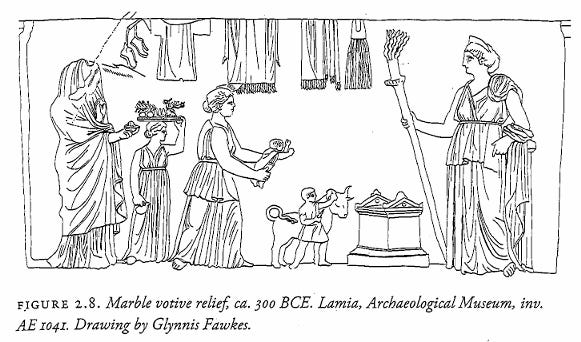
Pregnancy in ancient Greece was not simply biological. It was social, spiritual, and perilous. In a world without reliable medicine, childbirth carried real risk. Women turned to ritual not out of symbolism, but out of necessity. Sanctuaries, offerings, and prescribed practices formed a system meant to contain that danger.
The Greeks rarely depicted pregnancy directly. It appears instead in quieter forms. Votive plaques, terracotta figurines, and relief carvings preserve fragments of how women moved through this stage of life without placing it on public display.
Clothing became one of the clearest signals of that transition. Greek dress did not emphasize the body. It obscured it. Women loosened their belts or wore unbelted chitons, allowing fabric to fall naturally over the body. The change was subtle but understood.
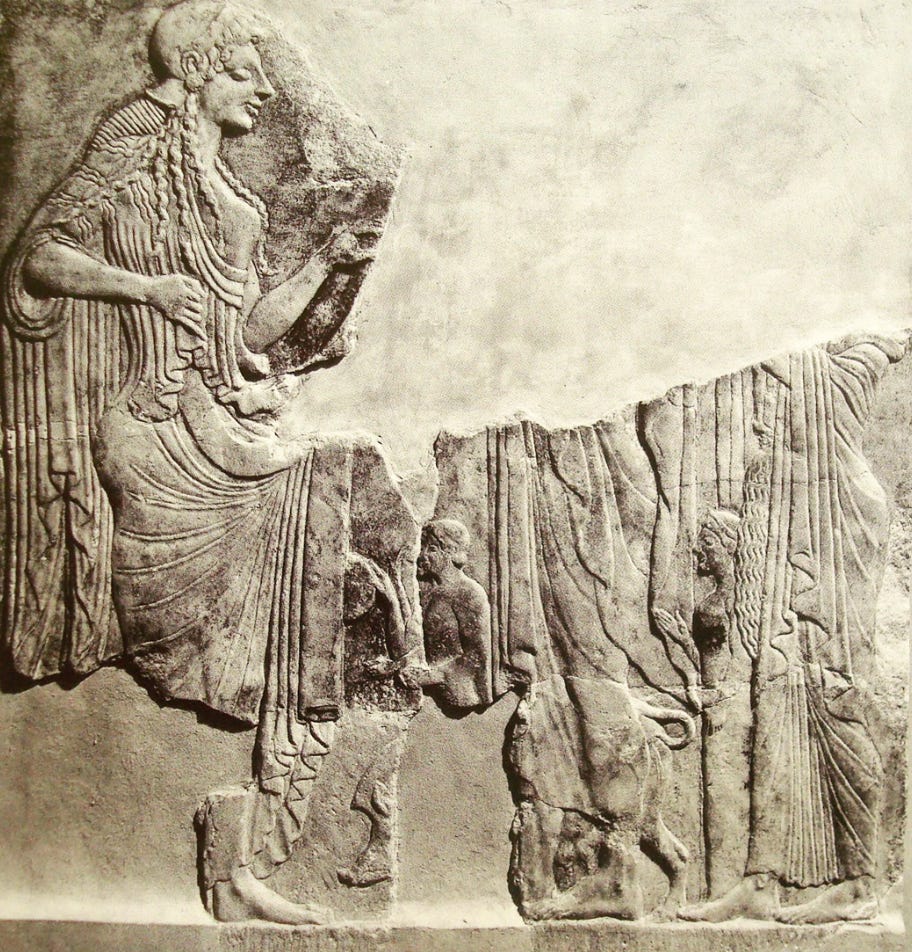
On wooden votive plaques from Pitsa, women approach altars wrapped in dense layers of fabric. One figure is almost entirely concealed, her face and form dissolved into folds. These scenes are not decorative. They show women seeking protection, using clothing as part of that appeal.
