

How to Start a Renaissance Today
5 Lessons from Ancient Egypt’s Saite Period Revival

A renaissance begins when a wounded culture stops chasing novelty and recovers the standards that once made it strong.
That is the lesson of Egypt’s Saite Period. It came after generations of strain resulting from internal division, Nubian rule from the south, Assyrian invasions, and the sack of major sacred and political centers such as Thebes and Memphis. Egypt had been shaken badly enough to lose confidence in its own order. Then, in the 7th century BC, a new dynasty based at Sais reunified the country under Psamtik I and began one of the most deliberate cultural revivals in ancient history.
The 26th Dynasty ruled from 664 to 525 BC, though Egyptologists often mark Psamtik’s full control of Egypt from 656 BC. Its kings and officials reached backward into Egypt’s older past, especially the Old Kingdom, though they also drew from other earlier periods. They brought back forms, texts, titles, artistic proportions, and symbols that Egyptians already associated with sacred order, strong kingship, and the most admired periods of their civilization. Egyptologists call this archaism: the conscious return to earlier styles and traditions after they had fallen out of active use.
This mattered because Egypt’s renewal came after humiliation. A country that had been pressured by foreign powers turned back to its own deepest memory, but it did so with discipline. The Saite revival treated the past as a source of training, legitimacy, and cultural confidence. It also used new tools when those tools served the larger purpose. That combination produced nearly 140 years of stability, artistic achievement, and renewed civilizational force.
The first lesson is that a culture in crisis has to reconnect with deep roots, but it has to study them carefully and choose selectively. The Saite kings did not revive everything. They focused on what still carried power: idealized poses in sculpture, older artistic proportions, sacred texts, archaic titles, biographical formulae, and symbolic forms connected to kingship and sacred order. Saite artists studied earlier models so closely that some works look almost Old Kingdom at first glance. Only small differences in carving technique, proportions, and finish reveal their true date.
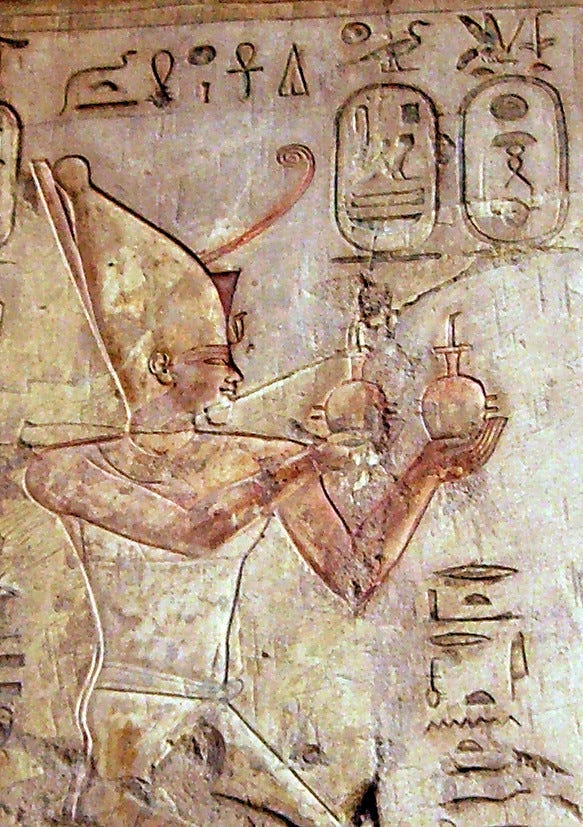
One striking example appears in the Theban tomb of Sheshonq, known as TT 27. Sheshonq was a learned official, and his tomb shows the revival at a high level. On the entrance staircase, ancient biographical phrases were rendered through a kind of alphabetic treatment of hieroglyphic writing. This was studied adaptation rather than mechanical copying. Old Egyptian language, older prestige, and contemporary alphabetic influence brought together by someone who understood the tradition from the inside.
That is the first mark of real renewal. The past has to be studied before it can be used. A revival fails when people borrow the look of the past without recovering the discipline behind it. It endures when they restore the habits, standards, and training that made those older forms worth reviving.
But Saite Egypt’s revival had another strength. It reached back without closing itself off. Egypt’s ancient past gave it standards; the world of its own century gave it Greek and Carian soldiers, Mediterranean trade, and Naukratis.
