

How to Write an Essay
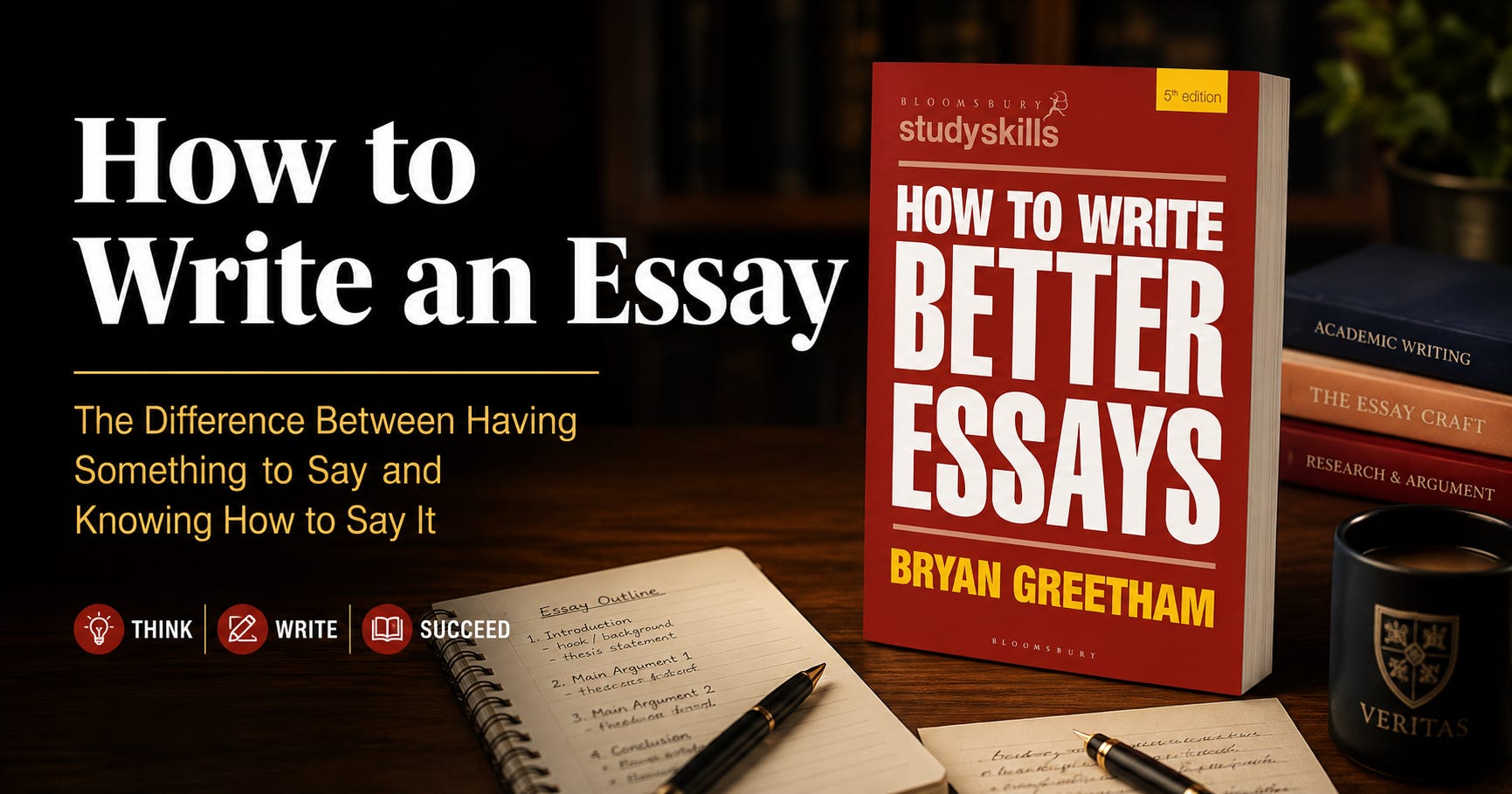
Brian Greetham reveals the difference between having something to say and knowing how to say it.

A writer receives a question, opens a blank document, and starts wrestling with the first sentence. Twenty minutes later, half a paragraph exists. The introduction has been rewritten several times, but the essay still has no clear direction. The difficulty started earlier. The writer has yet to decide exactly what the question demands and what the essay will ultimately prove.
Good essay writing begins with thinking. Before drafting a sentence, you need to understand the question, identify the problem inside it, decide which evidence matters, test possible answers, and arrange those ideas into an argument. Bryan Greetham makes this process central to How to Write Better Essays. He divides essay writing into five stages: interpreting the question, research, planning, writing, and revision. Each stage prepares the next. A poorly understood question leads to unfocused research; unfocused research weakens the plan; and a weak plan forces the writer to discover the argument while trying to express it.
That is why learning to write an essay begins with learning how to read a question.
The Question Is Your First Problem to Solve
Suppose a history professor asks:
Was the Industrial Revolution truly a revolution?
A writer might immediately think of steam engines, factories, coal, textile production, railways, and urbanization. All of these subjects belong in the discussion. Yet describing them one after another would produce a history of industrialization rather than a direct answer to the question.
The crucial word is revolution.
What qualifies as revolutionary change? Does it have to occur quickly? Must it involve political upheaval or the overthrow of an existing order? Or can gradual changes become revolutionary when their cumulative effect transforms how millions of people work, travel, produce goods, build cities, raise families, and understand economic life?
Greetham places considerable emphasis on examining key concepts because apparently ordinary words often contain the intellectual problem the essay expects you to solve. Terms such as freedom, authority, democracy, crisis, and revolution appear straightforward until we ask exactly what they mean in a particular argument. He uses the Industrial Revolution itself to show the difference: judged primarily by speed, industrialization can appear evolutionary; judged by the scale and depth of change, the description “revolution” becomes far easier to defend.
That distinction immediately produces the beginnings of a thesis:
Although British industrialization developed over decades rather than through a sudden rupture, the scale of its economic, technological, demographic, and social transformation justifies describing it as a revolution.
Now there is an argument to develop.
“The Industrial Revolution changed Britain” identifies a subject. “Its gradual pace does not disqualify it as a revolution because the scale of transformation matters more than speed” makes a judgment about that subject. The second statement gives the essay somewhere to go.
Before researching, therefore, interrogate the wording. What exactly does the question ask you to judge, explain, compare, or defend? Which words require definition? What assumptions have already been built into the question? Could those assumptions themselves be challenged? If the question asks whether something was successful, what measure will determine success? If it asks whether an event was inevitable, what realistic alternatives existed? If it asks whether one cause was primarily responsible, what competing causes must be weighed against it?
The wording of the question often contains the architecture of the eventual essay.
Knowing the Subject and Answering the Question Require Different Skills
Imagine two writers answering:
To what extent was Napoleon responsible for his own downfall?
The first knows an extraordinary amount about Napoleon. He writes about the Italian campaigns, Egypt, Austerlitz, the Continental System, Spain, Russia, Leipzig, Waterloo, and St Helena. The essay contains impressive facts and accurate chronology.
The second writer knows fewer details but pauses over the word responsible. Responsibility immediately suggests several causes whose importance must be weighed. Napoleon’s own decisions matter, but so do circumstances outside his control. The essay therefore examines the invasion of Russia and the Spanish campaign alongside Britain’s financial and naval strength, nationalist resistance, the durability of the European coalitions, and the sheer difficulty of maintaining French dominance across the continent.
The second writer has understood the assignment more precisely.
This distinction matters because knowledge alone cannot determine relevance. An essay answers a particular question under limited conditions. The writer must select ruthlessly. Interesting facts can still distract from the argument, and impressive quotations can still occupy space without advancing it. Greetham repeatedly warns against collecting material simply because it belongs to the wider topic.
This explains why some essays feel strangely empty despite containing substantial research. Facts appear because they are interesting. Quotations appear because respected scholars said them. Paragraphs accumulate information while the central question gradually disappears.
Every piece of information should earn its place.
A useful test is simple: What does this help me prove?
When the answer is unclear, the material probably belongs in your notes rather than in the essay.
Think Before You Research
Research feels productive. You read books, highlight passages, save articles, and fill pages with notes. Yet, without direction, research can consume hours while leaving the central argument untouched.
Before opening a book, spend ten or fifteen minutes working with what you already know. Suppose the question is:
Why did the Roman Republic collapse?
Write down the obvious candidates: the Gracchi, inequality, territorial expansion, Marius, military reform, Sulla, political violence, Pompey, Caesar, the Senate, corruption, civil war, and Augustus.
Then move beyond the list and ask how those elements relate to one another. Did territorial expansion create pressures that republican institutions had never been designed to manage? Did changes in military recruitment strengthen soldiers’ dependence upon individual commanders? Did Sulla establish precedents later exploited by Caesar? Had repeated political violence already weakened republican conventions long before Caesar crossed the Rubicon?
You now possess something more useful than a collection of topics. You have questions.
Those questions change the way you read. Instead of asking a book to supply an opinion, you approach it with problems that require evidence. A source might confirm one assumption, weaken another, or reveal that the original framing was too simple. That is productive research because the evidence is capable of changing your mind.
Greetham treats this as part of the wider process of making ideas your own. Research becomes useful when the writer actively processes, compares, tests, and reorganizes what has been read rather than simply storing information for later use.
The best research therefore begins with uncertainty. You know enough to ask intelligent questions, but you remain willing to discover that your first answer was wrong.
Research for an Argument
Researching Alexander the Great gives a writer almost no useful direction. Alexander’s life touches Macedonian politics, Philip II, Greek warfare, Persia, Egypt, Central Asia, India, military organisation, religion, administration, cultural exchange, succession, and centuries of historical interpretation.
A focused question transforms the task:
To what extent did Alexander owe his military success to the army created by Philip II?
Now the research has boundaries.
You need to understand what Philip built: the Macedonian phalanx, the sarissa, Companion cavalry, combined-arms tactics, siege capabilities, experienced officers, and the political consolidation that gave Macedonia extraordinary military power. You also need evidence showing what Alexander himself contributed. The tactical decisions at Granicus, Issus, and Gaugamela; the siege of Tyre; his speed of movement; his adaptation to very different opponents; and his leadership during campaigns increasingly distant from Macedonia.
Then comes the harder part. You need evidence that creates difficulty for your preferred answer. If Alexander inherited an exceptional army, how much credit belongs to the commander who used it? If Philip possessed the same military system, why did Alexander accomplish something on a scale his father never reached?
Those questions prevent research from becoming a hunt for confirmation.
The way you take notes should reflect the same purpose. Notes organized by source often become cumbersome during writing because the argument has to be reconstructed from separate books. Categories such as “Philip’s military reforms,” “Alexander’s tactical decisions,” “Persian weaknesses,” and “counterarguments” are far more useful because the material has already been organized according to the essay’s intellectual problems.
Research should therefore begin processing evidence before the first draft starts.
Your Thesis Is the Judgment You Are Prepared to Defend
At some point, research has to produce an answer. That answer becomes the thesis. Writers are often told that an essay needs a thesis statement, so they produce a sentence that announces a fact:
Alexander the Great was one of history’s most successful military commanders.
The statement is accurate, but it leaves little meaningful disagreement to explore.
Compare it with:
Alexander’s tactical ability was essential to his conquests, but his victories also depended heavily on the military system created by Philip II. His distinctive achievement lay in using that inheritance with a speed, flexibility, and ambition that transformed Macedonian dominance of Greece into an empire stretching deep into Asia.
Now something must be proved.
The thesis weighs two explanations and makes a judgment about their relationship. The essay must establish what Philip contributed, what Alexander contributed, and why the interaction between the two explains the result better than either explanation alone.
A strong thesis gives the reader a claim that can be tested. It may weigh competing causes, qualify a conventional interpretation, distinguish between different measures of success, or argue that an apparently simple question contains several separate problems. Greetham’s emphasis on analysis matters precisely because a thesis becomes stronger when the writer has questioned the language and assumptions of the original prompt.
A good thesis should also remain provisional during research. Evidence may force you to narrow it, strengthen it, or abandon part of it. That process usually improves the final essay because the conclusion has been earned rather than chosen in advance.
Build the Argument Before Writing the Draft
Once you have a provisional thesis, plan how you will prove it.
For the Alexander question, the essay might begin by establishing what Philip gave his son. A second section could examine Alexander’s tactical decisions in major battles. Another could consider his adaptability during sieges and unconventional campaigns. A fourth might weigh Persian weaknesses and other external advantages. The final section could test the strongest competing interpretation: perhaps Alexander’s achievements were largely the predictable consequence of Macedonian military superiority.
Each section now has a purpose, and there is a reason for its position.
Planning therefore involves much more than deciding that an essay will contain five body paragraphs. Greetham treats planning as a separate stage because the order of ideas determines how effectively an argument develops.
One of the best tests is to summarize every planned paragraph in a single sentence and read those sentences on their own. Do they form a chain of reasoning? Does each one advance the answer? Does the essay become more precise as it proceeds?
If several paragraphs could be moved around without changing anything, examine the structure. Sometimes that flexibility is harmless. Often it reveals that the essay contains several observations about the same topic rather than a developing argument.
A strong essay moves. Each paragraph should change what the reader now understands.
The Introduction Should Establish the Problem
Many essays waste their first paragraph on background the reader already knows.
Throughout history, there have been many great leaders.
Or:
War has played an important role in human civilization for thousands of years.
These openings consume valuable space while delaying the argument.
Begin closer to the problem:
Alexander inherited from Philip II the strongest military system in the Greek world. Yet inheritance alone cannot explain the destruction of the Persian Empire, the conquest of Egypt, campaigns across Central Asia, and the Macedonian advance into India within little more than a decade. Philip created many of the conditions that made conquest possible, while Alexander’s tactical judgment, speed, adaptability, and personal command determined the extraordinary scale it eventually reached. His success therefore emerged from the interaction between an exceptional military inheritance and an equally exceptional ability to use it.
Within one paragraph, the reader understands the historical problem, the competing explanations, and the writer’s judgment.
A strong introduction does not need to preview every example that will appear later. It needs to establish the question, clarify important terms where necessary, state the central argument, and give the reader enough direction to understand why the next paragraph follows.
The introduction works best when the writer already knows where the essay is going. This is another reason planning should come before drafting.
The Paragraph Is Where the Essay Proves Its Case
The paragraph is the working unit of an essay. Each one should contribute something distinct to the argument.
Suppose the essay claims that Alexander’s own tactical judgment played a major role in his victories. Gaugamela provides useful evidence. A descriptive paragraph might recount Darius’s army, the Persian cavalry, the terrain, the Macedonian phalanx, and Alexander’s charge. A stronger paragraph asks what those details prove.
Alexander advanced obliquely, compelling Persian forces to respond to his movement and contributing to a weakness in their line. When the opportunity emerged, he directed the Companion cavalry towards the Persian centre. The significance lies in the command decisions behind the manoeuvre. The Macedonian army gave Alexander formidable military capabilities; his judgment determined where and when those capabilities were used.
That final movement turns evidence into analysis.
Evidence tells the reader what happened. Analysis explains why what happened matters to the argument.
The same principle works across disciplines. A quotation from Macbeth provides textual evidence; explaining how Shakespeare’s language alters our understanding of ambition provides analysis. Unemployment figures provide economic evidence; determining whether they support a particular policy claim provides analysis. Describing Kant’s reasoning demonstrates comprehension; examining whether the premises justify the conclusion demonstrates philosophical analysis.
This is also why quotations cannot carry an essay by themselves. Suppose a historian calls Caesar the man who destroyed the Roman Republic. The quotation may be useful, but the writer still has to ask what “destroyed” means, what evidence supports the interpretation, and how it accounts for decades of instability before Caesar. Sulla had already marched on Rome. Political killings and proscriptions had already occurred. Republican conventions had already suffered repeated violations.
Sources supply material. The essay writer determines what that material proves.
Take the Strongest Objection Seriously
An argument becomes more persuasive when it can withstand the best case against it.
Suppose your thesis claims that Caesar played the decisive role in destroying the Roman Republic. The obvious objection is that republican government had been deteriorating for decades before he crossed the Rubicon. Sulla had seized Rome with an army. Political violence had become increasingly normal. Powerful generals had accumulated personal military followings. Institutions built for an earlier political order struggled to govern a vast Mediterranean empire.
That evidence deserves direct attention. It may force a better thesis. Caesar may have delivered the decisive blow to a political system already weakened by decades of institutional failure, elite competition, and civil violence. The revised claim is more precise because it explains both Caesar’s importance and the conditions that made his rise possible.
This is one of the clearest differences between assertion and argument. Assertion protects the original claim. Argument tests it.
The strongest essays frequently develop through this process. A writer begins with a broad explanation, encounters evidence that creates difficulty, and produces a narrower and more accurate judgment. Complexity enters the essay because the evidence demanded it.
Make Paragraphs Build on One Another
Good structure extends beyond arranging sections in the right order. The relationship between individual paragraphs matters just as much.
Suppose one paragraph establishes that Philip created the Macedonian military system. The next could begin:
Philip’s reforms explain why Alexander possessed such a formidable army at the beginning of his reign. They leave another question open: how much did victory depend upon the commander who used it? Alexander’s early campaigns provide the first opportunity to separate inherited military strength from his own decisions in command.
The transition performs intellectual work. It explains what the previous paragraph established and why the next problem follows from it.
Words such as however, therefore, yet, and by contrast can help clarify relationships, but transitions work best when the logical relationship already exists. A transition word cannot create an argument that the paragraphs themselves lack.
At the beginning of each paragraph, ask: Why does the reader need this paragraph now?
A clear answer usually produces a clear transition.
Clear Writing Comes From Precise Thinking
Academic writing often becomes unnecessarily difficult when writers confuse complexity with intelligence.
Consider:
The utilization of military methodologies by Alexander can be understood as being indicative of his possession of a considerable degree of tactical capability.
The underlying idea is simple:
Alexander’s battlefield decisions reveal his tactical ability.
Greetham devotes separate attention to simplicity and economy because clear prose allows the argument to remain visible.
Some ideas genuinely require technical language, careful qualification, and long explanation. Use that complexity when precision demands it. The important question is whether the difficulty belongs to the subject or has been added by the writer.
Read difficult sentences aloud. If you reach the end and have forgotten how the sentence began, divide it. Prefer direct verbs when they make the sentence clearer. Cut phrases that repeat a point already established. Use technical vocabulary when it expresses an idea more precisely than ordinary language and define it when readers may reasonably need help.
The purpose of style in an essay is straightforward: make the reasoning as easy to follow as the subject allows.
The Conclusion Should Deliver the Judgment
A weak conclusion repeats the preceding sections:
In conclusion, Philip II made many military reforms. Alexander was also a talented general. Persia had weaknesses. All of these factors contributed to Alexander’s success.
The reader receives a summary but little final judgment.
A stronger conclusion returns to the original problem with the benefit of everything the essay has established:
Philip gave Alexander the military instrument with which Persia could be conquered; Alexander determined how effectively and how far that instrument would be used. The Macedonian army, experienced officers, and tactical system inherited from his father make any explanation based entirely on individual genius difficult to sustain. Yet inheritance alone cannot explain Alexander’s decisions at Issus and Gaugamela, the siege of Tyre, or his ability to adapt Macedonian warfare to increasingly unfamiliar conditions. His achievement lay in converting an exceptional inheritance into conquests that exceeded anything Philip had accomplished.
That conclusion answers the question and tells the reader how the evidence should finally be weighed.
The best conclusions sometimes go one step further. They show that the original question was framed too simply. Asking whether Philip or Alexander deserves the credit may create a false choice when the evidence points towards interaction between inherited institutions and individual command. The essay has then done more than choose between two answers. It has improved the question itself.
Revision Begins with the Argument
When writers hear the word revision, many begin looking for commas and spelling mistakes. Those details matter, but they belong near the end of the process.
Start with the argument.
Greetham treats revision as the fifth major stage because writing improves when the writer returns to both structure and content after the initial draft. Read the thesis and then the first sentence of every body paragraph. Does the sequence make sense? Does each paragraph help prove the thesis? Is an important counterargument missing? Have two sections made the same point in different words? Does the evidence genuinely support the claim attached to it?
Then examine individual paragraphs. Remove material that has become irrelevant. Strengthen analysis where evidence has been left unexplained. Check whether quotations have been interpreted. Look closely at confident claims that lack support.
Only after those larger problems have been solved should you move down to individual sentences. Cut repetition. Replace vague language. Shorten inflated phrases. Check spelling, grammar, punctuation, references, and formatting.
Time helps. Leaving a draft alone for several hours, or preferably overnight, creates enough distance to notice weaknesses that seemed invisible while writing. Greetham repeatedly stresses the value of separating stages where circumstances allow because ideas often become clearer when we return to them fresh.
What looked perfectly convincing at midnight can look very different the following morning.
The Final Test
There is one simple exercise that can expose the structure of an entire essay.
Summarize the main claim of every paragraph in one sentence. Put those sentences together and read them in order. Everything decorative has disappeared: quotations, dates, examples, references, and polished prose. What remains is the skeleton of the argument.
Does one claim logically lead to the next? Does every paragraph help answer the question? Does the argument become more precise as it develops? Does the conclusion follow from the case that came before it?
A sentence that contributes nothing may reveal a paragraph that contributes nothing. Two sentences making almost the same claim may expose repetition. A sudden jump between two ideas may show that an important stage of reasoning is missing. And a paragraph that cannot be reduced to one clear purpose probably needs to be rewritten.
This brings us back to the mistake that began the whole process. Writers often treat the essay as a writing task because writing is the part they can see. Yet the sentences on the page are the final result of decisions made much earlier: how carefully the question was interpreted, which evidence was selected, what evidence was rejected, how competing explanations were weighed, how the argument was ordered, and how willing the writer was to change an initial judgment.
Vocabulary and grammar certainly matter. So do elegant sentences. But neither can rescue an essay whose thinking remains unclear.
A strong essay shows what you can do with what you know. The difference between having something to say and knowing how to say it is the difference between collecting material and taking responsibility for a judgment.

Excellent essay on essays! Inspires me to rework a format and the intent of my own Substack and online articles published on other sites.
This is very helpful to me. It is my first time approaching to write essays more concretely. Such an eye-opener read. One honest take I'd like to carry in my journey is that an essay moves in proving the argument, not stating facts alone. Thank you for this!💙