

Learning to See Again
Eleventh Day from G. K. Chesterton (Twelve Days of Christmas Gift Series)

Today is Day 11 of the 12 Gifts of Christian Theology. The earlier gifts showed us how to think, endure, and reflect. Chesterton shows us something we have forgotten how to do. How to look at the world again and actually notice it.
Before he became one of Christianity’s sharpest defenders, Chesterton was a struggling young man in London. He trained as an artist, worked as a journalist, and wrestled deeply with doubt. He flirted with nihilism and depression, once admitting that he felt the pull of darkness even while walking familiar streets. What unsettled him most was not suffering, but meaninglessness.
Chesterton’s life never fit the image of a distant intellectual. He was famously absent-minded, chronically late, laughed loudly, argued in pubs, and wrote essays at a furious pace. He married Frances Blogg, whose steady faith grounded him long before his own conversion. He lived in debt, smoked constantly, and wrote not from comfort but from pressure. Yet out of that messy life came a clear insight that changed him. The world, he realized, was not dull. He had simply stopped seeing it.
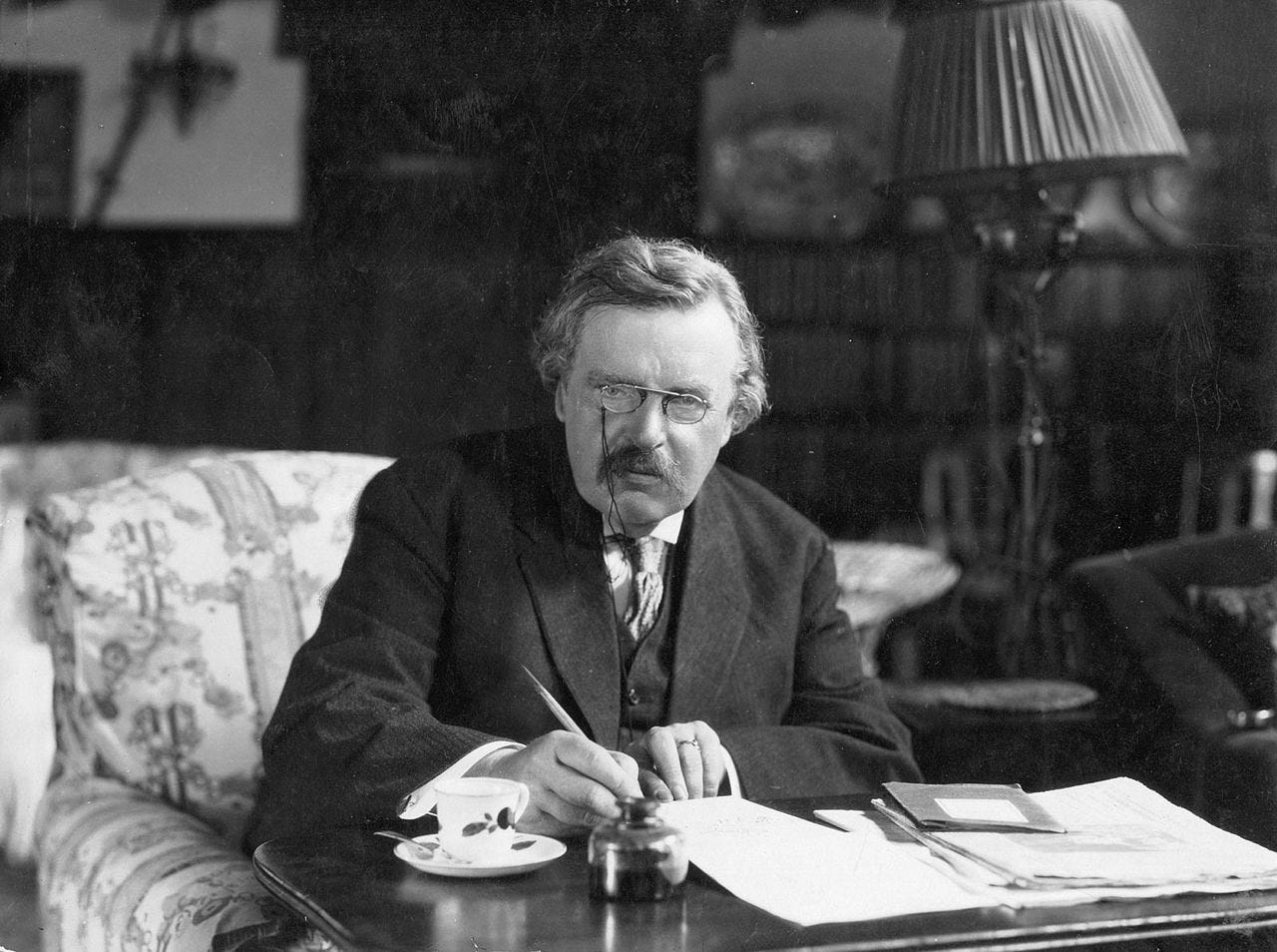
That realization became the turning point of his faith. Chesterton did not return to belief because he solved every doubt. He returned because he rediscovered gratitude. He noticed that existence itself was strange. That anything existed at all was astonishing. Once he saw that clearly, belief no longer felt forced. Christianity, for him, was not about escaping the world. It was about waking up inside it.
Chesterton’s main insight was direct. The modern world, he argued, is not exhausted because life is too demanding. It is exhausted because life feels flat. We explain everything away. We reduce mystery to systems and usefulness. We treat the world like something we are owed instead of something we’ve received. Chesterton believed Christianity survives because it refuses to flatten reality. It keeps the world strange, alive, and worth thanking God for.
This is the gift Chesterton offers. Wonder as a habit. Gratitude as a discipline. He did not mean shallow positivity or forced cheer. He meant learning to receive life instead of assuming it. He believed Christianity holds together things we keep pulling apart. Joy and sorrow. Freedom and obedience. Humility and dignity. He called this holding on to “furious opposites.” The faith works, he thought, because it does not sand down reality. It lets it remain sharp.

I included Chesterton in this series because he speaks to people who would never pick up a theology book. He did not write as a cleric or an academic. He wrote as a man arguing with his own age. He met modern doubt on its own ground and exposed its blind spots with humor, clarity, and common sense. For many readers today, Chesterton is the bridge. He shows that faith is not an escape from reality but a way of seeing it more honestly.
This matters now because we live in an age that numbs itself. We scroll endlessly, know everything instantly, and feel very little. When wonder fades, we grow entitled. When entitlement grows, resentment follows. Chesterton would say boredom is not a lack of stimulation. It is a failure of gratitude. We do not need more novelty. We need recovered attention. The ability to stop and say, this did not have to be here, yet it is.
Wonder doesn’t fade by accident. Chesterton believed it is trained out of us. The reason why may explain much of our modern exhaustion. I explore that idea in the premium section.
