

Leonardo da Vinci Proved That Formal Schooling is Not the Same as Genius
Leonardo da Vinci and the Disciplined Eye That Shaped the World

A boy who had only a basic schooling in Florence grew into a man whose drawings still teach surgeons, painters, and engineers how to see.
Somewhere in Leonardo da Vinci’s notebooks, between sketches, problems, and observations, there are lists of Latin words. That detail catches the whole tension of his life. He knew what he lacked. Renaissance Italy gave enormous prestige to men trained in grammar, rhetoric, Greek, and Latin. Leonardo never received that full humanist formation. He had the ordinary elementary schooling of a well-off Florentine boy, learned arithmetic early, and later had to build much of the rest for himself. Even his defenders admitted that as a boy he had “small Latin and less Greek.” Leonardo himself said he was no man of letters. Yet the man who stood outside the official culture of learning ended up seeing more than many who had mastered it.
Florence was full of polished men. Lawyers, notaries, secretaries, scholars, and courtiers drew authority from language. A man who could quote, gloss, and speak in proper Latin carried social weight before he had proved much else. Leonardo came from a neighboring world. He was the illegitimate son of Ser Piero, a successful notary. He grew up close enough to prestige to feel its force, but not close enough to inherit its full education. He entered the city’s life through drawing rather than grammar. That pushed him toward a different kind of authority, one built from looking, testing, drawing, and returning to the thing itself until it yielded its structure.
Even in childhood he seems to have learned this way. One of the earliest portraits of him says that after only a few months of arithmetic he was already troubling his teacher with doubts and difficulties. That reveals the shape of his mind before the fame. He did not simply absorb lessons; he pushed against them. He wanted to know why a thing worked, not merely how to repeat it. The same account says that although he sampled music and other studies, he never stopped drawing and modeling in relief, because those were the things that held him most strongly. In other words, the young Leonardo was already moving toward the disciplines where the eye and hand answer directly to reality.
His father saw that early and brought some of the boy’s drawings to Andrea del Verrocchio. That decision gave Leonardo the education that mattered most. Verrocchio’s workshop was not a poor substitute for school. It was a hard school of another kind. There a boy learned to draw from nature, model in clay, understand perspective, think through architecture, prepare surfaces, and solve visual problems through repeated labor.
Leonardo entered that workshop with unusual willingness and quickly moved beyond one branch of art. He worked in sculpture, architecture, engineering sketches, and studies from nature. He made clay models draped with linen dipped in clay and then drew them with patient exactness. He practiced the kind of attention that turns talent into judgment.
Leonardo’s greatness came from submitting himself to a discipline different from the one his age admired most. Humanist schooling trained memory, style, citation, and verbal command. Workshop training demanded accuracy, patience, proportion, and fidelity to what was in front of you. Leonardo took that second training and drove it further than almost anyone else. While other men built intellectual status through texts, he built it through exact encounter with form, movement, weight, shadow, water, bone, and flesh.
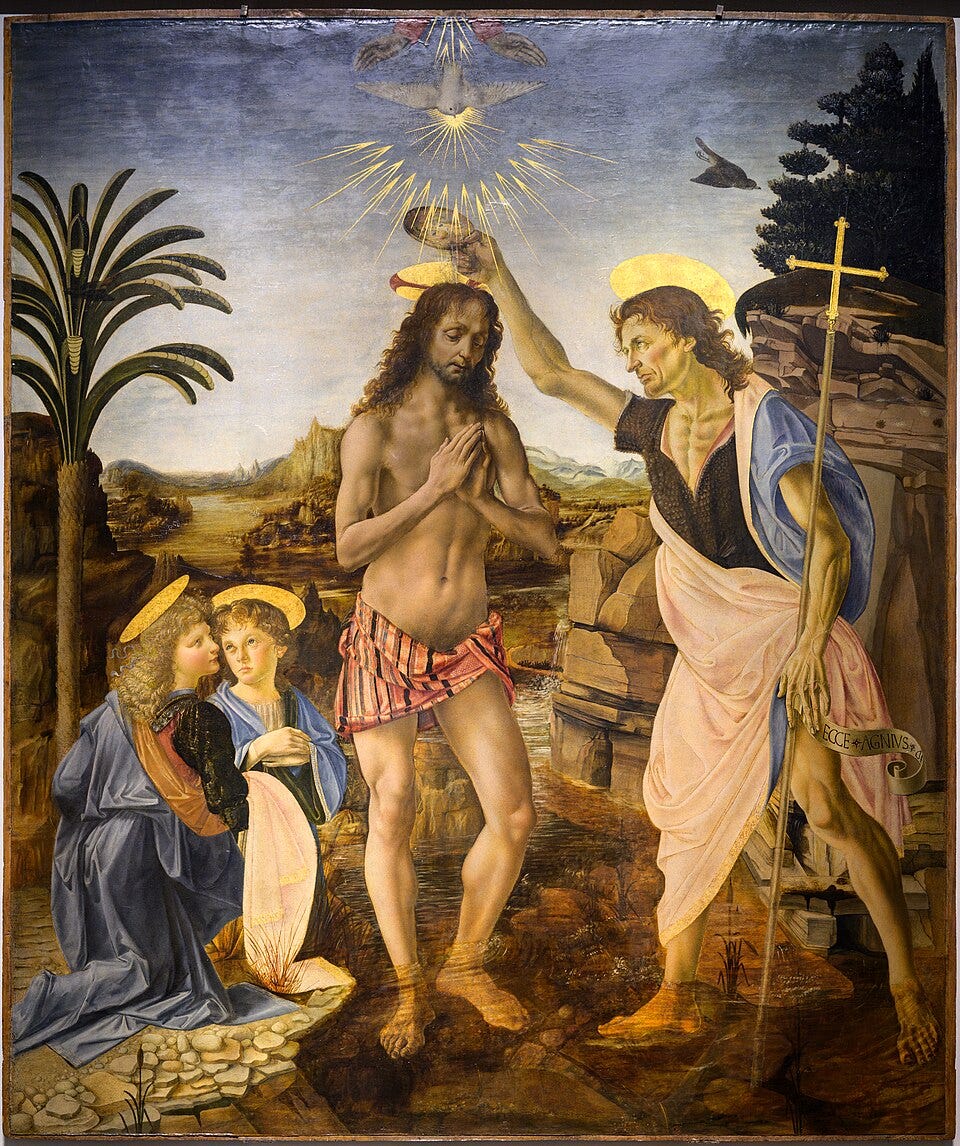
His early work already shows what that meant. In the workshop of Verrocchio, he helped on the Baptism of Christ. The famous story says the young Leonardo painted an angel so well that Verrocchio was humiliated. The anecdote may be embroidered, but the broader point stands. From the beginning, Leonardo’s eye moved toward softness of flesh, subtleties of light, and a livelier sense of presence.
Another early work described in old accounts, a cartoon of Adam and Eve prepared for a hanging to be woven in Flanders, gives an even better clue. It lingered over a meadow full of varied grasses, a fig tree with carefully foreshortened leaves, animals, and the radiating crown of a palm. Viewers marveled at the diligence and truth to nature. This is the work of someone studying how the world actually appears.
The rest of this essay beyond the paywall follows Leonardo from the workshop into the notebook, the dissecting room, and the great paintings that changed how Europe saw the world.
