

No Society Is Stronger Than the Character of Its People
Article 2 of the Ramadan Blueprint Series - Al-Farabi

Article 2 of the Ramadan Blueprint turns to Al-Farabi and a simple but an eye-opening lesson: no society is stronger than the character of its people. Before we reform institutions, we must build order within ourselves. Civilization begins inside the human being.
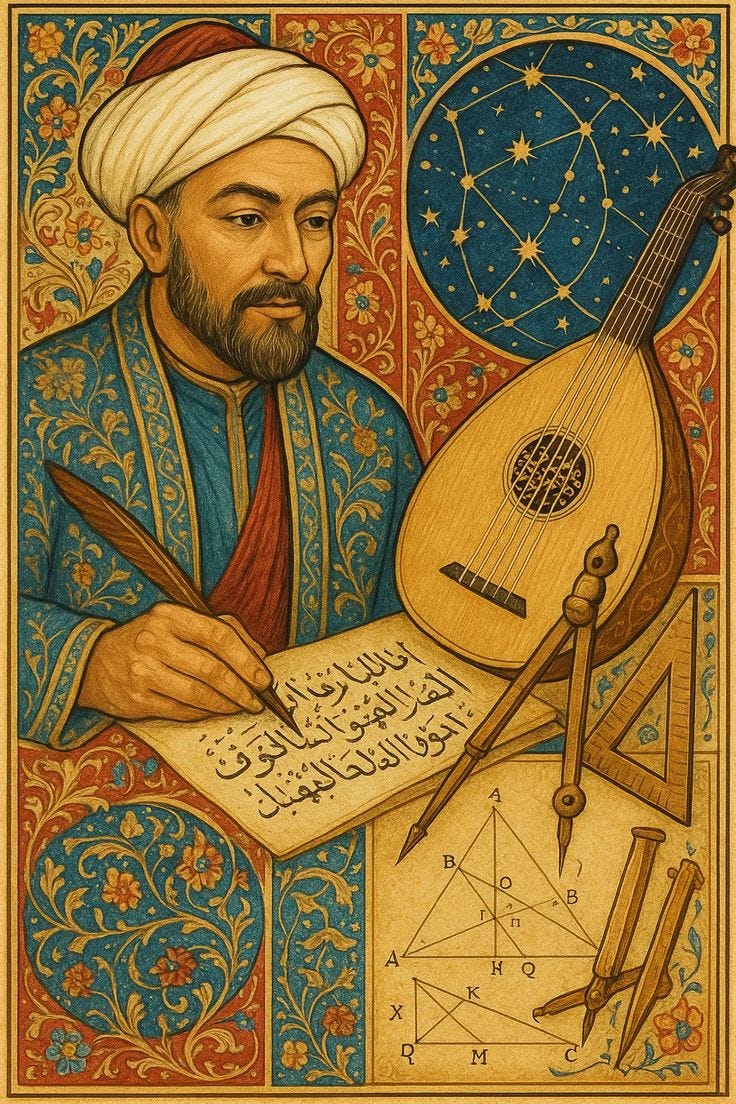
In a modest study circle in Baghdad, a scholar from Khurasan (now Central Asia) sits surrounded by manuscripts of Aristotle and Plato. Al-Farabi (Alpharabius in the Latin West) had traveled for years in search of knowledge, studied logic under Syriac Christian scholars, mastered music, wrote on metaphysics, and absorbed Greek philosophy. Yet something unsettled him. The Greeks explained politics, categories, and ethics. But they do not answer the deepest question: Why does anything exist at all? They did not show how revelation and reason could live together. That tension would define his life’s work. Later generations would call him “The Second Teacher.”
Most philosophers before him focused on what things are. A tree is wood and leaves. A ruler is someone with authority. A city is a collection of people. Al-Farabi asked something more basic. Before we ask what something is, shouldn’t we ask why it exists in the first place? What does it mean for something to be real?
To make this easier, think of a chair. You can describe its shape, its material, its color. That is what it is. But Al-Farabi wants to ask: why does this chair exist at all instead of nothing? Existence itself becomes the mystery. For him, existence is not just another object you can examine. It is the foundation behind everything.
He believed reality has structure. It is not random. It flows from a First Being, from which everything else unfolds step by step. Imagine light pouring out from a single source. The further it moves, the more it spreads, until it reaches the world we live in. That image shaped how he understood the universe. The world is ordered, layered, connected.
And that same structure should appear in society.
Al-Farabi compares a healthy city to a healthy body. In a healthy body, the heart leads. The hands do not try to replace the heart. The eyes do not compete with the lungs. Each part does its job. When each part works properly, the whole body thrives.
Now imagine a body where every organ tries to dominate. The heart refuses to pump unless it is praised. The brain ignores signals. The lungs decide to work only when they feel like it. The result would be chaotic. For Al-Farabi, many societies look exactly like that.
He believed the best city is one where people cooperate toward a higher goal. Not just wealth, pleasure, or power. The true goal is happiness in the deepest sense. Not the happiness of a good meal or a new purchase. The happiness of becoming better human beings.
