

Plato Exposed the Business Model of Fake Holiness 2400 Years Ago
How sacred books, paid rituals, and borrowed names turned guilt into a business?

People still pay to feel clean.
In some evangelical circles, the language is seed money, breakthrough, covering, and divine favor. Give the right amount, attend the right event, obey the right preacher, and blessing is made to feel almost guaranteed. In parts of Pakistan and South Asia, the pattern can appear around certain pirs and spiritual operators who promise protection, healing, fertility, curse removal, or relief from misfortune through payments, offerings, amulets, and rituals.
The traditions differ. The mechanism is familiar.
A person arrives with fear, guilt, grief, illness, ambition, or desperation. A religious specialist offers access to unseen power. The offer usually comes with sacred language, inherited authority, a famous lineage, or a text that ordinary people are told they cannot fully understand. The result is a transaction: pay, obey, perform the ritual, and the burden will lift.
Plato saw this business model 2,400 years ago.
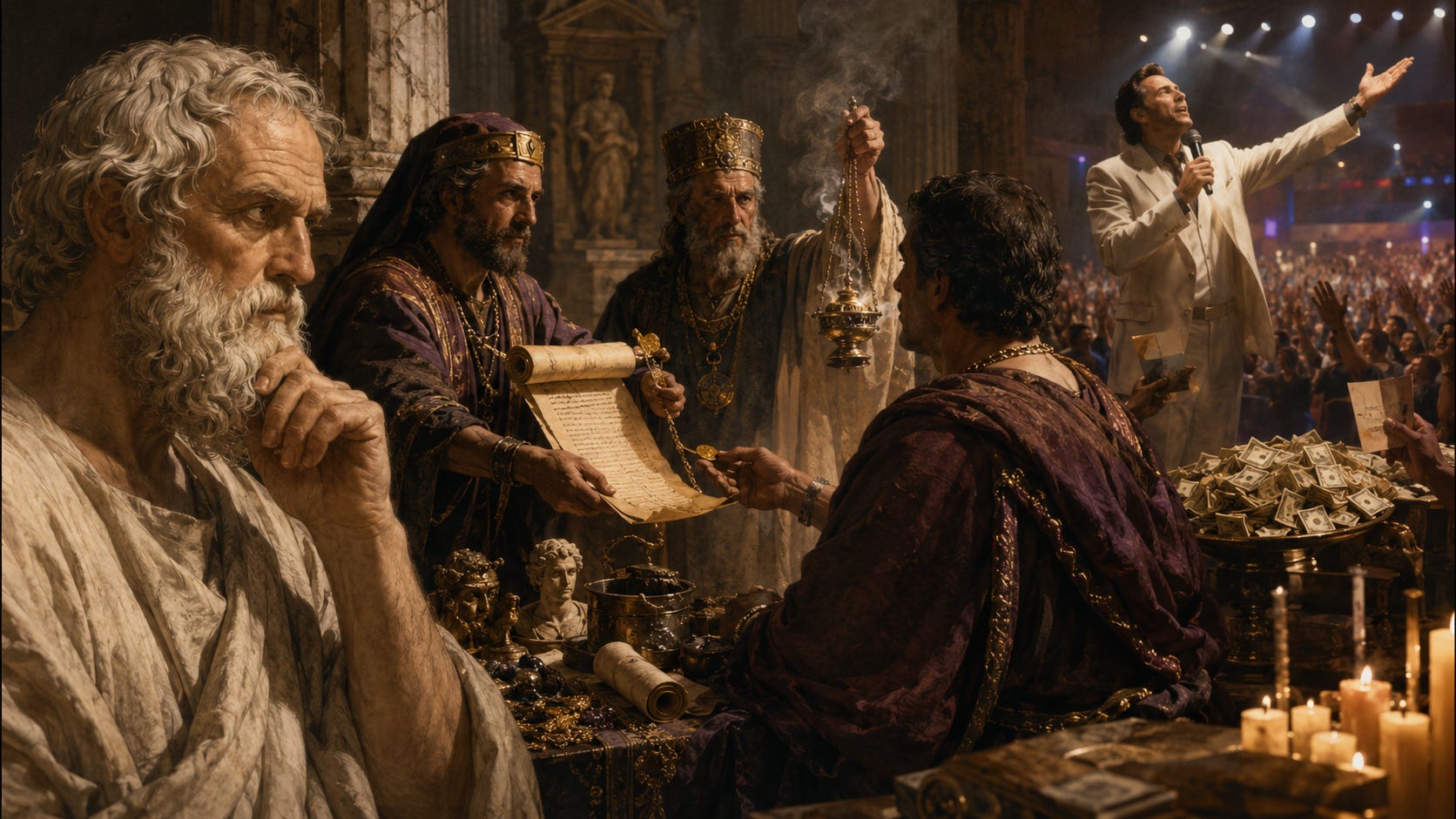
In Book II of the Republic, Plato has Adeimantus describe a recognizable transaction. Religious operators arrive at wealthy households carrying books. They claim these books come from Orpheus and Musaeus, figures tied to the Muses and hidden knowledge. For payment they offer to cleanse a person’s own or their ancestors’ injustice through sacrifices and festivals. They promise protection for the dead in the afterlife. They claim spells that can harm enemies and even bend the gods.
Here is the passage:
“Begging priests and soothsayers go to rich men’s doors and make them believe that they by means of sacrifices and incantations have accumulated a treasure of power from the gods that can expiate and cure with pleasurable festivals any misdeed of a man or his ancestors, and that if a man wishes to harm an enemy, at slight cost he will be enabled to injure just and unjust alike, since they are masters of spells and enchantments that constrain the gods to serve their end. And they produce a bushel of books of Musaeus and Orpheus, the offspring of the Moon and of the Muses, as they affirm, and these books they use in their ritual, and make not only ordinary men but states believe that there really are remissions of sins and purifications for deeds of injustice, by means of sacrifice and pleasant sport for the living, and that there are also special rites for the defunct, which they call functions, that deliver us from evils in that other world, while terrible things await those who have neglected to sacrifice.”
The detail that matters most is not the superstition. It is the business model. These men do not preach publicly to everyone. They go where the money is. They sell a service. Moral accounting outsourced to ritual and text. The client keeps the habits and desires that produced the injustice. The priest clears the record.
Authority Built on Borrowed Names
Priests do not rely primarily on personal presence or civic standing. They carry books attributed to Orpheus and Musaeus. In Greek tradition, Orpheus was imagined as a singer whose voice could move animals, trees, and the powers of the underworld. His authority came from song and proximity to the divine. When that authority moved into writing, it became portable and commercial.
A written text could carry the aura of the ancient singer. A priest could hold up the roll and claim it was not his invention. The voice of Orpheus had become a product that could be transported, interpreted, and sold.
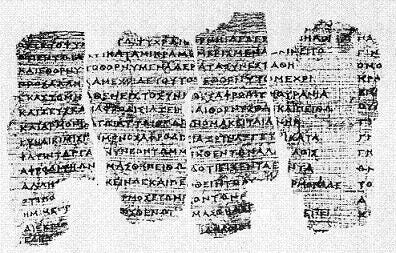
One surviving example shows how this worked in practice. The Derveni Papyrus, a fourth-century BC text discovered in a Macedonian tomb, is a commentary on an Orphic poem about the origin of the cosmos. The commentator treats the poem as enigmatic. He does not simply read it aloud. He explains what it really means through allegorical and philosophical interpretation. The text is presented as containing hidden layers that require a specialist to unlock. The customer needs the book, the ritual, and the interpreter who stands between the text and its meaning.
This is how manufactured authority scales. Attribution to a famous name creates initial credibility. The claim that the material is difficult or symbolic creates dependence on the specialist. The ritual gives the client a feeling of action. The fee turns the whole arrangement into a source of revenue. Plato registers exactly this structure in the Republic.
What Plato Actually Means by Justice
Adeimantus raises the example while challenging Socrates on why anyone should value justice for its own sake. Most people, he says, praise justice because of its external rewards: reputation, honor, safety, and divine favor. Injustice looks easier and more profitable, provided a person can hide it or buy ritual relief from its consequences.
Plato goes beyond conventional piety. He treats justice as the inner order of the soul, not a ritual record managed by priests. In a just person, the parts of the soul — reason, spirit, and appetite — stand in the right relation to one another. Reason rules with wisdom. Spirit supports reason with courage. Appetite obeys. When this internal order exists, the person does not need external rituals to reset a moral ledger because the soul is already arranged correctly.
The priests in the passage sell the opposite model. They treat the soul as something that can remain disordered while the external record is cleared. A person can keep greed, cruelty, or ambition and still purchase the appearance of purity. The ritual addresses symptoms without touching the underlying condition. This is why Plato presents their offer as corrosive. It preserves the profitability of injustice while removing the appearance of risk.
No book or ceremony can substitute for that internal ordering. Character is not a transaction.
The Pattern That Persists
The same pattern appears whenever someone sells authority as a shortcut. They claim their teaching comes from an ancient source, hidden knowledge, or a special revelation. Then they offer it to people who feel afraid, guilty, ambitious, or desperate for control.
The words change from age to age, but the method stays the same. The buyer is told that the right ritual, course, donation, or practice can solve the problem without demanding real change. The offer feels too sacred, too ancient, or too powerful to question. That is how authority becomes a product.
You can see the same pattern in some modern online programs. They promise to release “ancestral trauma,” unlock “divine codes,” or activate hidden powers for abundance and protection. The buyer pays for a course, ritual, or sequence of steps that claims to clear old wounds or open a higher level of life.
The promise is simple: follow the method, trust the specialist, and the change will happen. But the deeper problem is avoided. Instead of asking the person to face their habits, desires, wounds, and moral choices, the program offers a shortcut. The hard work of becoming different is replaced by a paid procedure.
Other versions operate in prosperity-oriented teaching that links financial giving or specific declarations directly to guaranteed material or spiritual returns. The divine becomes something that responds predictably to the right input. Faith or practice becomes a technique. These examples are not identical to one another or to the priests Plato describes. They belong to different cultural and theological worlds. What they share is the offer of external relief or advantage without requiring the transformation of the person who seeks it.
Plato’s point is not that all payment for teaching or ritual is corrupt. Teachers can be compensated. Books can be sold. Rituals can carry real meaning. The corruption begins when the offer bypasses the condition of the soul and sells the appearance of order instead of the reality of it.
The Test That Still Works
Plato gives a practical test that still works. When someone offers spiritual knowledge, ritual, or teaching, ask what actually changes in the person who accepts it.
Genuine authority can survive this kind of scrutiny. It does not depend on secrecy, unverifiable claims, or the prestige of ancient names used as branding. It points beyond itself toward clarity, discipline, and actual change in the person.
Manufactured authority behaves differently. It multiplies credentials and attributions. It turns ancientness or hiddenness into proof that cannot be checked. It uses sacred or elevated language to make examination feel inappropriate.
The priests Plato describes understood their market. Guilty people want cleansing without changing. Ambitious people want advantage without cost. Frightened people want protection without discipline. The priests brought books attributed to famous names and sold each desire in religious form.
Plato is not simply mocking superstition or ritual. He is exposing a recurring human temptation: the desire to replace the difficult work of becoming just with access to the right procedure, the right text, or the right specialist. The robes, vocabulary, and delivery systems change. The books become courses, private transmissions, or premium programs. The old promise returns in new packaging.
You can be declared clean without becoming different.
Plato’s answer remains the same. When people lose the will to order their own souls, they begin looking for someone who will perform the ordering for them at a price. The test is whether the offer strengthens the capacity for self-examination and honest living, or whether it simply manages the symptoms while leaving the underlying condition untouched. That distinction still separates authority worth following from authority that is for sale.
The mission of Culture Explorer is to defend beauty, tradition, and civilizational memory in an age that forgets all three. Our publication exists to show that great art, architecture, religion, history, and inherited standards are part of what makes human life meaningful, serious, and worth preserving. At its core, the publication argues that beauty is not a luxury, tradition is not nostalgia, and civilizations survive when they remember what made them worth building in the first place.
The fastest way to destroy a civilization isn’t war. It’s teaching people to accept ugliness.
We’re standing at a cultural crossroads. One path keeps lowering standards until nothing demands effort, attention, or meaning. The other asks us to recover something we’ve quietly abandoned. You can see it everywhere.
Cities like London and Dubai filled with identical glass towers. Streets that could belong to any country and end up belonging to none. Brands flattening themselves into generic logos that carry no memory. Art that grabs attention for a moment, then leaves nothing behind.
We produce more than ever and almost none of it lasts.
Our publication exists to push back against that drift.
Architecture that was built to lift the eye. Paintings that carried beauty and meaning not just style. Traditions that formed people, not just entertained them. We’ve been told beauty is subjective, optional, even irrelevant. But the past says otherwise.
Civilizations that cared about beauty, built things that still command respect centuries later. Civilizations that stopped caring faded into oblivion.
That’s the line we’re exploring here. Through essays, visual threads, and now two eBooks, I’m researching and documenting what made cultures endure and what caused them to decay.
If you want to support this work, a paid subscription makes it possible to go deeper and publish more consistently.
Paid members get:
– Full access to premium essays and longform breakdowns
– Early access to new ebooks and future releases
– Deeper analysis on art, architecture, and civilizational themes
– Direct connection to ongoing research and ideas behind the content
This publication is about recovering standards that shape people, and through them, shape the future. If that matters to you, you’re in the right place.

Please try to read this
https://substack.com/@1234881826/note/c-274462512?r=8kg6wq