

Super Bowl LX and the Myth America Still Believes In

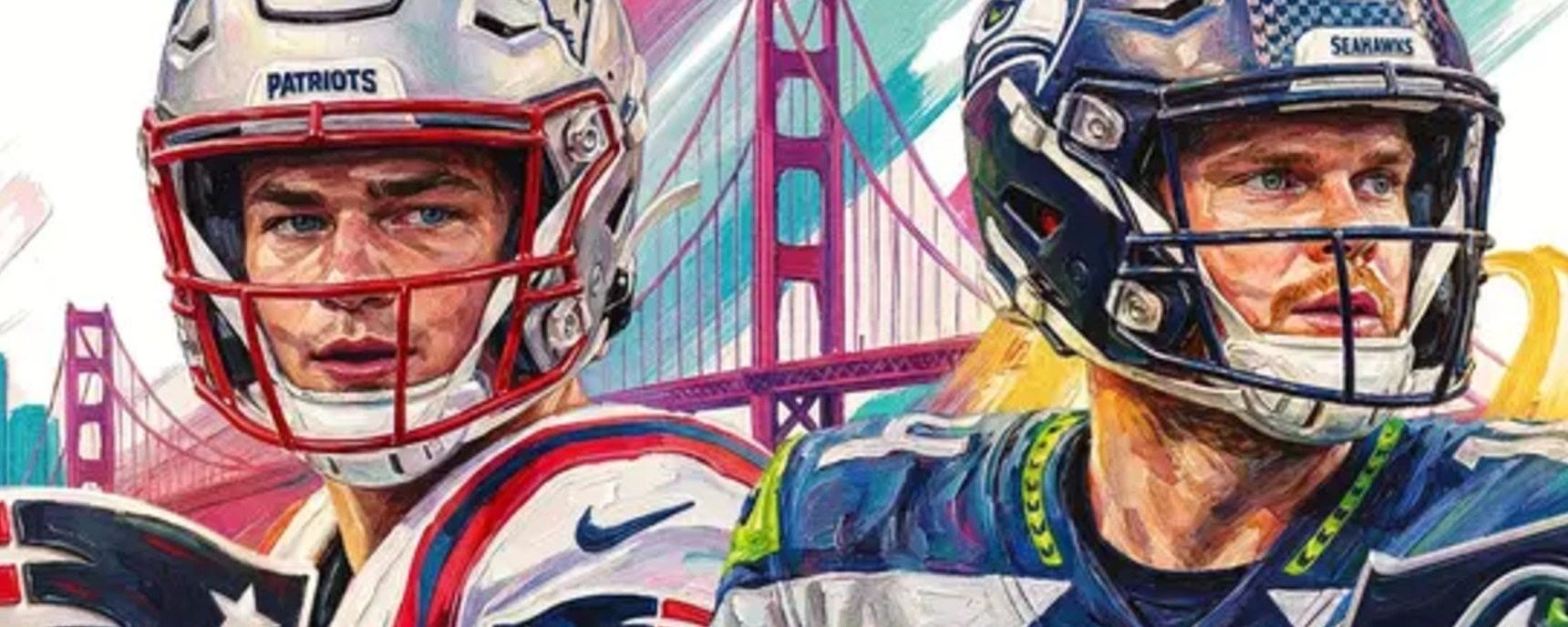
I still remember watching the Super Bowl in a Boston suburb in February 2005. I had just moved to the city in December 2004, still adjusting to the cold, the accent, and the strange intensity of a place that treated sports like a civic religion. That night the Patriots were playing the Philadelphia Eagles. I wasn’t even a serious football fan yet, but I could feel something in the air that went beyond entertainment. The room wasn’t loud in a casual way. It was tense, almost sacred. Every play felt like it carried weight, not only for the team, but for the people watching. When the Patriots won 24–21, it was their 3rd ever Super Bowl and third in the last four years. It was also their first back-to-back Super Bowl win. It felt like the city exhaled. As if something invisible had been settled.
That night I realized what I had witnessed wasn’t simply fandom. It was ritual. And somehow, without planning it, I’ve returned to it every year since, like millions of others, drawn back to the same strange national ceremony.
And Super Bowl LX, arriving on Sunday, February 8, 2026, makes that reality clearer than ever. The Seattle Seahawks and New England Patriots will meet again, this time at Levi’s Stadium in Santa Clara, California, in a rematch of their legendary 2015 showdown. But the football game, as always, is only part of the story. The Super Bowl has become something far larger than a championship. It has become one of America’s most important cultural events, a yearly national ceremony that reveals what the country values, what it fears, and what it is becoming.
This year’s Super Bowl feels especially revealing because it sits at the crossroads of sports, politics, identity, and entertainment in a way that would have seemed unthinkable decades ago. It has the familiar ingredients: two teams with dramatic arcs, a major broadcast spectacle, record-breaking advertising, and the kind of storylines that can dominate national conversation for weeks. But it also has something else: a halftime show performer whose selection has ignited political backlash, cultural anxiety, and a level of public debate that is almost unprecedented.
It is tempting to treat that controversy as noise. But it isn’t. It is the main signal. It reveals what the Super Bowl has quietly become: not just America’s biggest game, but America’s biggest mirror.
If you want to understand why the Super Bowl dominates America the way it does, you have to treat it as a modern myth, one that reflects and reinforces the values of American society. The Super Bowl is not simply a football game watched by millions. It is a ritualized mass activity that merges electronic media, commercial power, and spectator sport into something that resembles ancient communal spectacle.
That is why the Super Bowl is dominant. It does not compete with other events so much as swallow them. The actual football action shown live is tiny compared to the total broadcast time. The rest is commentary, pregame buildup, halftime entertainment, and advertising. The game is framed as the center of the world, but the broadcast is really an orchestrated cultural performance.
The NFL now stages Super Bowl week like a festival. There are corporate experiences, celebrity events, carefully branded media coverage, and an advertising economy that dwarfs almost every other broadcast event. NBC’s “Legendary February” marketing campaign, bundling the Super Bowl with the Winter Olympics and the NBA All-Star Game, is a statement of cultural hierarchy. These are the moments where attention is harvested at national scale, and attention is the most valuable currency in the modern world.
Yet the reason people watch the Super Bowl has never been reducible to football. Many watched simply because it was “the big game.” Some watched because others would be watching. Even then, the Super Bowl functioned as a communal gathering point, a cultural checkpoint that gave people something to share. The important point is not whether viewers love football. It is that the Super Bowl has become a ritual that makes millions of people feel temporarily synchronized.
This is why the Super Bowl still matters even in an America that often feels fractured. Modern society has fewer shared experiences that cut across class, race, ideology, and religion. Politics divides. culture divides. Even entertainment has fragmented into niche streaming worlds. But the Super Bowl remains one of the last national moments where the country still gathers around a single screen. A mythic spectacle creates collective participation. It gives people a shared symbolic space, even if only for a few hours.
Super Bowl LX also brings a specific mythic appeal because the matchup itself carries narrative gravity. Seahawks versus Patriots is memory. Their Super Bowl XLIX meeting in 2015 ended in one of the most famous plays in NFL history: Malcolm Butler’s goal-line interception, the moment that froze Seattle and crowned New England once again. Now the franchises return to the same stage, with entirely new rosters, but the same symbolic tension.
The Seahawks arrive as favorites after a dramatic turnaround under head coach Mike Macdonald and quarterback Sam Darnold, a player whose career has been defined by near-collapse and unexpected revival. The Patriots arrive as an improbable wild card story led by rookie quarterback Drake Maye and first-year head coach Mike Vrabel, carrying the narrative of the underdog that refuses to die.
This matchup can be described as mythic. Myths are not merely stories people enjoy. They are stories that create archetypes: the fallen man who returns, the empire fighting to remain an empire, the challenger seeking revenge, the underdog chasing legitimacy. The Super Bowl thrives because it produces these archetypes in real time, and the public consumes them not as fiction but as lived drama.
But the defining cultural storyline of Super Bowl LX is not the rematch. It is the halftime show.
Bad Bunny headlining the halftime performance just days after winning Album of the Year at the 2026 Grammys has created a level of pre-game cultural debate rarely seen in Super Bowl history. The NFL’s decision is clearly strategic: a deliberate effort to expand its Latino audience and global appeal.
Yet the backlash has been equally deliberate. Conservative critics have framed Bad Bunny’s Spanish-language dominance and his previous political statements as a provocation rather than an artistic choice. That reaction is revealing. It shows that for many Americans, the Super Bowl is not just entertainment, but symbolic ownership. Whoever stands at the center of that stage is perceived as representing the nation itself.
The Super Bowl does not simply entertain. It sacralizes dominant cultural tendencies and reinforces social structure. The halftime show, the anthem, the commercial breaks, the heroic narratives, and the pageantry are all part of the same machine. They shape what feels “normal” and what feels “American.”
In that light, the Bad Bunny controversy is not really about music. It is about demographic reality colliding with cultural identity. The Latino presence in the United States is not a future trend, it is a present fact. But facts do not automatically become symbols. Symbols have to be placed into sacred spaces. That is what the halftime show is. It is one of the most sacred cultural stages America has left. And the anger surrounding it suggests that some Americans experience this cultural shift not as enrichment but as displacement.
Even the decision to highlight ICE presence at the event adds to the surreal symbolism. A stadium meant to embody celebration and unity becomes shadowed by the language of enforcement and political theater. The Super Bowl, which once served primarily as escape, now absorbs the tensions people were trying to escape from. In a sense, it has become too large to remain neutral. It is no longer simply a festival. It is a national mirror.
Yet if the halftime show reveals cultural identity struggles, the commercials reveal something even deeper: what America worships most consistently.
The Super Bowl is an economic engine, a ritual that moves goods. Even in the 1970s, advertising was central to the event, with dozens of commercials shaping the rhythm of the broadcast. The Super Bowl was not merely sponsored by corporations. It was structured around corporate consumption.
That reality is even more extreme today. NBC charging roughly $7 million for a 30-second ad slot is not an accident. It is the price of access to the one moment when the public cannot look away. The Super Bowl is one of the only broadcasts where people watch advertisements voluntarily, discuss them afterward, and treat them as entertainment. In older civilizations, festivals ended with offerings to gods. In modern America, the offering is attention, and the gods are brands.
The Super Bowl is not only entertainment, but a reinforcement of a particular worldview: aggressive competition, technological organization, strict regulation, corporate hierarchy, and commercial reward. Football is an aggressive, regulated team contest fought between males, using violence and technology to gain control of territory for economic gain inside a nationalistic entertainment framework.
That may sound harsh, but it is difficult to argue with. Football is conquest structured into rules. It is territorial war compressed into a field. It is time controlled by a clock rather than nature. It is teamwork shaped by hierarchy. It is physical sacrifice performed for institutional reward. And the Super Bowl is the highest stage where these values are celebrated as national identity.
This is why the Super Bowl remains so emotionally magnetic. It offers a rare experience in modern life: the feeling that something is bigger than you. In an age where people feel atomized, lonely, and overwhelmed by endless private screens, the Super Bowl creates a temporary shared world. Even people who claim to hate it still know its power. They still talk about it. They still measure culture by what happens there. That is exactly what myth does. It becomes unavoidable.
Super Bowl LX may be remembered for the Seahawks and Patriots rematch. It may be remembered for whether Sam Darnold completes his redemption story or Drake Maye becomes the face of a new Patriots dynasty. But culturally, the deeper meaning will likely be Bad Bunny’s presence and the public reaction to it, because it exposes a truth America is struggling to face: the country is changing, and the rituals that once unified it are now contested ground.
Super Bowl LX may be remembered for the Seahawks and Patriots rematch. It may be remembered for whether Sam Darnold completes his redemption story or Drake Maye becomes the face of a new Patriots era. But culturally, the deeper meaning will likely sit elsewhere, in the halftime stage and the reaction to it, because it reveals the quiet tension underneath modern America: a country still hungry for unity, but unsure what kind of identity can hold it together.
The Super Bowl began as a championship game. It has become something closer to a national ceremony. It is one of the last moments when millions of people stop at the same time, look in the same direction, and participate in the same story. That is why it still feels powerful even to people who claim they don’t care about football.
And that may be the most revealing part of all.
In an age where shared meaning is disappearing, America still finds a way to gather. Not in churches. Not in civic halls. Not around a common moral vision. But around a stadium, a screen, a corporate spectacle, and a game built on conquest, strategy, sacrifice, and entertainment.
For better or worse, the Super Bowl is no longer just a game.
It is one of the clearest mirrors America still has.
Professional sports in general and the NFL in particular were ruined for me in 2020. Before that, loved it, especially when the Patriots were in the Super Bowl and the Red Sox were in the World Series. Then, it just became another way to express your politics and, as a police officer, let me know my worldview was all wrong. Now, I’ll go watch the game at my brother’s because it will be time together, sharing an experience. But, I will the watching something else when the halftime show comes on. I can only take so much shoved in my face.
Interesting to see it framed as more of a cultural moment than merely a game of football. Good analysis! As a non-fan of the Super Bowl or any football, I wouldn’t have thought to see it this way.