

The Father Who Was Gone for Twenty Years
The Odyssey turns absence into the first crisis of civilization.

The first crisis in The Odyssey is a father’s twenty-year absence. Homer opens the poem in Ithaca, where Odysseus’ absence has become a public emergency. The war has ended. Troy has fallen. The other men have either returned, died, or had their fates reported. Odysseus remains missing, and the damage has reached the house, the marriage, the son, and the kingdom.
Homer delays Odysseus’ entrance for four books because he wants us to feel what absence does before we see the absent man. The poem begins roughly ten years after the fall of Troy, and the first four books belong mainly to Telemachus. The father’s story waits because the son’s crisis has already begun.
Penelope lives in a state that has no clean name. She does not know whether she is wife or widow. If Odysseus lives, her duty is to preserve the house for him. If he has died, her duty is to remarry and pass the household to Telemachus. Homer gives her no easy moral position. Her loyalty keeps the house alive, but that same loyalty prolongs the crisis.
Telemachus faces the same pressure from another direction. He does not know whether he should guard his father’s kingdom or claim authority as a grown man. He is old enough to act yet still trapped under the shadow of a father whose fate remains unknown. A son can inherit a dead father. Telemachus cannot fully inherit a missing one.
The poem assumes a world where kingship still holds society together. Ithaca has lived without Odysseus for twenty years, and the absence has entered every room of his house.
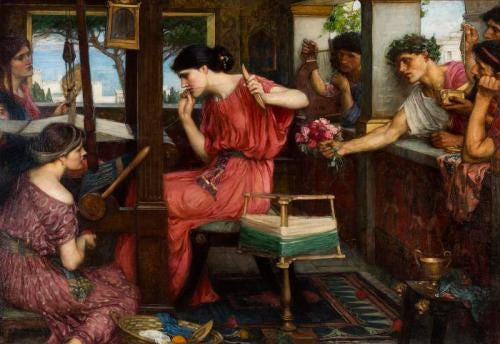
In this backdrop, the suitors begin to matter. They are not simply rude men eating another man’s food. They are men exploiting a broken line of authority. They are courting Penelope, but they are also competing for power. Whoever marries Penelope may gain the throne of Ithaca. Their pursuit of her threatens the marriage of Odysseus, the inheritance of Telemachus, and the political order of the island. Homer makes the household a political site because in Ithaca the king’s house is also the center of public order.
Telemachus has grown up inside that humiliation. He sees men old enough to know better eating at his father’s tables while speaking to him as if he has no authority in his own house. He has the bloodline of Odysseus, but he has not yet learned how to carry the weight of that name. Homer makes this painful because Telemachus knows something is wrong. He feels the insult but lacks the formed courage to answer it. A son raised under an absent father must learn in public what other sons learn at home.
Athena enters because Telemachus needs more than encouragement. She comes disguised as Mentor, and the name already says he needs a guide who can push him into his own inheritance. Her instruction is practical. Call the men of Ithaca, speak against the suitors, and leave home. Visit Pylos and Sparta and ask Nestor and Menelaus what happened after Troy. The son must search for the father, but the search also teaches him how men speak, host, remember, judge, and command.
His first real act is speech. Telemachus calls an assembly and brings the shame of his house before the island. That moment has political meaning. Homer’s world still has chiefs and hereditary authority. Leaders still lead, yet they must speak before others, persuade them, and face opinion. Telemachus’ complaint therefore marks his first step into manhood. He stops suffering the insult privately and names it before Ithaca.
The suitors expose themselves by their contempt. Eurymachus mocks the prophet Halitherses and brushes aside the warning of divine judgment. He treats omens as chatter and Telemachus’ anger as the tantrum of a boy. In that scene, Homer shows a social order losing shame before it loses power. The suitors still know the customs but no longer fear breaking them. A society becomes fragile when its worst men still understand the rules and decide the rules carry no cost.
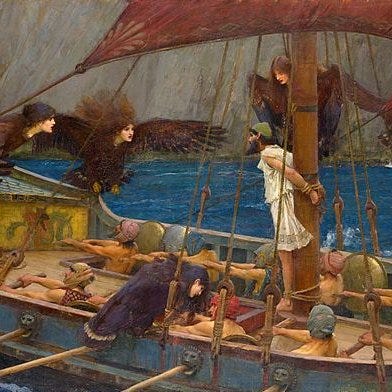
Their great crime is the abuse of xenia, the guest-host bond that allowed the Greek world to function across distance. A stranger was to be fed before he was questioned while the host gave shelter and respect. A guest accepted the gift without draining the house dry. This was not sentimental kindness. It was a sacred social code protected by Zeus Xenios. The suitors receive the privileges of guests while behaving like invaders.
Telemachus’ visits to Nestor and Menelaus makes this point more clearly. At home, he has seen guests destroy a house. In Pylos and Sparta, he sees older men perform the code correctly. Nestor receives him properly, gives him horses, and sends his own son Peisistratus to accompany him. Menelaus hosts him in Sparta and speaks of Odysseus with the respect owed to a great man. Telemachus goes looking for information, but he receives a lesson in order.
The praise of Odysseus wounds Telemachus because it gives him a father in words before he receives him in flesh. Menelaus speaks of Odysseus’ courage and cunning, and the son weeps. That grief has a sharp edge. Telemachus is hearing strangers give shape to the man whose absence has shaped his life. He learns that his father belongs to public memory, to the story of Troy, to the judgment of kings, and to the songs men carry home after war. He has inherited a famous name before inheriting a father.
The story of Agamemnon and Orestes adds pressure to that inheritance. Nestor tells Telemachus how Agamemnon returned from Troy and was murdered by Clytemnestra and Aegisthus. Orestes then avenged his father. Homer repeats this story because it gives Telemachus a dangerous comparison. Orestes knew his father was dead. Telemachus does not know whether Odysseus is dead or alive. Orestes could act against a named killer. Telemachus faces a crowd of suitors who have not yet killed Odysseus but have already begun to take his place.
To keep reading the full essay, become a paid subscriber. The public part of this article shows the visible crisis in Ithaca: a father gone, a son unformed, a wife trapped, and a house under occupation. The rest of the article follows Homer’s deeper argument in the Odyssey that time tests whether a family can still recognize itself after twenty years of waiting.
