

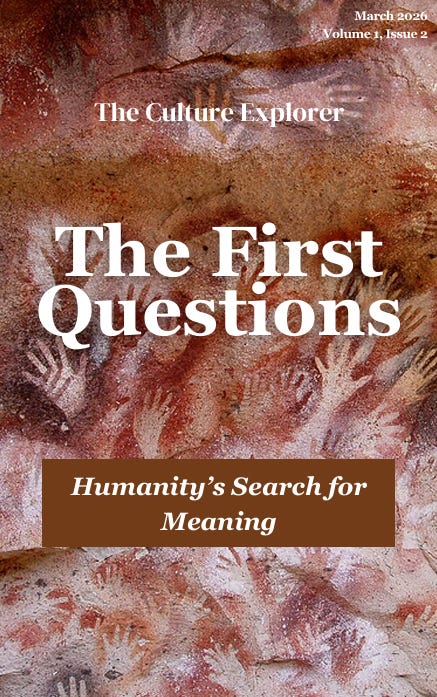
The First Questions
Humanity's Search for Meaning

I just released my latest eBook, The First Questions. It came out of a simple realization that became harder to ignore the more I read across different civilizations. Human beings have always been trying to answer the same questions.
Why does the world exist? Why does it break? Why do we suffer? And beneath all of it, a deeper question that never quite disappears. What are we meant to become?
Across continents and centuries, cultures that never met still returned to these questions. They built myths, laws, rituals, and philosophies as ways to make sense of life. What changes across history is not the question itself, but where people look for the answer. This ebook follows that movement, step by step, showing how each attempt to answer these questions pushed the problem deeper rather than resolving it.
Part 1: Why Does the World Exist?
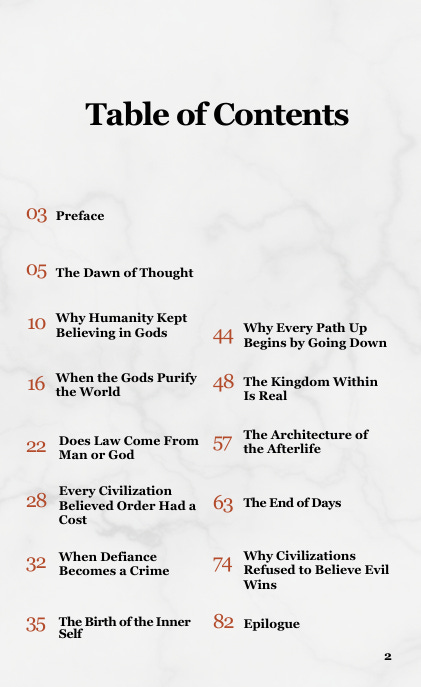
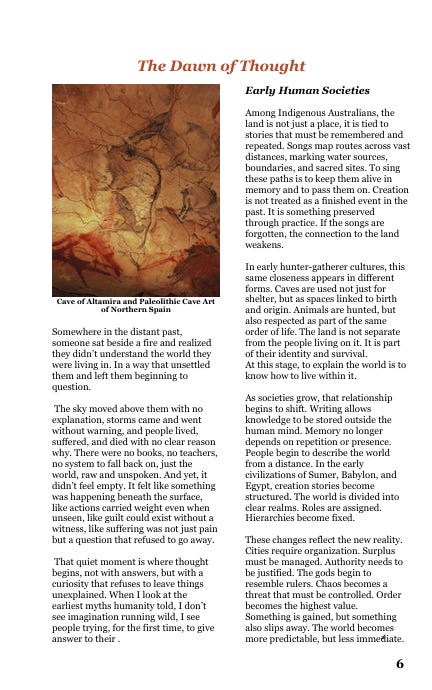
It begins with the earliest stage, when human beings tried to understand the world itself. Storms arrived without warning, death came early, the sky moved with no explanation, and yet despite how unpredictable reality was, it felt like something held it together and something could tear it apart. That tension produced the first myths. Creation stories were attempts to answer a harder question. Why does the world exist? Across civilizations, the same structure appears. Chaos comes first then something imposes order. In Mesopotamia, it happens through conflict. In Genesis, through command. In India, through cycles. In Greece, through human-like struggle. Different stories, same conclusion. The world must be sustained for it to be secure.
Part 2: How Order is Maintained
From there, the problem shifts. If order exists, it has to be maintained. Civilizations begin to ask not just what the world is, but how it can be held together long enough for life to matter. This is where law, sacrifice, and moral obligation enter the story. Law does not appear as a human invention, but as alignment with something higher. From Egypt’s maat to Hammurabi’s code to the covenantal laws of Israel, societies treated justice as rooted in a structure they did not create. Even today, modern systems carry that structure while denying its origin. But this raises a deeper problem. What happens when that order is broken? Every civilization arrives at the same answer. Disorder has a cost. This is where sacrifice appears as a way to absorb the damage caused by human failure. Different forms, same logic. Order must be paid for. This is one of the most uncomfortable truths in the book. Civilizations require constant correction.
Part 3: The Battle Against the Self
But even that is not enough. At a certain point, civilizations stopped looking outward and began to turn inward. Greek myth reflected human psychology as the gods behaved like people. Conflict became internal. Philosophy grew from this shift. The problem is no longer only how to live in the world; it is how to live with oneself.
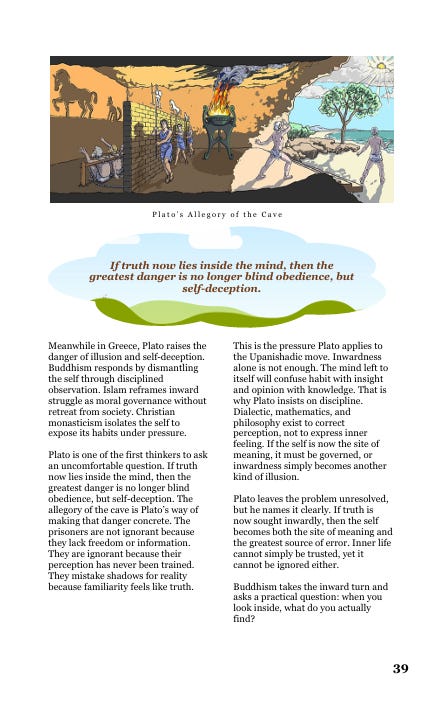
And what people find is not reassuring. The self is divided. It reaches for order but resists it. It knows what is right but fails to act on it. That discovery breaks the idea of simple progress. Transformation can no longer be imagined as a steady ascent. Sometimes, it requires a descent. Across myth, scripture, and ritual, the same pattern appears. Before renewal, there is collapse. Before ascent, there is confrontation. The cave, the wilderness, the underworld. These were locations where real change began. Only by facing what resists order can anything be rebuilt.
Part 4: What Happens When Life Ends
But this creates a final problem that cannot be avoided. If the self carries moral weight, what happens to it when life ends? The question does not stop at death. This is where ideas of the afterlife emerge. Heaven, hell, and rebirth were extensions of the same moral structure already present in life. Justice did not disappear. It continued after death. But even that does not resolve the tension. Because if individuals are judged, what about the world that shaped them?
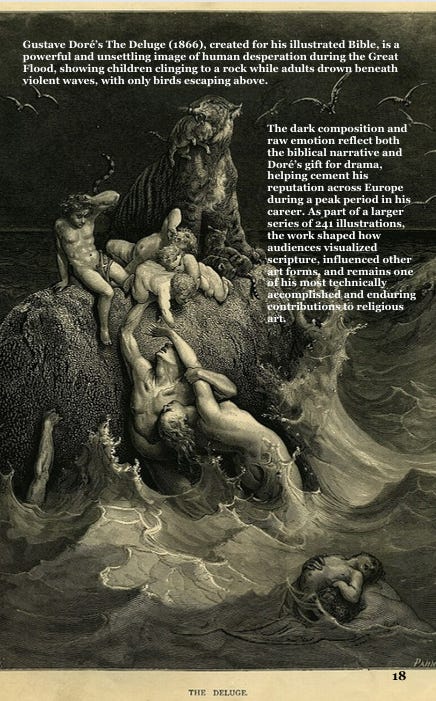
This is where civilizations began to imagine the end of days. Flood myths, Ragnarök, the Yugas, apocalyptic visions. Different traditions, same structure. The world is destroyed and brought to account. These stories are about resolution and some of the most unsettling versions are not cosmic at all. In Beowulf, the world does not end in fire or flood. It ends when a good king dies and no one is left to replace him. No divine intervention. No renewal. Just a civilization that knows it cannot hold itself together. That is the quietest and most disturbing possibility. Collapse comes from within.
What makes The First Questions powerful is that it reveals a pattern. Each stage does not solve the problem. It pushes it deeper. From explaining the world, to holding it together, to confronting the self, to imagining its final judgment. And that pattern has not disappeared. We no longer speak in the language of ancient myths, but we still search for order, argue about justice, struggle with the self, and still fear collapse, even if we describe it differently.
The same questions are still here. Only harder to ignore.
If this way of thinking resonates, don’t stop here.
The full eBook goes deeper into each stage, with examples, connections, and patterns that aren’t in this article. It’s built to be read slowly, to sit with, and to change how you see history, belief, and the self.
As a paid subscriber, you have supported my research and will get access to download your free copy of The First Questions. Download your free copy in the premium section.
View some pages from the eBook…
Keep reading with a 7-day free trial
Subscribe to The Culture Explorer to keep reading this post and get 7 days of free access to the full post archives.