

The Goddess Who Survived the Sea
Why the Nike of Samothrace still unsettles us?

The strangest thing about the Nike of Samothrace is that it feels more alive because it is broken.
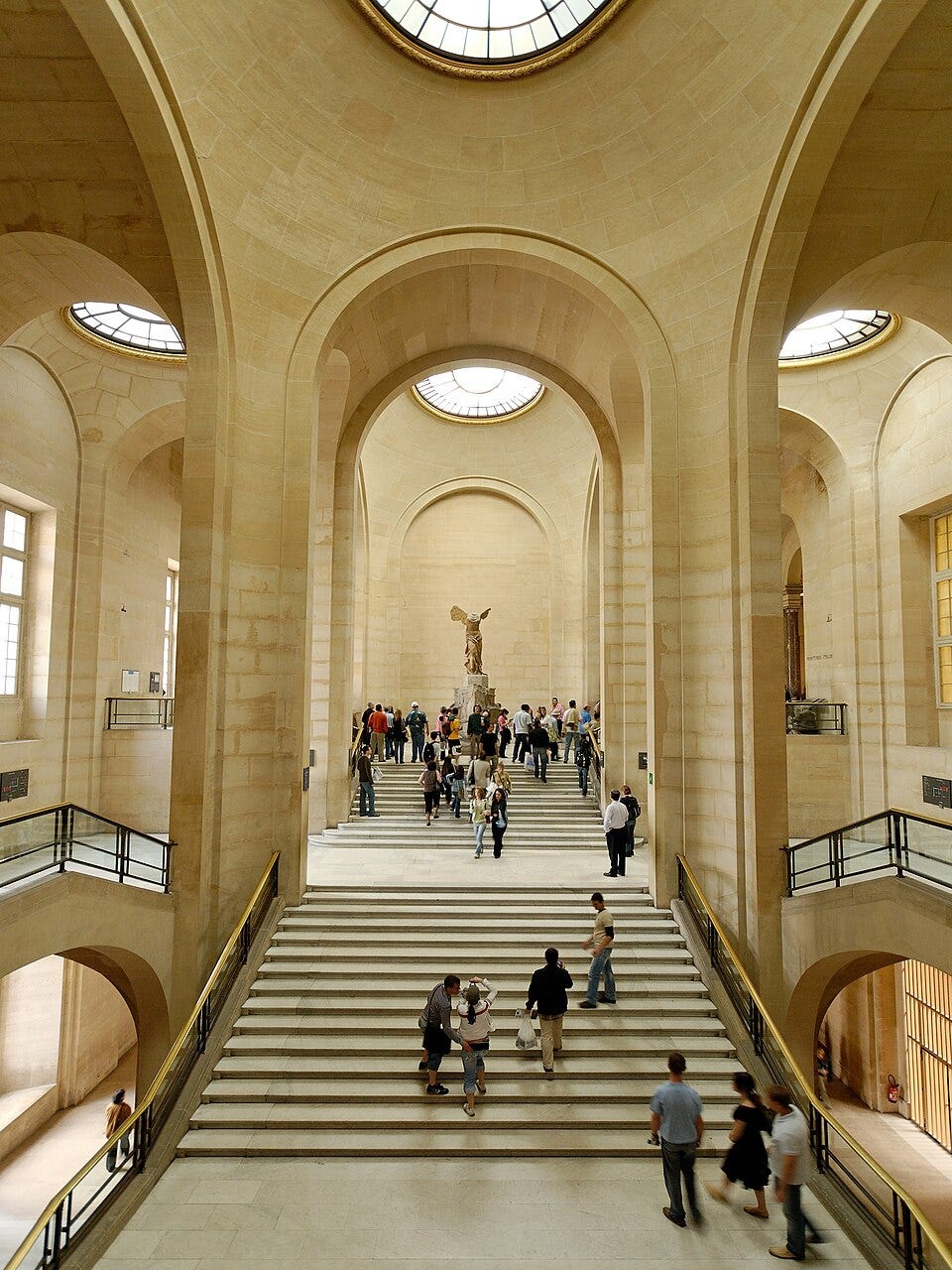
She has no head, no arms, and parts of her wings are gone. Even so, she does not feel ruined. She feels unstoppable. At the top of the Louvre’s Daru staircase, she still seems to have landed only a moment ago, her chest thrust forward, her wings straining behind her, her robes whipped by a wind that never stopped blowing. The marble looks less like stone than cloth pinned to flesh by weather. That is why the sculpture still hits with such force. It does not just stand there; it arrives.
Long before Paris turned her into one of the museum world’s most famous icons, she stood on the island of Samothrace in the northern Aegean, inside the Sanctuary of the Great Gods. That was not an ordinary religious site. It drew pilgrims, sailors, elites, and initiates who came seeking divine favor and, above all, protection at sea. The island itself was a landmark in ancient navigation, dominated by Mount Saos, one of the tallest peaks in the Aegean. Ancient tradition even imagined Poseidon watching the Trojan War from its summit. This was a place where land, weather, fear, and religion pressed hard against each other.
That setting gives the statue its real charge. In the Louvre, the Nike is easy to admire as a masterpiece. On Samothrace, she belonged to a harsher world. People approached by ship. They crossed dangerous water and entered a sanctuary shaped by rites of initiation and old promises of safety. The sea was a threat, a road, a grave, and a test. To understand the statue, you have to put that sea back into the story.
The sculpture itself makes that impossible to ignore. The goddess does not stand on a plain base. She lands on the prow of a ship. That single decision changes the whole meaning of the work. The figure becomes part of an event. She is not posed in calm triumph after danger has passed, she appears in the middle of movement, with the ship driving forward and the wind crashing against her body. Her garments cling tightly across the torso, then burst into thick, violent folds lower down. The whole composition feels unstable in the best way. You sense sea spray even though none is carved.
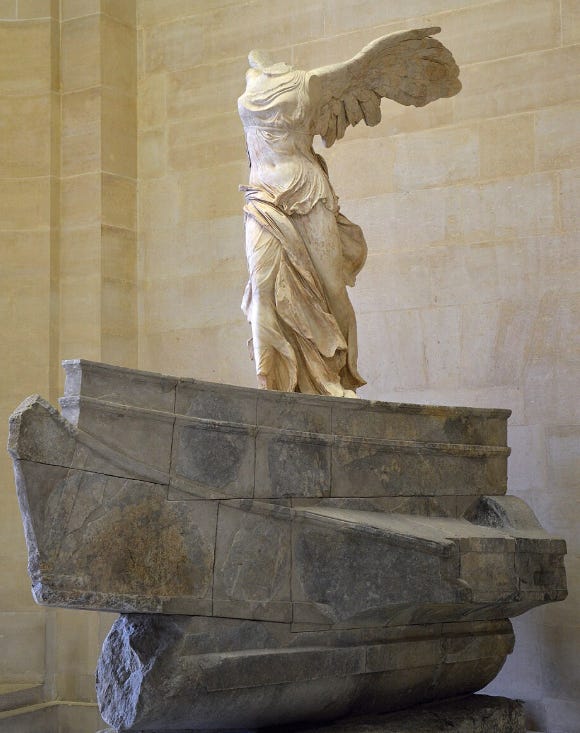
When Charles Champoiseau discovered the statue in fragments in 1863, he immediately knew he had found something extraordinary. Writing about the drapery, he said it was like muslin made of marble, pressed by wind against living flesh. It is still one of the best descriptions ever written about the sculpture because it catches the impossible thing the artist achieved. Many ancient statues are beautiful. Very few make you feel air.
The Nike belongs to the Hellenistic age, when Greek sculptors pushed beyond stillness and balance and aimed instead for movement, drama, and emotional force. Earlier Greek art could be serene, measured, almost self-contained. The Nike of Samothrace wants tension, impact, and the viewer to feel that something has just happened and something else is still unfolding. The body does not settle into a single, neat outline. It surges. That is why the sculpture keeps escaping the calm language usually used for museum objects. It feels charged, almost aggressive in its vitality.
Scholars still debate who commissioned the monument, who sculpted it, and what exact victory it marked. It was made in the second century BCE and is widely understood as a naval victory monument. One major theory ties it to a Rhodian success at sea, which would make sense, since Rhodes was famous in the Hellenistic world for maritime power and sculptural brilliance. The uncertainty matters, but not in the way people often think. It deepens the importance of the statue. We know the kind of world that made it, even if some names remain lost.
Yet Samothrace makes the usual “victory monument” label feel too narrow. The island’s sanctuary was bound to the cult of the Great Gods, whose mysteries promised aid and protection, especially for those who faced danger on the sea. In that setting, victory may have meant more than military conquest. It may also have meant surviving the voyage, escaping shipwreck, and returning alive. Sarah Pruski argues that initiates could have read the statue in exactly that way, as a sign not just of triumph in battle, but of triumph over drowning itself.
In the Greek imagination, drowning carried a special horror. It did not only mean death. It could mean vanishing without burial and without the final acts that placed a person properly among the dead. To be lost at sea was to risk being cut off from memory as well as life. Against that fear stood Samothrace, a sanctuary where people sought help from powers greater than luck, wind, and panic. In that world, a winged goddess descending onto a ship’s prow could speak to the most urgent human hope there is: passage through danger.
This may explain why the statue feels larger than a standard allegory of victory. The body is too exposed, the drapery too violent, the whole composition too weather-struck to read as mere celebration. The danger has not been erased. It remains visible in every fold. The Nike appears inside the storm and masters it. That is what gives the sculpture its emotional weight. It shows triumph, yes, but triumph with risk still clinging to it.
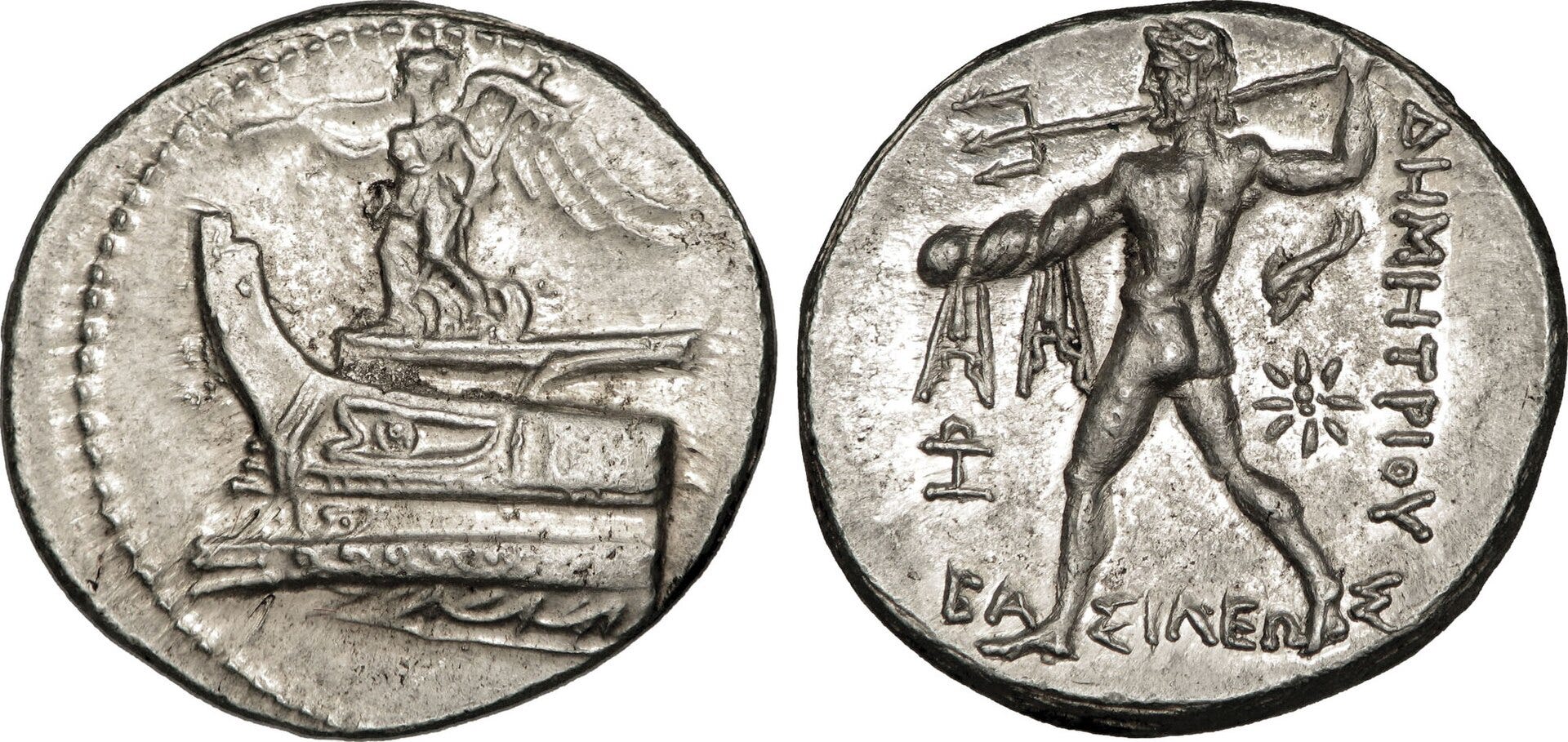
Even the missing parts now serve that deeper effect. A complete head would have fixed the gaze. Intact arms would have settled the gesture. Their loss makes the figure feel more open, more unresolved, more active in the imagination. Some ancient coin evidence suggests she may once have held a trumpet, garland, ribbon, or scepter. Those details would have clarified the action. Their absence does something stranger. It pulls the viewer into the act of completion. You do not simply observe the statue. You finish its motion inwardly.
Modern viewers also miss something else that would have changed the statue’s presence in antiquity. The Nike was not simply white marble. Traces of blue pigment have been found on the wings, reminding us that ancient Greek sculpture was often painted. That matters because it breaks one of the most stubborn myths about classical art. The pure white statue so many people imagine is usually the result of time stripping color away. The sculpture we praise for its clean austerity has already been altered by centuries of loss.
In a strange way, that makes the modern Nike a double survivor. She survived the sea world that gave her meaning, and she survived the long history that shattered and relocated her. She lost her original setting, her color, her head, her arms, and still came out of history with her force intact. That is rare. Many objects need context to live. This one can survive displacement and still dominate the room. Even separated from Samothrace, she carries Samothrace in her body. The wind never left her.
That endurance helps explain why later generations keep returning to the statue. Modern artists have recolored it, reworked it, boxed it, inverted it, and turned it into a symbol in fashion and popular culture. It lends itself to reuse because it already holds several meanings at once. It is beautiful but wounded. It is triumphant but marked by danger. The Nike can stand for glory, survival, empire, resilience, or broken greatness depending on the age looking at it. Very few works of art remain that open without becoming vague.
The real secret of the statue may be that it captures a truth older than any museum. Human beings are moved most deeply not by perfection alone, but by force that survives pressure. The Nike overwhelms us because it still surges forward after damage.
At The Culture Explorer, I write about beauty, tradition, art, and civilizational memory. Paid subscribers get the deeper essays, the stronger arguments, and the kind of detail that changes how you see what the modern world has taught people to overlook.

I must stared at her for 30 minutes when I first saw her in person.
Wonderful essay on this magnificent sculpture. I think it stands out also because of where the Louvre curators have staged it. Standing alone on the stair landing you look up to it as you ascend the steps. To me, this enhances the mystery and beauty of it.