The Madness of Being Too Certain
A lesson from Chesterton on reason, madness, and certainty.

The most dangerous mind may be the one that can explain everything.
That is the unsettling force behind G.K. Chesterton’s chapter “The Maniac” in Orthodoxy. He begins with a small social moment, almost comic in its shape. A prosperous publisher says of a man, “That man will get on; he believes in himself.” It sounds like ordinary advice. We still hear it everywhere: trust yourself, back yourself, believe harder. Chesterton hears something else. He looks up, sees an omnibus marked “Hanwell,” the name of a famous asylum, and turns the slogan inside out. The men who believe in themselves most completely, he says, are often found in lunatic asylums. That is the first shock. Self-belief, when cut off from humility, correction, reality, and moral limits, does not make a man strong. It can make him unreachable.
Chesterton’s point is sharper than a simple attack on confidence. He is not praising timidity. He is attacking the modern idea that certainty proves health. Complete self-confidence can look impressive from the outside. It can speak with force, dismiss doubt, refuse criticism, and treat hesitation as weakness. But Chesterton sees a danger here. A man may believe in himself because he has courage. He may also believe in himself because he has lost the ability to see anything beyond himself. That difference matters. One kind of confidence stands inside reality. The other builds a private kingdom and refuses all visitors.
This is why Chesterton starts the chapter near the madhouse. Older Christian thinkers often began with sin because sin was a fact they thought every honest person could see. Modern people, Chesterton says, have become clever enough to deny sin, explain it away, soften it, or rename it. But they have not yet denied insanity. They may reject hell, but they still recognize Hanwell. So Chesterton shifts the test. Instead of asking which ideas help a man save his soul, he asks which ideas help a man keep his sanity. It is a brilliant move because it forces modern thought to answer on modern ground. If an idea makes the mind smaller, colder, narrower, and more trapped, then perhaps the problem is not faith. Perhaps the problem is the idea.
Then Chesterton springs the trap.
Most people assume imagination is dangerous. They think poets, mystics, dreamers, and visionaries are the ones likely to lose their grip on reality. Chesterton says this gets the matter backward. In his view, imagination often protects sanity because it keeps the world large. It allows wonder, humor, mystery, and surprise to remain alive. The real danger comes from reason when reason becomes sealed off from affection, experience, and common sense. The poet wants to lift his head into the heavens. The pure logician wants to force the heavens into his head. Chesterton’s verdict lands hard: the head splits.
This does not mean Chesterton hates reason. He uses reason with fierce skill. His warning concerns reason cut loose from the rest of the human person. Reason works best when joined to humility, imagination, gratitude, conscience, humor, and love. Once reason becomes the only tool, it starts acting like a tyrant. It does not ask whether its explanation leaves room for ordinary life. It only asks whether the explanation fits its own system. That is where the mind begins to narrow. It can still argue. It can still define terms and even win debates. But winning the debate may be the very sign that something has gone wrong.
Chesterton then gives the chapter its most famous sentence:
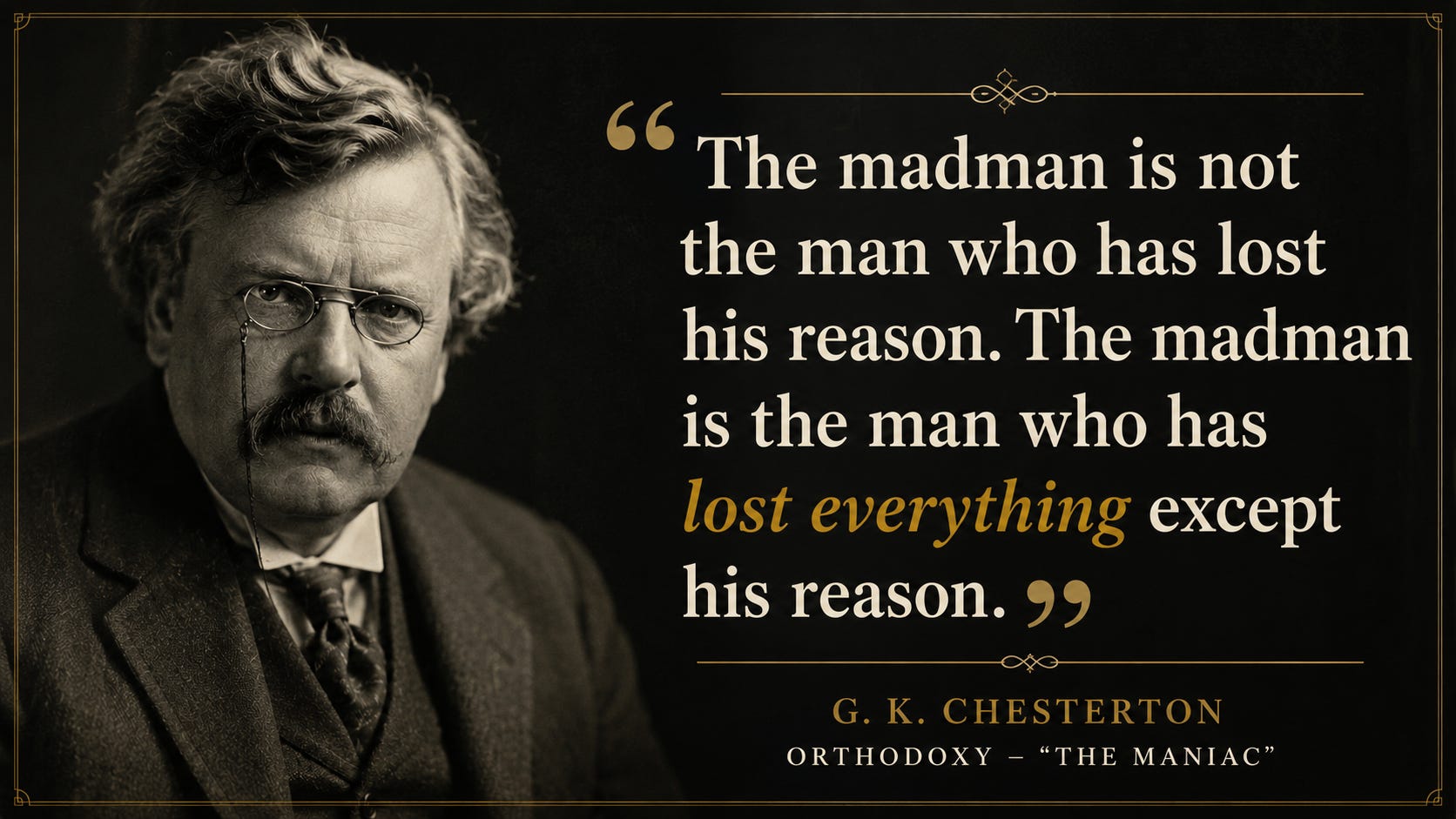
“The madman is not the man who has lost his reason. The madman is the man who has lost everything except his reason.”
That line survives because it names something people recognize before they can explain it. The madman, in Chesterton’s argument, does not lack logic. He may have too much of it, or rather too little of anything else. His theory explains every detail. If he believes everyone is conspiring against him, every denial becomes proof of the conspiracy. If he believes he is the rightful king, every rejection by the authorities proves that the authorities fear him. If he believes he is Christ, the world’s denial of him appears to confirm the pattern. His argument may be hard to disprove because it has already trapped every objection inside itself. That is the horror. The prison has windows painted on the walls.
Madness can feel complete because it has an answer for everything. That is what makes it dangerous. A narrow mind can explain many details and still miss reality. It can collect facts and still fail to see people. It can create a perfect theory and then turn that theory into a prison.
A sane mind leaves room for limits. It knows it may be wrong. It knows life is larger than any single explanation. Other people are more than our theories about them. A mother, a lover, a soldier, a beggar, a saint, and a child each carry a life that no formula can fully explain.
That is Chesterton’s warning. Sanity keeps us in contact with real life. Madness takes one idea and forces all of life to fit inside it.
Become a paid subscriber to keep reading the deeper argument: why Chesterton believed modern thought can sound intelligent while quietly shrinking the human soul.