The Moby-Dick Most People Never Read
How the modern classroom habit of cutting the novel teaches the wrong lesson about difficulty?

The modern school habit of cutting Moby-Dick teaches students the wrong lesson before they even meet the whale. It tells them that difficult books must be made manageable before they deserve serious attention. It tells them that the strange parts of a classic are secondary to the famous parts and that the purpose of reading is to extract a theme, name a symbol, write an essay, and move on.
That approach may produce cleaner lesson plans. It does not produce enlightened readers.
Moby-Dick has been reduced in many classrooms to a shorthand: Ahab, obsession, the white whale, the chase, and the final disaster. That version supplies conflict, character, symbolism, and a memorable ending. However, it removes the experience that makes Melville’s novel necessary.
The book contains 135 chapters. The plot about Ahab and the whale occupies only part of it. Around that plot Melville places sermons, jokes, stage directions, whale anatomy, legal arguments, labor scenes, racial encounters, biblical echoes, old travel writing, commercial statistics, and sustained attempts to classify a creature that keeps defeating classification.
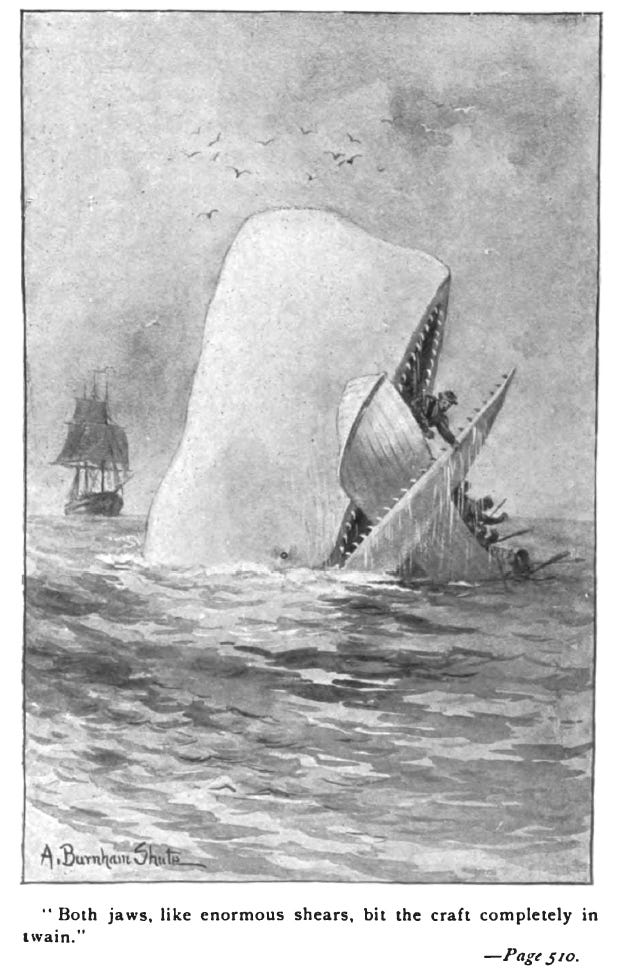
Modern schooling often treats this abundance as an obstacle. It should treat the abundance as the point.
A student who reads only the selected chapters meets the plot. A student who reads the whole book meets Melville’s mind at full scale. That difference matters because Moby-Dick was built to resist shortcuts. It trains attention, patience, judgment, and humility before complexity; precisely the capacities schools claim to cultivate.
Everyone remembers the first sentence: “Call me Ishmael.” But Melville begins before Ishmael. He opens with “Etymology” and “Extracts,” two strange sections filled with dictionaries, scripture, Shakespeare, Milton, Hobbes, Pliny, sailors, scholars, and old whale lore.
Extracts
“And God created great whales.” — Genesis
“Leviathan maketh a path to shine after him; One would think the deep to be hoary.” — Job
“Now the Lord had prepared a great fish to swallow up Jonah.” — Jonah
“There go the ships; there is that Leviathan whom thou hast made to play therein.” — Pslams
“In that day, the Lord with his sore, and great, and strong sword, shall punish Leviathan the piercing serpent, even Leviathan that crooked serpent; and he shall slay the dragon that is in the sea.” — Isaia
“That sea beast Leviathan, which God of all his works Created hugest that swim the ocean stream.” — Paradise Lost
Before the narrator introduces himself, the whale has already passed through religion, language, literature, empire, commerce, and rumor. That opening teaches the first rule of the novel. No reader reaches the whale directly. Every reader reaches it through inherited language.
A classroom that skips those sections has already changed the book. It has made the whale arrive as plot before students understand the whale as culture, knowledge, myth, business, and fear. It has turned Melville’s opening argument into background material.
A revealing story appears in Geoffrey Sanborn’s writing1 on the novel. An Amherst professor who had taught Moby-Dick for years realized he had mostly taught selected passages, the parts that could be turned into respectable classroom wisdom. Sanborn estimates that the usual selections came from roughly twenty of the book’s 135 chapters. That anecdote should bother anyone who cares about literary education.
A teacher can spend years teaching Moby-Dick and still avoid most of Moby-Dick. A student can pass a unit on the novel and still receive only the approved classroom version. A school can claim to teach a Great Book while quietly protecting students from the experience that made it great.
If this article made you want to read more deeply, become a paid subscriber today and continue reading below the paywall.
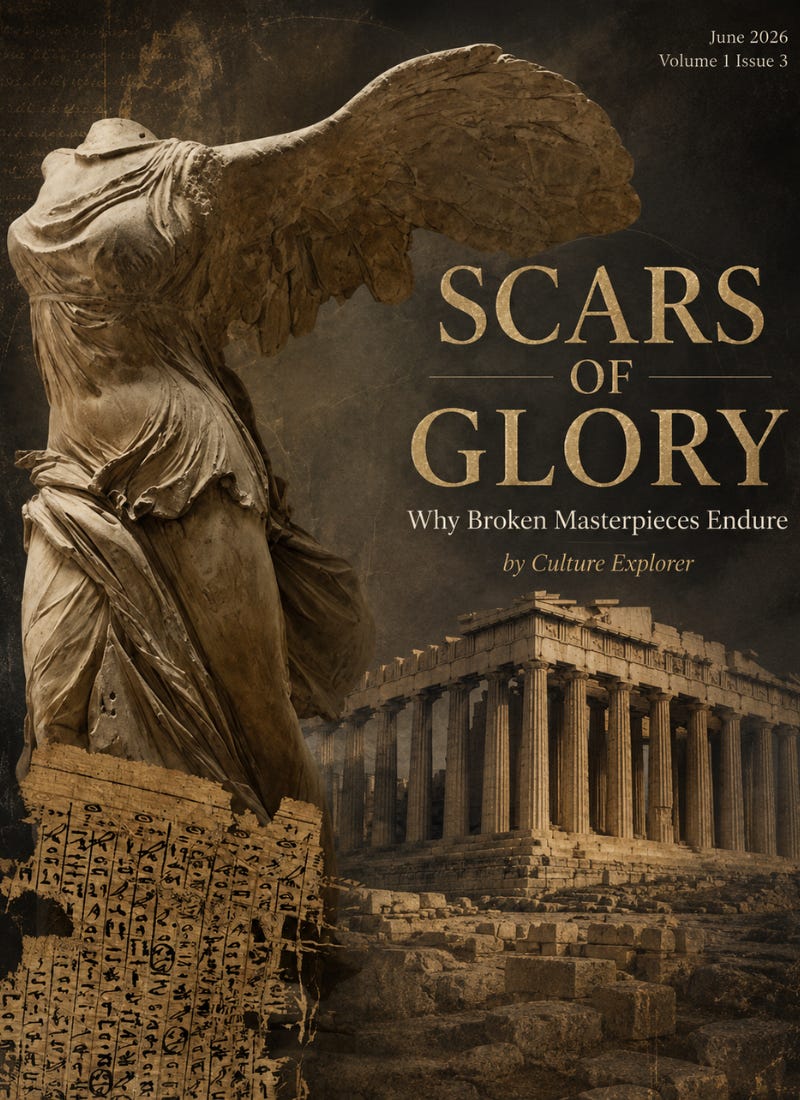
Our third eBook, Scars of Glory: Why Broken Masterpieces Endure, is coming next week. It will explore why cracked statues, ruined temples, unfinished works, and wounded masterpieces often move us more than flawless objects ever could.
Paid subscribers will receive the eBook as part of their membership, along with full access to premium essays, deeper cultural analysis, and future subscriber-only projects.
For a limited time, you can get 15% off an annual subscription and join before Scars of Glory is released.
Become a paid subscriber, support serious cultural writing, and receive the next ebook when it arrives.