

The Scarred King: Messi, Age, and the Modern Odyssey
Age strips greatness down to its deepest form.

At thirty-nine, Lionel Messi can no longer overwhelm a match through constant movement. The sudden burst that once carried him through entire defensive lines appears less often. He walks for long passages, studies the spaces around him, and waits while younger players spend their strength.
Then the match reaches its decisive moment, and the old authority returns.
Argentina trailed England 1–0 in their World Cup semifinal in Atlanta on July 15. Anthony Gordon had given England the lead in the 55th minute. In the 85th minute, with five minutes of regular time remaining, Messi moved toward the right side and found Enzo Fernández outside the penalty area. Fernández struck the equalizer.
Seven minutes later, deep into stoppage time, Messi received the ball again. He lifted a measured cross into the penalty area, where Lautaro Martínez rose above the defence and headed Argentina into a second consecutive World Cup final. Messi had created both goals in the closing minutes of a match that appeared to be slipping away.
When the final whistle sounded, he dropped to his knees.
The scene captured something more enduring than another display of footballing brilliance. It showed what happens when physical power begins to recede while authority continues to deepen.
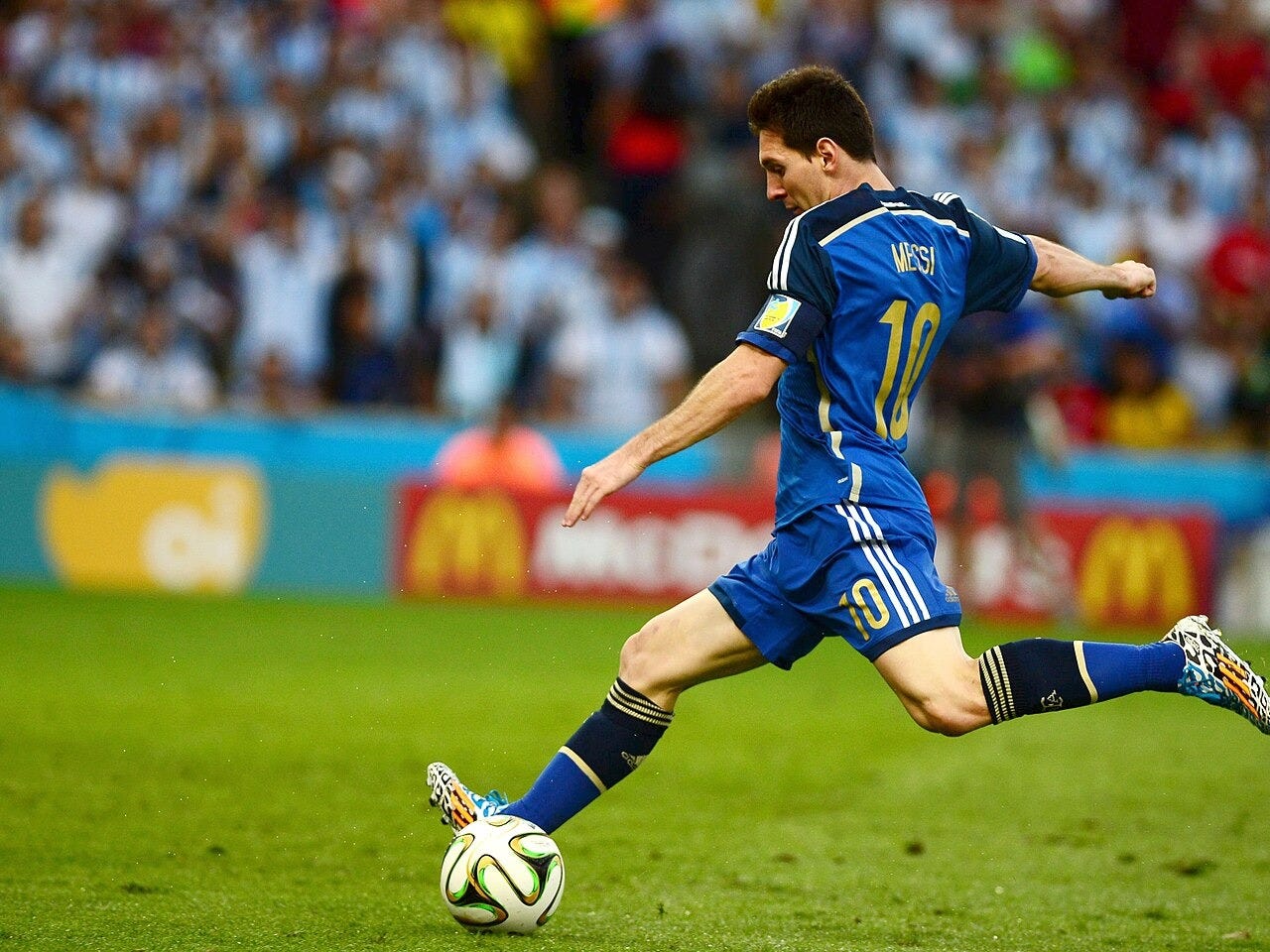
This is Messi’s sixth World Cup. He has played every minute of Argentina’s knockout matches in this tournament, carefully conserving energy and choosing where his remaining speed can have the greatest effect. He scored in earlier knockout victories, contributed key assists, and then created both goals against England. His two assists against England raised his World Cup total to a record twelve assists alongside twenty-one goals, giving him one of the most productive careers in the tournament’s history.
The young Messi could seize a match through repeated acts of physical and technical dominance. He attacked defenders again and again until their structure collapsed. The older Messi works through selection. He may disappear from the immediate action for several minutes, yet he continues to read the field. He studies the spaces forming between defenders, the direction of a teammate’s run, and the moment when exhaustion begins to weaken judgment.
What appears to be inactivity is often preparation.
Against England, younger legs had carried the match for eighty-five minutes. Messi decided it during the final seven.
There is an older story behind this kind of authority.
When Odysseus returns to Ithaca in Homer’s Odyssey, twenty years have passed since he left for the Trojan War. He comes home after battle, shipwreck, captivity, hunger, and the loss of every man who sailed with him. Athena disguises him as an elderly beggar so he can enter his own household without being recognized.
His palace has been occupied by suitors seeking to marry Penelope and take control of his kingdom. They eat his food, insult his son, mistreat his servants, and mock the stranger standing before them. They see age, poverty, and weakness. They have no idea that their king has returned.
Odysseus carries one piece of evidence beneath the disguise.
Years earlier, during a boar hunt, the animal wounded him and left a scar above his knee. When his old nurse Eurycleia washes the stranger’s feet, her hands find the scar. She recognizes him immediately. Time has changed his face, his clothing, and his body, but the wound carries the memory of who he has always been.
The scar reveals the king.
The bow confirms him.
Penelope announces a contest. She will marry the man who can string Odysseus’s great bow and shoot an arrow through twelve axe heads. One suitor after another attempts the task. Each man possesses youth, confidence, and control of the palace. None can even string the weapon.
The disguised Odysseus takes the bow into his hands. He examines it carefully, strings it with ease, and sends the arrow through the axes. Recognition follows the act. His authority survives because he can still perform the deed that belongs to him alone.
Messi’s cross against England carried something of that moment.
Thousands of players can run faster than he now runs. Younger forwards can press for longer, recover more quickly, and cover greater distances. Yet few can see the decisive pass before the opening fully exists. Even fewer can deliver it under the pressure of a World Cup semifinal with time disappearing.
The body has changed. The bow still bends for him.
This gives Messi’s late career a cultural meaning that extends beyond football. We live in an age that treats youth as the purest form of value. Faces are altered to hide time. Careers are judged by their most productive years. Public attention moves quickly toward the next younger figure, the next record, and the next display of physical possibility.
Older cultures often understood age through a wider lens. Time could weaken the body while strengthening judgment. A ruler, craftsman, commander, or poet gained authority through accumulated experience. Wounds carried history. Survival became evidence.
Damaged works of art often hold this same power.
The Winged Victory of Samothrace stands at the top of the Daru staircase in the Louvre without a head or arms. Her marble surface bears the effects of more than two thousand years. Yet she still appears to move against the wind, her clothing pressed against her body as she steps forward on the prow of a ship. The missing parts draw attention toward everything that has survived: the angle of the torso, the force of the wings, the weight of the fabric, and the forward movement of the body. Time has taken pieces from the sculpture while leaving its command intact.
Messi’s late career belongs to this category of beauty. His greatness now includes everything time has taken from him. The reduced pace gives greater meaning to the sudden run while the long periods of walking make the decisive movement more visible. The physical limits reveal the scale of his judgment.
At twenty-five, he could create several miracles in one match. At thirty-nine, he may need only two.
Homer offers another contrast through his two great heroes. Achilles embodies the glory of youthful force. He is swift, physically supreme, and devastating in battle. His greatness burns with such intensity because his life will be brief.
Odysseus follows a longer road. He survives through patience, restraint, strategy, disguise, and endurance. He knows when to act and when to remain silent. His victory comes after years of loss, and his final test takes place inside the home he has struggled to reach.
Messi’s early career carried something of Achilles. The speed, close control, and relentless attacks belonged to a young man operating beyond the physical limits of those around him.
His final years have moved closer to Odysseus.
He conserves his strength. He reads the intentions of others. He waits while the impatient reveal themselves. When the decisive test arrives, he still knows how to string the bow.
Argentina now travels to New Jersey for the World Cup final against Spain on Sunday, July 19. Spain arrives with youth, technical discipline, and a defence that has gone four consecutive matches without conceding. Argentina carries the experience of defending champions and a captain who may be approaching his final appearance on football’s greatest stage.
The final will shape the ending. Another victory would give Messi a second consecutive World Cup and the clean conclusion that sporting mythology loves. Defeat would deny him that perfect conclusion while leaving the meaning of his journey intact.
Sunday will determine how the story ends. Atlanta has already revealed what the story means.
Messi has already shown that greatness can survive transformation. He has accepted the limits imposed by age and built a different form of influence within them. The player who once ruled through constant brilliance now chooses a few moments and makes them count.
Odysseus returned to Ithaca carrying twenty years of wounds. His scar revealed the distance he had travelled. His bow proved that the king remained.
Messi enters the final carrying the evidence of his own long journey. The speed has faded. The body has absorbed two decades of pressure, injuries, defeats, and victories. Yet when Argentina needed one final answer in Atlanta, the scarred king still knew where to place the ball.


Thank you for this article! You have put the feelings of these moments into words and I appreciate your poetry.
Fantastic comparison - love this article. Sending it to my 17 yr old soccer playing son - who only has eyes for Lamine.