

Two Traps Most Writers Fall Into
Beyond Self-expression and Clever Techniques

Guest article by Justi Andreasen, author of Reclaiming the Biblical Worldview.
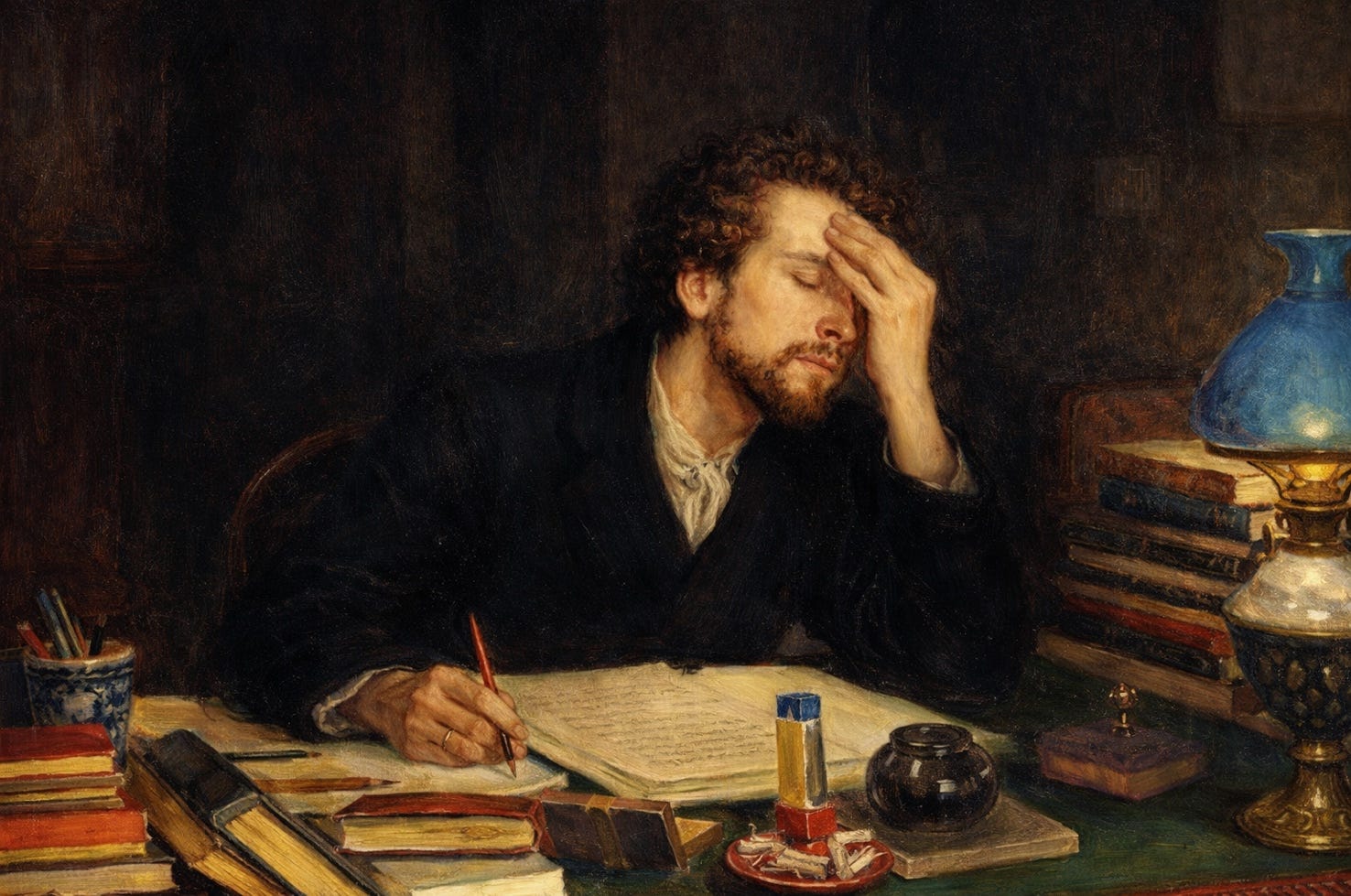
Most writers fail in one of two ways. They write for the algorithm, or they write for themselves.
You’ve probably noticed it. You sit down to write something that matters, and two voices compete for your attention.
One says “optimize.” Find the trend. Publish every week. Give the algorithm what it wants.
The other say “be authentic.” Write from the heart. Ignore the audience. Express yourself.
This is not an accident. Most writing advice quietly pushes you toward one of these poles. As a result, writers keep oscillating between them, rarely stopping to ask whether the dichotomy itself is the problem.
Both paths sound reasonable but lead to the same place. Writing that doesn’t last.
When I started writing online and felt the pull of both, I remembered an article I had read almost a decade earlier that diagnosed this split with unusual clarity. It was called The Robot, the Mutant and the Artist, written by J. Pageau. The piece is about art and craft, but the framework applies directly to writing.
It is about two traps. And a third way that almost no one talks about.
The Robot and the Mutant
The article named the first error “the robot.” Here, the maker disappears entirely into function. Think of the SEO article engineered to rank, the newsletter optimized for open rates, the LinkedIn post reverse-engineered from what performed last week. Everything is trying to be efficient. Nothing is meant. The writing works in the short term by achieving its metric, but it carries no weight beyond its immediate use.
The second error is the opposite. The article named it “the mutant.” Here, the maker disappears entirely into self-expression. Think of the personal essay that speaks only to the author, the experimental prose that requires a decoder ring, the confessional piece where the reader’s presence is an afterthought. The writing may be authentic. But it belongs nowhere and serves no one except the writer’s need to express.
Writers fall into the first trap when they treat writing as a set of techniques.
Writers fall into the second trap when they treat writing as self-expression.
Twins, Not Opposites
Here is what the article made clear: these two errors look like opposites. The robot seems like the enemy of the mutant.
But they are twins. They both assume that function and meaning cannot coexist in the same piece of writing. The robot keeps function and discards meaning. The mutant keeps meaning and discards function. Neither can imagine holding both together.

After reading the article, I realized the pattern was everywhere.
More “robots” gravitate toward business, marketing, and copywriting. More “mutants” gravitate toward literary fiction, personal essays, and poetry. More “robots” tend conservative in temperament, prioritizing order, efficiency, and what works. More “mutants” tend progressive, favoring expression, disruption, and what’s new.
Neither side realizes they share the same premise. Both have accepted that utility and meaning are enemies. And so, a lot of online writing is either sterile or confused, never landing anywhere solid.
Subscribe to Justi Andreasen for more writing that cuts through false modern dichotomies and shows how older patterns still work in real life.
What Was Lost
For most of history, this split did not exist.
Consider the craftsman building a table. His work could not be reduced to knowing the right techniques (the tricks, the shortcuts) nor was it about expressing who he really was deep down. It was about building a table that fit the people it was made for: long enough to seat everyone, light enough to move when they relocated, sturdy enough to withstand children’s spills, and ornamented in a style that suited the room.
The craftsman had to know who he built for. The distinction between “craft” and “art” did not exist. Craft was not reducible to technique. Art was not reducible to expression. Both words pointed to the same thing: making something that worked and meant something, because it had a place in someone’s life.
Writers once thought this way too. Writing was not an outlet for self-expression, nor a set of techniques to be optimized. It belonged to established forms whose purpose was already known. Commentary, sermon, chronicle, hymn, etc. You did not invent the form in order to express yourself. You entered it in order to serve what it was for.
When writing focuses on technique, it becomes strategy or propaganda.
When it aims for just expression, it becomes private speech.
Writing happens in the narrow space between those two failures. It works when the writer disappears into the form without vanishing from it.
What Actually Works
The best writers on Substack have already figured this out.
They are not optimizing for clicks nor writing diaries. Before asking what techniques work or what expresses who they are, they orient the writing toward a purpose.
The harsh truth is that people read your writing because it serves them. It solves a problem. It expands their horizon. It offers a new perspective. The techniques matter, but only in service of this. The authentic voice matters, but only when it is directed toward someone other than the self.
Think of it like writing to someone you care for. You do not write well merely by using clever techniques, nor merely by expressing yourself sincerely. You write well by knowing the person before you well enough to make them feel seen.

This is what it looks like to refuse the false choice. Writing that works and means something. Function and meaning, held together in the same act.
The next time you sit down to write, notice the voices. The one pushing you toward pure utility: “optimize and convert.”
The one pushing you toward pure expression: “ignore others’ judgement, write what matters to you.”
Both are traps.
The older way was different. Write something that serves someone. Write something that has a place in a reader’s life.
Reclaiming the Biblical Worldview
Thanks for reading The Culture Explorer! This post is public so feel free to share it.
As Justi suggests in the article, many people write more but say less, and that’s why their ideas disappear the moment you scroll past them. In four days, you’ll learn how to turn one idea into something people actually read, remember, and share.
On March 28th, I’ll be hosting a live writing session inside Art of Purpose’s Content Academy, where we break the process down in real time and turn ideas into finished work.
If you’re serious about writing that makes an impact, join the Long Form Academy and build something that lasts.
Click here to join the Long-Form Academy.
