

What A Tale of Two Cities Still Teaches Us About Paris
Ignored people do not disappear. They gather.

Dickens still explains Paris because he saw how hunger, insult, and bad governance turn ordinary streets into places of confrontation.
In A Tale of Two Cities, Saint-Antoine revolts because bread is scarce, aristocratic contempt has become unbearable, and public life gives the poor no honest way to be heard. That is why the novel still feels current. In modern France, fuel taxes brought the Yellow Vests onto the Champs-Élysées in 2018. Pension reform filled Paris with protests in 2023. Farmers drove tractors into the capital in 2026. A PSG victory turned into fires, arrests, and clashes with police. The causes are different, but the pattern is familiar: when people believe power has stopped listening, Paris takes the argument into the streets.
In Saint-Antoine, spilled wine sends poor people into the street. They bend down, scoop it up, stain their hands, and drink because hunger has trained them to treat an accident as relief. Defarge’s wine shop gives that hunger a room. Madame Defarge’s knitting gives it a list of names. Dickens keeps showing the social order behind the anger: who gets called “sir,” who gets called “madam,” who gives orders, who obeys, who is watched, and who is dismissed. Status-based language appears more often than any other kind in the in A Tale of Two Cities. That explains why violence does not appear suddenly. It grows from a society where rank has become humiliation, and humiliation has started to organize. Saint-Antoine becomes dangerous because poverty has found a meeting place.
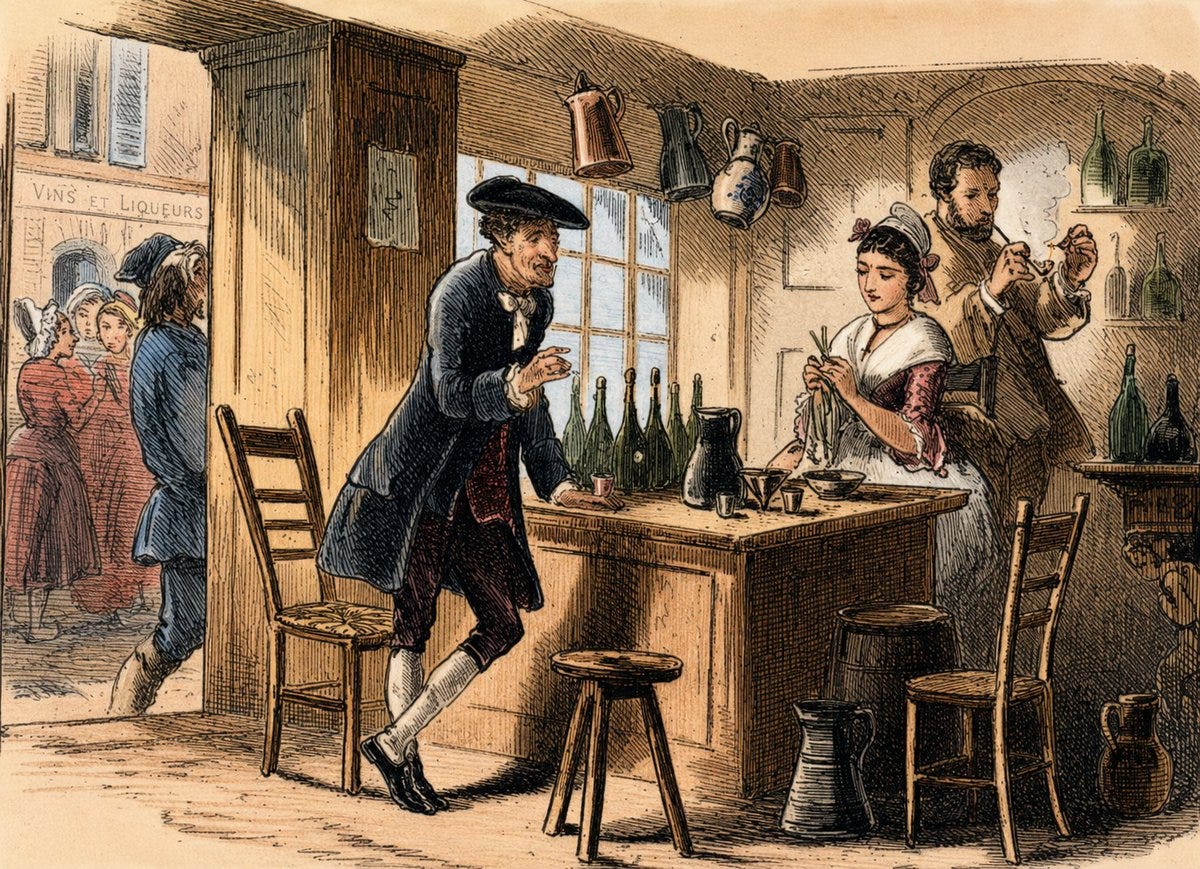
Dickens’ Paris becomes most dangerous when grievance finds a place. The Bastille is a prison, but it is also a target. Saint-Antoine is a poor district, but it is also a meeting place for anger. The spilled wine scene shows people trained by hunger to rush toward any relief. Defarge’s wine shop gives them a room where grievance can gather. Madame Defarge’s knitting turns private hatred into a record of names. By the time the crowd moves toward the Bastille, Dickens has shown that revolt begins long before the first prison gate falls.
Dickens often makes Paris feel open and public. We see crowds gathering, moving, shouting, and acting together in the streets. London feels more closed in. Its scenes are often smaller, darker, and more private. This matters because Paris gives Dickens a way to show politics as something people do in public, not just something leaders decide behind closed doors.
The modern city still follows that older pattern. Paris can absorb tourists, luxury brands, fashion week, museum crowds, river cruises, restaurant queues, and wedding photos, then shift into confrontation with startling speed. The trigger does not have to be revolutionary. A fuel tax, a pension law, a police killing, a trade deal, or even a football victory can do it. The question Dickens raises still matters: what happens when people believe the street is the only place where power will listen?
The night of May 30, 2026 gave that question a strange form. Paris Saint-Germain won the Champions League against Arsenal, and celebration across Paris turned violent. The Champs-Élysées and areas near Parc des Princes filled with flares, fireworks, blocked roads, vandalism, burning vehicles, damaged shops, and clashes with police. The Guardian reported 780 arrests across France, including about 480 in Paris, and 57 injured officers. AP reported around 20,000 fans near the Champs-Élysées, attempts to attack a police station in the 8th arrondissement, damage to businesses, and barricades near the PSG stadium. Reuters reported that France had deployed 22,000 police because officials expected trouble after earlier PSG celebrations had turned violent.
A football riot is not a revolution, but it tells us something important about Paris. In some cities, celebration remains entertainment. In Paris, mass emotion can become a test of order. Joy gathers, thickens, searches for movement, and then finds police lines, storefronts, traffic, and monuments. That does not make Paris uniquely savage. It makes Paris unusually honest about the link between crowd energy and public space. Dickens would have understood the speed of that transformation. His Paris is full of moments where hunger, fear, vengeance, and hope stop living inside private bodies and begin acting as a crowd.
“The wine was red wine, and had stained the ground of the narrow street in the suburb of Saint Antoine.”
That sentence from the wine cask scene is one of Dickens’ strongest pieces of political writing because it turns need into a public act. The poor rush toward spilled wine because the city has given them too little, and the accident becomes a rehearsal for violence. Dickens is not subtle there. The red stain points ahead to blood. The scene works because it shows people discovering themselves as a group. They have not yet stormed the Bastille nor built a new regime. They have done something simpler and more dangerous: they have seen that deprivation can be shared, named, and acted out in the street.
That is also why May Day still matters in France. On May 1, 2026, unions called demonstrations in Paris and elsewhere under the slogan “bread, peace and freedom,” linking wages, living costs, labor rights, war, and political pressure. PBS reported that framing, while independent coverage of the Paris march described the route from Place de la République to Place de la Nation, with union estimates of close to 100,000 participants in the capital. The exact number matters less than the geography. République to Nation March is symbolic. It moves between names that carry the memory of political identity. In Paris, even the route has an argument.
May Day shows the organized version of this Parisian habit. Workers and unions enter the street because a demand has more force when it disrupts the city. A wage complaint in a meeting can disappear into paperwork. A march from République to Nation blocks roads, draws police, fills the cameras, and tells the government that the issue has moved beyond negotiation. A protest can turn a complaint into a problem the state has to manage.
Dickens’ Saint-Antoine was built on the same principle, though under more brutal conditions. The poor gained power when suffering acquired form, direction, and numbers.
The farmers’ protests in January 2026 sharpen the point because they brought a different France into Paris. Reuters reported that farmers drove tractors into central Paris on January 8, blocking roads and protesting the EU-Mercosur trade deal, lumpy skin disease policy, and wider agricultural grievances. A second Reuters report said about 350 tractors took part in a later Paris demonstration, with farmers converging near the Arc de Triomphe and the National Assembly. Le Monde reported that around 50 farmers were detained after forcing their way into the Agriculture Ministry building on January 14, while the UN human rights office expressed alarm over 52 arrests at what it described as a peaceful protest.
The tractor in Paris is a blunt political image. It carries soil into the capital without needing to say so. It tells the ministries that agriculture is not a spreadsheet. It tells the urban public that food comes from people squeezed by disease rules, fuel costs, retail pressure, environmental regulation, and trade deals signed far above the farm gate. When tractors circle the Arc de Triomphe or stand near the National Assembly, the countryside enters the symbolic center of France and refuses to remain an abstraction.
Dickens would have understood that gesture because A Tale of Two Cities is built around the geography of pressure. The Marquis rides through the village with contempt. The child dies under his carriage. The aristocrat throws a coin as compensation. That scene condenses a social order into one brutal incident. The road, the carriage, the coin, the dead child, and the watching crowd all explain the Revolution better than a manifesto. Dickens knew that political collapse often begins when the ruling class loses the ability to read ordinary humiliation.
The Yellow Vest movement made the same lesson visible in 2018. Reuters reported that the protests erupted over planned fuel tax increases, and Prime Minister Édouard Philippe eventually said:
“No tax is worth jeopardizing the unity of the nation.”
That sentence admits what technocratic politics often misses. A policy can look rational from the center and still feel like punishment at the edge. For drivers in rural and peri-urban France, a fuel tax touched work, commuting, family budgets, and social rank. The yellow vest itself became a perfect symbol because every driver had one. The protest began with an object already sitting in cars, waiting to become political.
The 2023 pension reform protests turned another administrative question into a national drama. Reuters reported that more than a million people marched across French cities on January 19, 2023 against President Emmanuel Macron’s plan to raise the retirement age. Reuters later described huge crowds marching again on January 31, with schools, transport networks, and refinery deliveries affected. By March, after the government used special powers to push the bill through without a vote, Reuters reported intensified protests and quoted one Paris banner: “France is angry.”
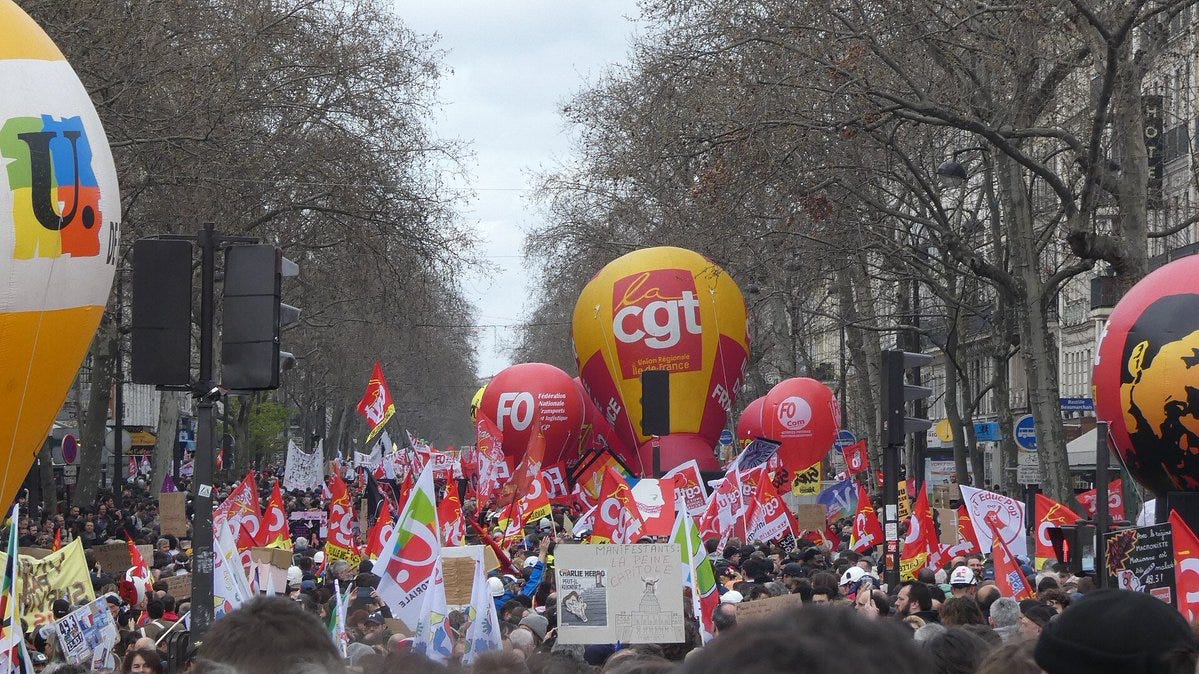
That anger had a clear moral shape. The pension fight was not only about two extra years of work. It was about who pays for the state’s promises, who is trusted to decide, and whose body carries the burden of reform. A retirement age sounds technical until it reaches a nurse, warehouse worker, train operator, cleaner, builder, or factory hand. Dickens understood that politics becomes explosive when legal language touches the body. Bread, prison, taxation, labor, and punishment are never abstract for the people who bear them.
The 2025 “Block Everything” protests showed how quickly that anger can return under a new name. Reuters reported that the movement spread across France in September 2025 over budget cuts, austerity, and anger at the political elite. Demonstrators blocked highways, erected burning barricades, clashed with police, and faced tear gas and water cannon. More than 80,000 security personnel were deployed nationwide, and nearly 200 people were arrested in Paris. Reuters photographs from later September show police charges, tear gas, protesters, flares, and signs against government cuts in Paris.
The phrase “Block Everything” sounds crude, but it names a serious political instinct. When people believe the state will ignore them, they stop the things the state needs to keep moving. Dickens’ crowds do something similar. They understand that a city’s power lies in routes: streets, gates, bridges, courtyards, prisons, markets, and courts. Control the route and you briefly control the political imagination.
This is where modern Paris and Dickens’ Paris meet most closely. The issue is not that France is returning to 1789. That would be lazy history. The sharper point is that Paris still gives conflict a visible grammar. A grievance needs a site. A police line gives the confrontation an edge. A monument turns the event into memory. Place de la Bastille, Place de la République, Place de la Nation, the Champs-Élysées, the Arc de Triomphe, the National Assembly, and the Ministry of Agriculture all carry political meaning.
This also explains why A Tale of Two Cities remains more than a novel about violence. Dickens superimposes Paris and London, using the two cities to rethink political space, movement, and reform. Paris becomes the city of swift action and public energy, while London often appears slower, enclosed, and legally blocked. That contrast matters because Dickens was not simply condemning French violence from a safe English distance. He was using revolutionary Paris to examine what happens when a society refuses timely reform.
The novel’s most famous line still works because it describes a society divided in its own self-understanding.
“It was the best of times; it was the worst of times.”
That sentence has been quoted so often that it can feel dead, but its meaning remains exact. A nation in crisis rarely experiences itself in one way. For one class, the city is order, elegance, profit, culture, and security. For another, it is rent, surveillance, insult, commute, debt, and fatigue. The same Paris can be a honeymoon photograph, a police kettle, a farmer’s blockade, a union march, a football riot, and a teenager’s memorial. The contradiction is the subject.
Dickens’ answer to that contradiction is moral attention. He asks the reader to look at the poor before they become a mob, at the prisoner before he becomes a symbol, at the aristocrat before he becomes a corpse, at the crowd before it becomes a machine, and at Sydney Carton before he becomes a sacrifice. The novel’s politics are rooted in that act of attention. It knows that neglect creates monsters on both sides: cruel elites who no longer see the people beneath them, and crowds that begin to love punishment because punishment feels like justice.
Paris keeps testing that warning. Its greatness lies in the fact that it still treats public life as something worth fighting over. Its danger lies in the fact that street politics can move from dignity to destruction in a single night. The same avenue can hold a victory parade, a luxury storefront, a labor march, a police charge, and a burning car. That is the city’s historical burden.
Paris sells one image of itself: museums, bridges, cafés, fashion, and romance. Its streets keep revealing the other Paris: the worker who feels cheated by pension reform, the farmer who drives a tractor into the capital, the banlieue resident who sees police before opportunity, the football crowd that turns celebration into confrontation. Dickens saw this clearly in Saint-Antoine. A neighborhood becomes dangerous when people have no office, newspaper, court, or minister willing to hear them. They still have the street. That is where grievance becomes impossible to ignore.
Paris still gives the world beauty, but its streets keep telling the truth the postcard leaves out. Dickens saw that truth in Saint-Antoine: when people have no real power inside the system, they take their anger outside it. That is why A Tale of Two Cities still feels current. Paris is still Paris because it can give you the Seine at night and a barricade by morning.
The Culture Explorer newsletter is for those who believe the past still has something urgent to teach us. I write about art, architecture, faith, myth, history, and the civilizational roots beneath the world we inherited.
Because when a society loses its sense of beauty, it eventually loses its sense of duty. Subscribe if you believe tradition still matters.
To support The Culture Explorer newsletter, please consider becoming a paid subscriber. It makes a real difference to the time, research, and care I can put into this work.
You’ll get:
Premium essays on tradition, beauty, faith, art, history, and civilization
Deep dives into cathedrals, sacred architecture, paintings, myths, empires, and forgotten cultural treasures
Collector’s edition guides created only for paid subscribers
Access to the full archive of premium articles
A stronger role in helping this project grow into a serious home for people who believe beauty and tradition still matter.
Free subscribers help keep the conversation alive. Paid subscribers help build the movement. Subscribe here:

Really didn't expect to see such a retarded take from a page like this. So much mental gymnastics to avoid discussing the huge elephant in the room.