

What Homer and Tolkien Reveal About Heroism
Two Visions of Heroism That Still Judge Us

Achilles drags Hector’s body around the walls of Troy while a father and mother watch from above. Frodo spares Gollum, again and again, long after common sense would have called mercy a danger. These two scenes reveal two very different ideas of the hero. One world gives us greatness blazing so fiercely it almost becomes monstrous. The other gives us a small figure whose mercy helps save the world.
That is the real contrast between Homer and Tolkien. The Iliad does not give us simple brutes who love war for its own sake. Achilles grieves. Hector loves his wife and child. Odysseus survives because he can think as well as fight. Homer understood that heroism contains splendor and danger at the same time. The warrior who can defend a city can also be ruled by pride. The man who wins immortal fame may leave ruin behind him.
Tolkien inherits the old heroic world, but he changes its moral center. His heroes still fight, suffer, lead armies, and face death. Aragorn is no coward. Éowyn stands before the Witch-king. Gandalf falls in Moria. Yet the deepest tests in The Lord of the Rings often come before the sword is drawn. Boromir must face the desire to use the Ring for Gondor. Faramir must decide whether victory is worth corruption. Frodo must carry evil without becoming its servant. Sam must keep going when loyalty is the only strength left.
That is what makes the comparison worth taking seriously. Achilles and Frodo are not simply warrior and pacifist, or ancient and modern. They are two answers to an older question: what kind of person deserves to be called heroic? Homer answers through the battlefield, the wound to honor, the rage after loss, and the terrible price of fame. Tolkien answers through burden, mercy, restraint, and the slow wearing-down of the soul.
The Iliad begins with Achilles humiliated in front of the Greek army. Agamemnon takes Briseis from him, and Achilles hears more than a personal slight. He hears a public denial of his worth. In Homer’s world, honor must be seen, measured, and acknowledged. A warrior’s prize is not a private possession. It is proof that his excellence has been recognized. When Agamemnon strips Achilles of that sign, he wounds the heroic order itself.
Achilles’ response is devastating. He withdraws from battle and asks his mother, Thetis, to persuade Zeus to let the Greeks suffer in his absence. This is the first hard lesson of Homeric heroism: greatness does not automatically make a man good. Achilles has a real grievance, but his anger makes the whole army pay for it. His excellence becomes dangerous because it is joined to pride, injury, and the need to be publicly vindicated.
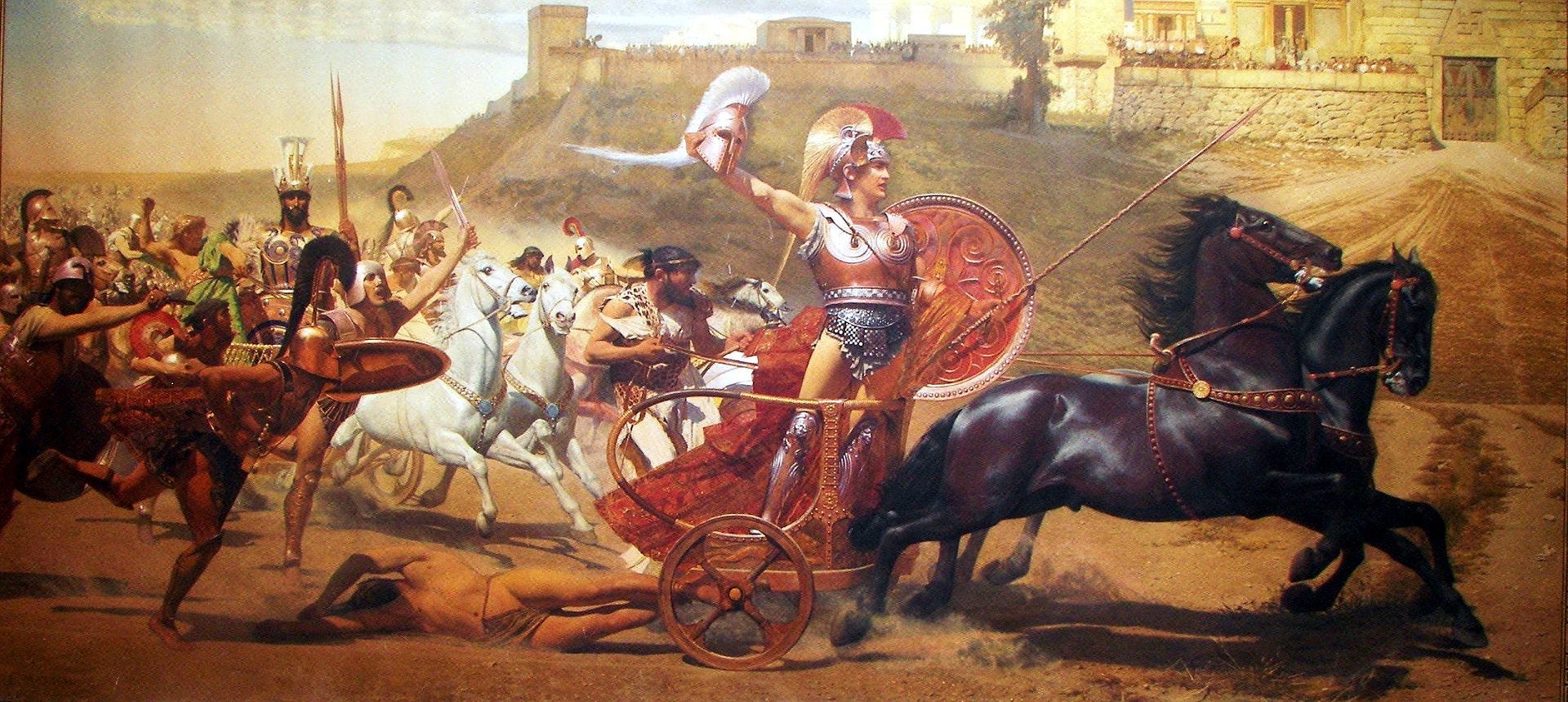
Only Patroclus’ death brings Achilles back to war. Yet even then, his return is grief turned into violence. He kills Hector, but the killing is not enough. He drags Hector’s body around Troy, as if victory must keep proving itself even after the enemy is dead. Homer forces us to look at the terrifying side of heroic glory. Achilles is magnificent, but his magnificence has crossed into desecration.
Hector gives the Iliad a different kind of hero. He is not driven by the same hunger for personal glory as Achilles. He fights because Troy stands behind him: his father, his wife, his child, his people. His farewell to Andromache is one of the most human scenes in ancient literature because it places domestic tenderness beside public duty. Hector knows what war will do to his family if Troy falls. He still goes back out to fight. His courage is not free from pride, but it is bound to responsibility.
Tolkien’s world also understands the danger of greatness. Boromir is brave, noble, and beloved, but the Ring finds the weak place in his desire. He wants power for a good cause. He wants Gondor saved. That is exactly why his temptation feels so human. Evil in Tolkien does not always begin with hatred. It often begins with the belief that power can be mastered by a good person for a righteous end.
This is where Frodo becomes a different kind of hero. He does not set out to win fame. At the Council of Elrond, he accepts a task that no one else wants to claim. His words are simple:
“I will take the Ring, though I do not know the way.”
