

What the Norse and Germanic Heroes Understood About Reputation
Honor and Betrayal in The Völsunga Saga and The Nibelungenlied

At a wedding feast in the hall of King Völsung, a stranger walked in with one eye, a broad hat, and a sword in his hand. No one knew his name at first. He went straight to the great tree that stood inside the hall, drove the sword deep into its trunk, and told the men gathered there that whoever pulled it free could keep it. Then he left.
The guests tried one after another. Kings, warriors, proud men with good blood and loud names stepped forward. None of them could move it. Then Sigmund, the king’s son, placed his hand on the hilt and pulled the sword out.
That scene explains the Norse view of reputation better than any lecture on heroism. A man could be born into a great house, sit near kings, and speak like a warrior but in order to become reputed, the sword still had to move in his hand.
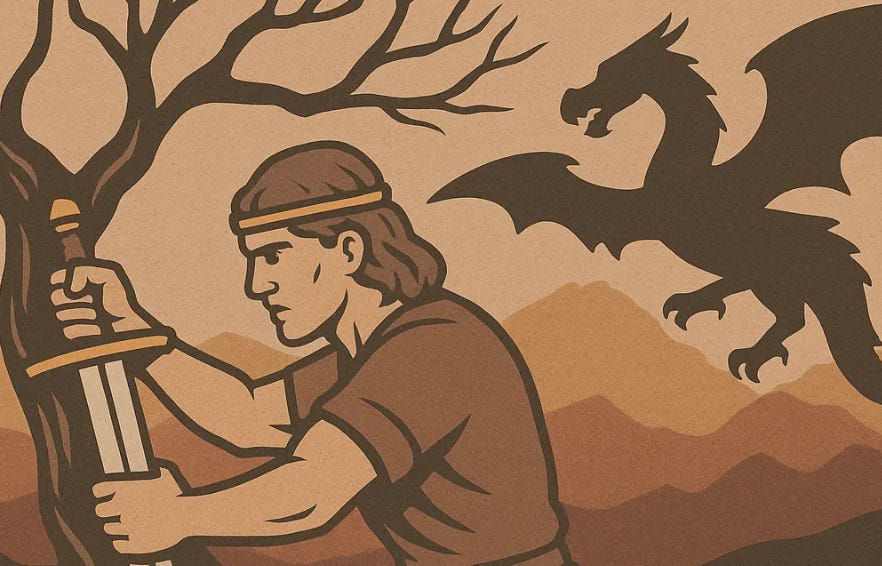
Siggeir, the king who had just married Signy, wanted the weapon. He offered Sigmund three times its weight in gold. Sigmund refused and answered that Siggeir could have taken it from the tree himself if he was meant to have it. That insult hit hard.
Siggeir invited the Völsungs to visit him. Signy warned her father that her husband planned betrayal. King Völsung still went. He chose the risk because turning back would leave another kind of wound. He would live, but his name would carry the mark of fear. In the saga world, that mark could travel farther than a corpse.
The ambush came. Völsung died fighting. His sons were captured. One by one, they were chained in the forest and killed by a she-wolf. Signy watched her family being destroyed inside her husband’s kingdom. She could not save them all. She saved the one who could carry the name forward: Sigmund.
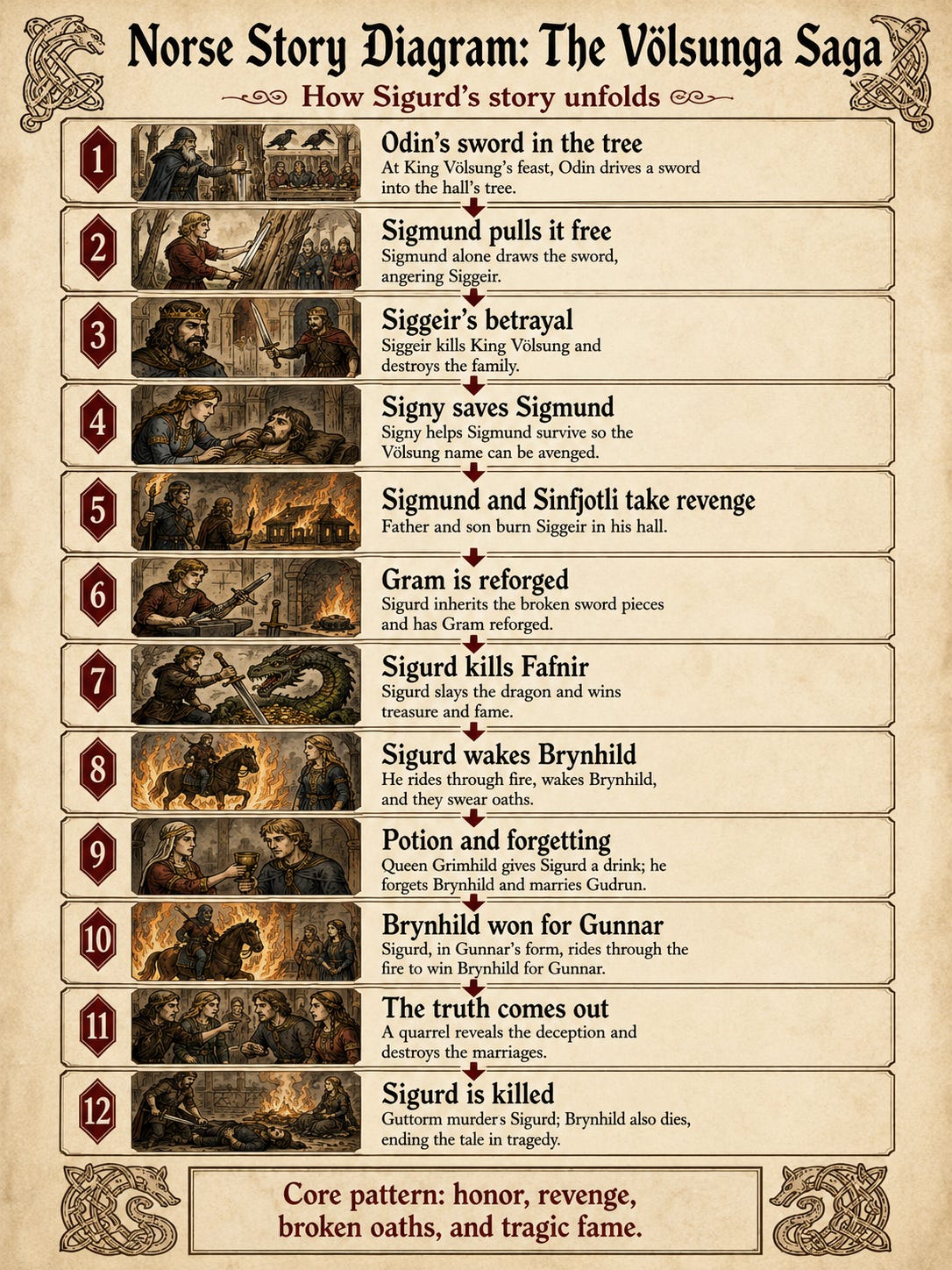
Signey sent help at the right moment. Sigmund survived by biting the wolf’s tongue and tearing himself free. He lived like an outlaw in the woods. He lived because his family had been betrayed, and someone had to avenge them.
This brings us to the first hard lesson from the Völsung story. Reputation belonged to the living and the dead at the same time. A family name could be attacked. A son, brother, or sister had to repair it. The wound did not close when the body was buried.
Signy then made one of the most brutal choices in the saga. She tested her sons and found them too weak for revenge. She knew Sigmund needed an heir strong enough to help him burn Siggeir’s house and avenge the Völsungs. So, she disguised herself, went to Sigmund, and conceived Sinfjotli. The act shocks the modern reader, but the saga does not soften it. Signy sacrifices ordinary morality to restore a murdered family line.
Years later, Sigmund and Sinfjotli trapped Siggeir in his hall and set it on fire. Signy walked into the flames after revealing what she had done. She chose death once revenge was complete. She had lived long enough to see the family name answered.
The saga gives no neat comfort here. It gives a world where reputation costs blood, years, exile, and moral damage. A name could be saved, but the price could be costly to the people saving it.
Sigurd inherited that world before he ever met the dragon. His father, Sigmund, died after Odin broke his sword in battle. The broken pieces passed down to Sigurd through his mother. Regin, the smith, tried to forge Sigurd a weapon, but the first blades failed. Then Sigurd brought him the shattered pieces of Gram, the sword once pulled from the tree. Regin reforged it. Sigurd tested it against an anvil, and the blade cut through.
Sigurd does not begin with a fresh weapon. He receives a broken inheritance and makes it usable again. His father’s failed sword becomes the blade that will create his own name.
Regin wants Sigurd to kill Fafnir, the dragon who guards cursed gold. Sigurd agrees, but first he rides to avenge his father. That order of action tells us how the saga measures him. Gold can wait. Family honor comes first.
Only after avenging his father does Sigurd turn toward Fafnir. He digs a pit in the dragon’s path, hides inside it, and waits. Fafnir crawls over him. Sigurd drives Gram upward into the dragon’s body.
After the killing, Fafnir warns him that the treasure will ruin its owner. Sigurd takes the warning, but he does not leave the gold. Then he roasts the dragon’s heart. When the blood touches his tongue, he understands the speech of birds. They warn him that Regin plans to betray him. Sigurd kills Regin before Regin can kill him.
Now the name is fixed. Sigurd becomes Fafnisbani, the slayer of Fafnir. The nickname does what all strong reputations do: it compresses a life into a deed. People do not need the whole story to know the measure of the man. They only need the dragon.
The saga then sends Sigurd to a mountain where fire burns against the sky. Inside the ring of flame, he finds a warrior sleeping in armor. He cuts off the armor and discovers a woman: Brynhild, a Valkyrie punished by Odin. She has sworn to marry only a man who knows no fear.
Sigurd wakes her. They speak. She teaches him runes and wisdom. They swear oaths. This should be the point where the hero’s reputation reaches its proper reward. He has the sword, the horse, the gold, the dragon’s name, and the woman whose own standard demands courage. Then the saga breaks the path.
Sigurd rides to the court of King Gjuki. Queen Grimhild sees at once that his heart belongs to Brynhild. She wants him for her daughter, Gudrun. So she gives him a drink. He forgets Brynhild. He marries Gudrun. He stays at that court for years. He fights beside Gunnar and Hogni. He gains more honor, more wealth, and more praise.
Then Gunnar wants Brynhild.
Brynhild still sits behind the fire. Gunnar cannot cross it. Sigurd can. Through magic, Sigurd takes Gunnar’s shape, rides through the flames, and wins Brynhild for another man. The public story says Gunnar performed the deed. The truth says Sigurd did.
That is where the saga becomes savage. Gunnar receives the bride, but Sigurd owns the act. Brynhild later discovers the truth during a quarrel with Gudrun. Gudrun reveals the ring Sigurd took from Brynhild. The private fraud becomes public humiliation.
Brynhild understands exactly what happened. She was promised to the man who knew no fear. The man who crossed the fire came to her in another man’s shape. Gunnar has the marriage, but Sigurd has the courage. In that world, the difference cannot stay hidden.
The result is murder. Brynhild demands Sigurd’s death. Gunnar and Hogni had sworn brotherhood with Sigurd, so they could not kill him themselves. Their brother Guttorm had made no such oath. They fed his anger, armed him, and sent him into Sigurd’s chamber. Sigurd died in bed, killed by a man whose hands carried another family’s betrayal.
Even at the end, the saga gives Sigurd one last action. He wakes after the blow and hurls Gram at Guttorm, killing him before he dies.
Gram had followed the Völsung line from the beginning. Odin drove it into the tree. Sigmund pulled it free. Sigurd inherited its broken pieces and had them reforged. When Guttorm stabbed him in bed, Sigurd still threw Gram across the chamber and killed his murderer before dying.
The saga has shown the same rule from the wedding hall to the deathbed. A name is built by deeds, and a false deed poisons everyone near it.
The same heroic problem did not stay in the North. It crossed into the German tradition and changed shape. In the Völsunga Saga, the story moves through Odin, family revenge, dragon-slaying, magic, broken oaths, and fate. In the Nibelungenlied, many of the same pressures enter a courtly world of kings, queens, marriage politics, public shame, and revenge. That makes the German version useful. It shows what happens when the older heroic code leaves the world of forests, dragons, and gods, and enters the court.
The central question stays the same: what happens when a man receives honor he did not earn, and another man’s reputation exposes the fraud?
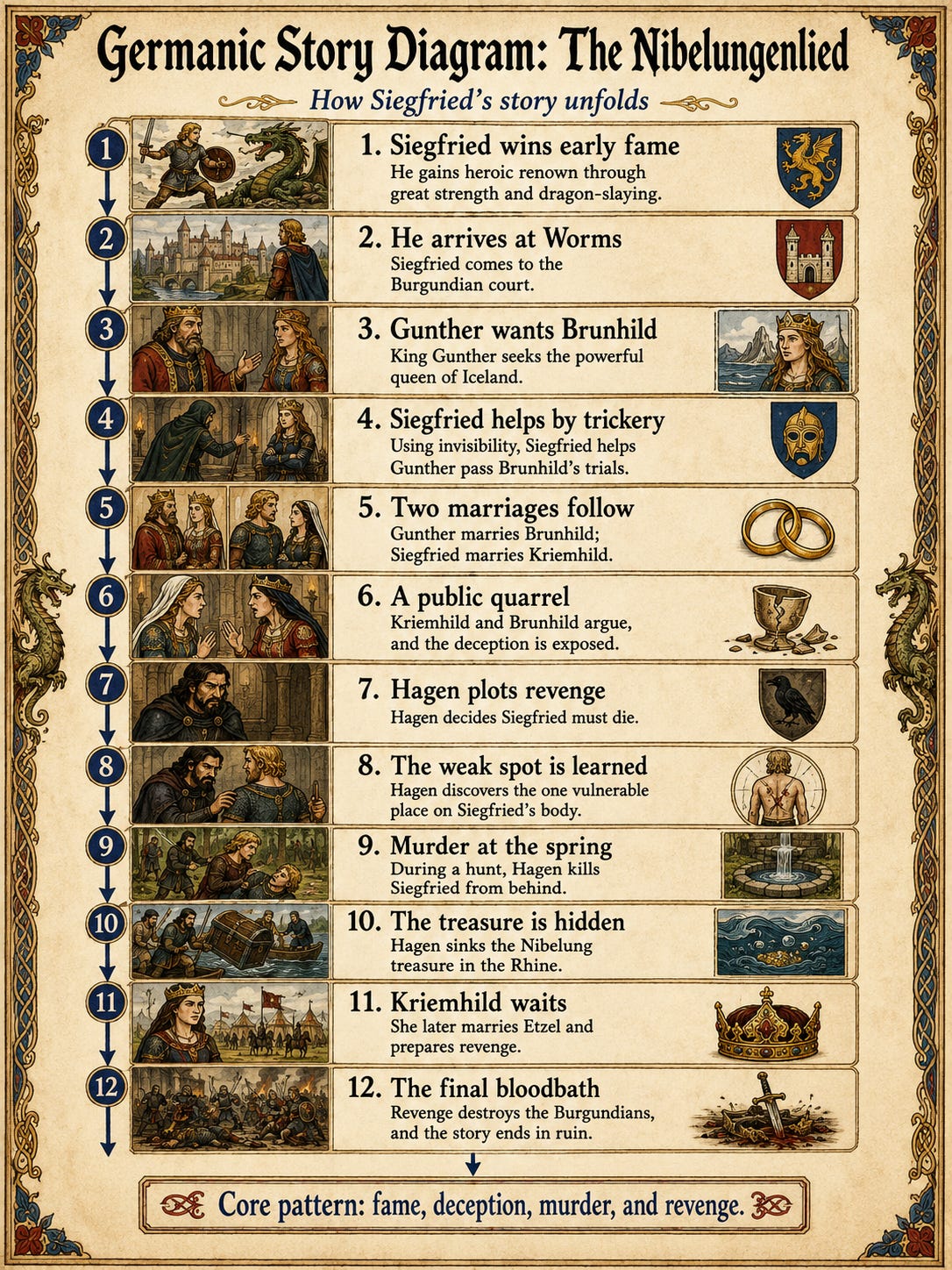
The German version, the Nibelungenlied, sharpens the same idea through Siegfried and Gunther. Gunther wants Brunhild, the powerful queen of Iceland. He cannot win her on his own. Siegfried helps him, using a cloak of invisibility so Gunther can pass the tests required to marry her.
Again, the public result goes to the weaker man while the deed belongs to another. The woman at the center of the story becomes the one who exposes the fraud.
The quarrel between Brunhild and Kriemhild turns reputation into a weapon. Kriemhild reveals that Siegfried, rather than Gunther, mastered Brunhild. Brunhild’s honor is damaged in front of the court. Hagen decides that Siegfried must die.
He does not challenge him openly. He learns the one vulnerable spot on Siegfried’s body. During a hunt, he waits until Siegfried bends to drink from a spring. Then he drives a spear into his back.
That scene gives us two reputations at once. Siegfried dies as the famous hero whose strength threatens the court. Hagen lives as the man who killed from behind. He later admits the killing, but the method still stains the act. He does not defeat Siegfried in combat. He removes him through betrayal.
Then Hagen takes the Nibelung treasure and sinks it in the Rhine. He wants control over the gold and the story. He gets neither in the end. Kriemhild carries her grief for years, marries Etzel, gathers power, and waits. Her revenge eventually destroys the Burgundians.
This is why Norse and Germanic heroic literature still feels harsher than most modern fantasy. The dragon can be killed. The court remains dangerous. The weapon can be reforged. The oath can still be twisted. The hero can earn glory and still die because other people cannot bear what his reputation exposes.
The old poets understood something people still avoid. Reputation creates judgment. When one man is known for courage, another man’s cowardice becomes harder to hide. When one person actually crosses the fire, the man who only claims the prize looks smaller.
That is why the Hávamál line still feels alive:
“Cows die, family die, you will die the same way. But a good reputation never dies for the one who earns it well.”
The line survives because the stories prove it. Modern readers often think reputation means visibility. The old northern stories give a better standard. Reputation comes from the deed people can repeat without needing your explanation. It comes from the moment when the sword moves, the fire is crossed, the oath is kept, the dragon is faced, or the betrayal is answered.
The Norse hero expected life to be remembered. That is a different way to live. It places weight on action because action outlives intention. It makes cowardice costly because other people will name it. It makes honor dangerous because a person may spend years defending it. It gives death a better ending than disgrace.
The body dies once, but the deed is judged every time the name is spoken.
Citations:
Kornelia Lasota’s 2024 PhD thesis, Myths, Gods and Saga Structure: On Heroism and Tradition in the Old-Norse Sagas, University of Silesia.
The thesis frames the Völsunga Saga as the leading Norse source and compares it with the German Nibelungenlied, especially through heroism, fate, inherited reputation, gold, the ring, and later cultural influence.
Sara Ann Knutson’s article “The Materiality of Myth: Divine Objects in Norse Mythology,” published in Temenos 55, no. 1 (2019), pages 29–53.

It was a little difficult keeping the story straight in my head reading this but the overall moral lessons were quite clear. Thank you, I never knew about this tale beforehand.
Icelander here. Loved this.