

When Ambition Outruns Conscience
What Macbeth and Doctor Faustus Reveal About Ambition Without Moral Limits

The most dangerous ambition begins when a person decides that conscience must give way to what he wants.
This is the moral crisis at the heart of Shakespeare’s Macbeth. Macbeth murders King Duncan while understanding his crime with extraordinary clarity. He knows Duncan is a good king, a relative, and a guest under his protection. He recognizes that murder may bring political consequences and judgment upon himself. Yet he also wants the crown. Shakespeare makes that conflict central because Macbeth’s tragedy comes from choosing ambition while fully aware of the moral cost. Christopher Marlowe examines the same problem from another direction in Doctor Faustus, where an accomplished scholar knowingly risks his soul for knowledge, power, and pleasure. Together, the plays ask a question that reaches far beyond kings and magicians: what happens to us when desire becomes more authoritative than conscience?
Macbeth Knows the Crime Before He Commits It
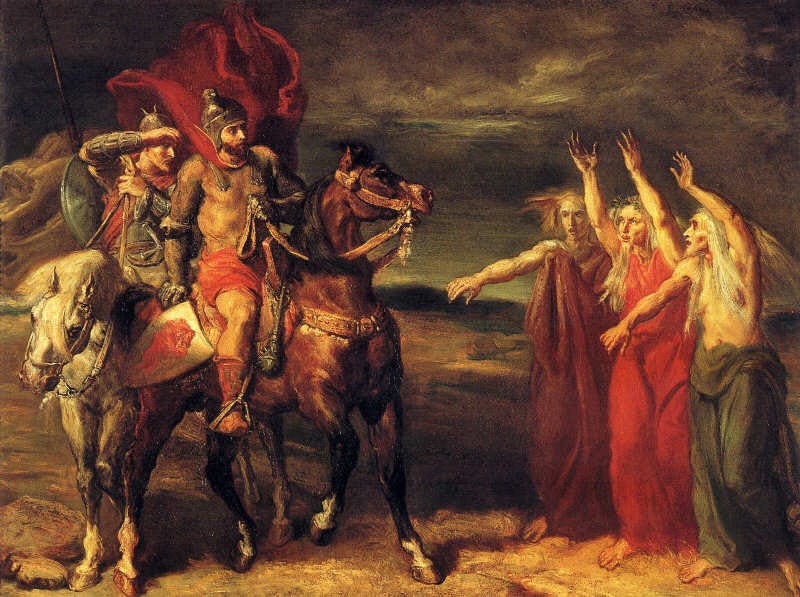
The witches awaken Macbeth’s ambition by predicting that he will become king, but they never tell him to murder Duncan. That decision belongs to Macbeth. At first, he considers allowing events to unfold without interference: “If chance will have me king, why, chance may crown me.” Soon, however, possibility becomes desire, and desire begins searching for a way to become reality.
Before Duncan’s murder, Macbeth conducts what amounts to a moral trial inside his own mind. Duncan has rewarded him. Macbeth owes him loyalty as a subject and protection as a host. Duncan has also ruled honorably, making the proposed murder especially difficult to justify. When Macbeth finally examines his own motive, he finds no legitimate grievance.
“I have no spur
To prick the sides of my intent, but only
Vaulting ambition.”
That admission makes the murder more disturbing. Macbeth cannot blame ignorance, rage, self-defense, or political necessity. He identifies ambition as his motive and understands that it provides no moral justification. He even tells Lady Macbeth, “We will proceed no further in this business.” His conscience has reached the correct judgment.
Yet the decision is made under sustained pressure. Lady Macbeth attacks his courage, questions his manhood, and reminds him of his earlier willingness to act. She does not create his ambition; she forces it toward action by refusing to accept his moral retreat. Macbeth’s responsibility remains his own because he ultimately accepts her reasoning and overturns the judgment he had already reached. Shakespeare separates moral knowledge from moral action with frightening precision. Macbeth can foresee much of the evil in front of him and still walk toward it.
The Crown Creates a New Kind of Fear
Duncan’s murder gives Macbeth exactly what he wanted, but kingship fails to produce the security he imagined. Banquo knows about the witches’ prophecy, and the witches have predicted that Banquo’s descendants will become kings. Macbeth has therefore committed an enormous crime to obtain a crown that may eventually establish another man’s dynasty.
His ambition now changes character. Before Duncan’s murder, Macbeth wants to acquire power. Afterward, he becomes obsessed with protecting it. Banquo must be eliminated, and Fleance must also die because he represents the future Macbeth cannot control. When Macduff becomes a threat, Macbeth orders the slaughter of his wife, children, and household.
The first crime has created a new set of problems. Macbeth now possesses something obtained through violence, and keeping it seems to require further violence. Rather than confront the original crime, he reorganizes his life around defending its rewards. Murder becomes a political method rather than an unthinkable exception.
The transformation becomes visible in his approach to action. Before killing Duncan, Macbeth deliberates at length. By Act IV, he announces a radically different principle:
“The very firstlings of my heart shall be
The firstlings of my hand.”
Reflection once gave his conscience time to resist. Macbeth now intends to eliminate that interval. The man who agonized over Duncan can order the killing of innocent children almost immediately. Shakespeare shows moral deterioration as a process: repeated violations make the next violation easier to commit.
Faustus Wants to Exceed the Human Condition
Christopher Marlowe begins Doctor Faustus with a man who already possesses much of what ordinary ambition seeks. Faustus is highly educated and has studied philosophy, medicine, law, and theology. Yet achievement leaves him dissatisfied. Existing fields of knowledge cannot provide the degree of power and mastery he now desires.
Faustus therefore turns to magic. His famous declaration reveals the scale of his ambition:
“A sound magician is a mighty god.”
The important word is “god.” Faustus wants knowledge that will allow him to command nature, acquire wealth, influence rulers, and exercise power beyond the ordinary reach of a scholar. Marlowe places that desire within the intellectual energy of the Renaissance, when classical learning was being recovered, inherited authorities were being questioned, and confidence in human capabilities was expanding. Faustus carries that confidence toward a dangerous extreme.
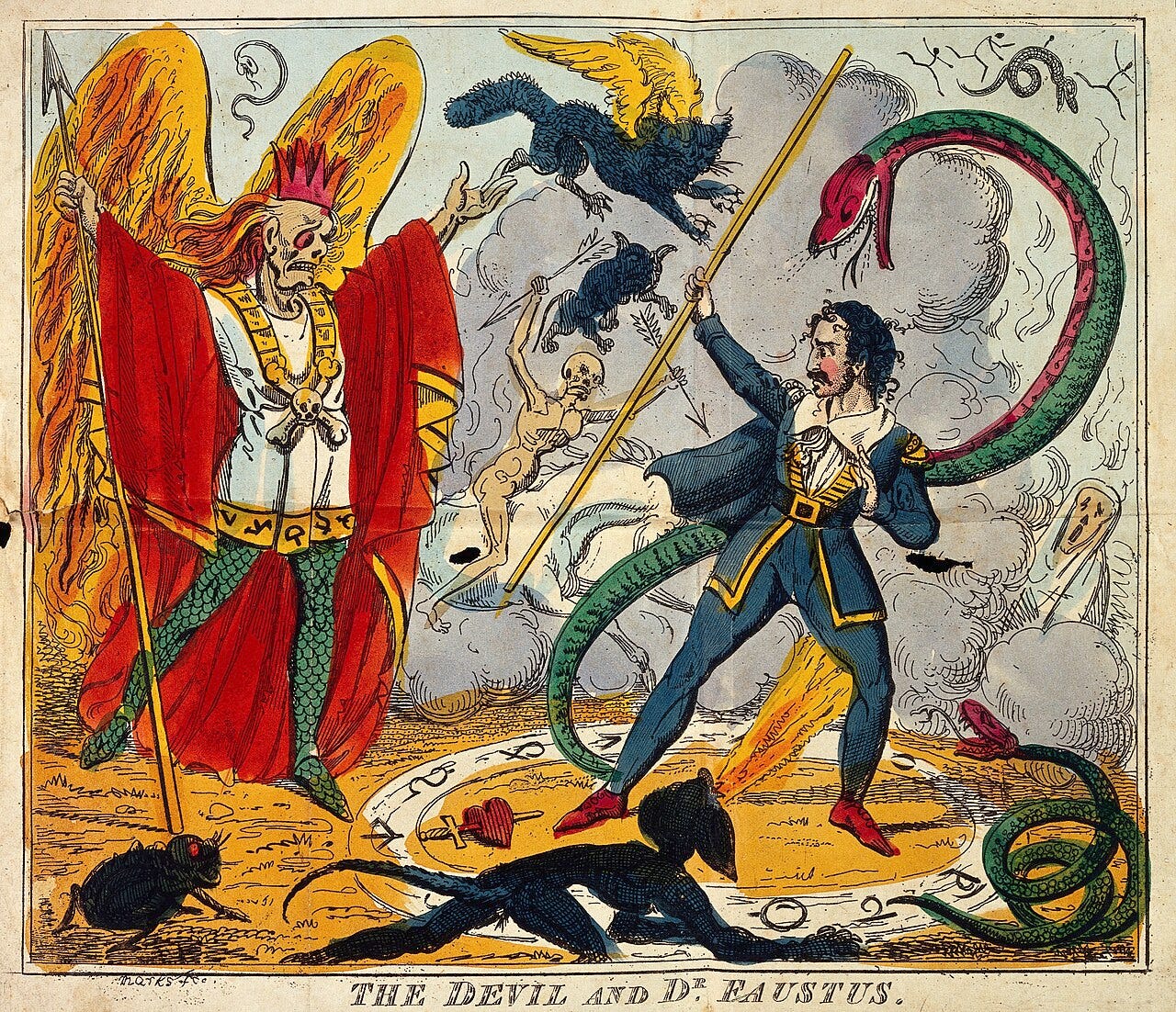
Yet he receives warnings from the beginning. The Good Angel urges him to abandon necromancy. His own doubts repeatedly interrupt his plans. Most remarkably, Mephistopheles himself warns him. When Faustus asks how a demon can be outside hell, Mephistopheles explains that separation from God is itself hell. Faustus therefore receives his warning from someone already experiencing the consequence he risks.
He signs the contract anyway, giving Lucifer his soul in exchange for twenty-four years of service from Mephistopheles. The bargain reduces his ambition to a terrible calculation: a finite period of power purchased with an eternal consequence.
What Faustus Does With Power Is the Real Indictment
Marlowe could have made Faustus increasingly impressive after the pact. Instead, the scale of his achievements shrinks. The man who dreamed of commanding enormous forces and discovering the secrets of existence increasingly uses supernatural power for entertainment, practical jokes, displays before rulers, and sensual gratification.
Much of the middle of the play descends into low comedy. Faustus and Mephistopheles humiliate a knight by giving him horns, trick a horse-courser, and conjure grapes for a duchess. The farce exposes the emptiness of the power Faustus has purchased. He dreamed of becoming almost divine and ends up using demonic assistance for spectacles and petty revenge.
His tragedy deepens because repentance remains possible throughout much of the play. Faustus repeatedly considers turning back, yet he increasingly treats his previous choices as proof that he cannot escape them. Despair becomes part of his imprisonment. Macbeth responds to his first crime by committing more crimes to preserve what he gained; Faustus becomes trapped by the belief that his first great choice has placed redemption beyond his reach. Both allow the past to dictate what they choose next.
Helen of Troy provides the final expression of his retreat from reality. As death and judgment approach, Faustus turns once more toward immediate experience:
“Was this the face that launch’d a thousand ships?”
The beauty of the line makes the situation more painful. Faustus has reached the end of his twenty-four years and still seeks temporary escape from the consequence he has spent years avoiding. The scholar who wanted extraordinary mastery over existence ultimately cannot master himself.
Why Neither Man Can Blame Fate
Both plays contain supernatural forces, but supernatural influence does not remove human responsibility. The witches predict Macbeth’s kingship without prescribing Duncan’s murder. Mephistopheles serves Lucifer, yet Faustus voluntarily summons him, negotiates the terms, and signs the pact.
This focus on personal responsibility is especially important to Renaissance tragedy. Classical tragedy had also explored the interaction between fate and human choice, but Shakespeare and Marlowe give extraordinary psychological attention to the decisions through which their protagonists participate in their own destruction. We hear Macbeth debate murder before committing it. We watch Faustus move repeatedly between repentance and refusal. Their inner conflicts matter because alternative choices remain visible.
The supernatural therefore intensifies the moral test rather than deciding its outcome. Prophecy gives Macbeth something to desire. Magic gives Faustus a means of pursuing desires that ordinary scholarship cannot satisfy. Neither force determines what the protagonist must do next.
What Ambition Actually Costs
Neither play asks us to reject ambition itself. Macbeth’s courage and ability have made him a celebrated soldier. Faustus’s intellectual hunger has made him an exceptional scholar. Their strengths become destructive when achievement is separated from moral limits.
That distinction gives both plays their continuing relevance. Political leaders seek office, entrepreneurs build companies, scientists pursue discoveries, artists seek recognition, and ordinary people work for wealth, influence, or status. Ambition becomes morally dangerous when obtaining the desired result requires actions a person already understands to be wrong. The immediate reward can then make retreat harder because admitting the wrong may also require surrendering what the wrong produced.
Macbeth pays for kingship long before he dies. He loses Banquo, his peace of mind, the loyalty of his country, his marriage, and eventually his capacity to find meaning in life. By the final act, the crown remains on his head, but almost everything that could have made kingship worth possessing has disappeared. Faustus receives the supernatural powers he requested, yet they provide no lasting satisfaction. When his twenty-four years expire, the confidence of the scholar who wanted to command spirits has given way to a terrified man begging time itself to stop.
Few people will murder a king for a Scottish throne or sign a contract with Lucifer. Many will encounter smaller versions of their choices: whether advancement justifies betrayal, whether success excuses dishonesty, whether power permits cruelty, or whether a desired result is worth violating a principle once considered firm. Shakespeare and Marlowe endure because they understand that moral collapse rarely requires ignorance. Intelligence, education, and foresight can coexist with terrible decisions.
Macbeth receives his crown. Faustus receives his twenty-four years. Both discover too late that getting what they wanted never settled the question of what it was worth. Their tragedies leave us with a harder measure of ambition: when we finally reach what we have spent years pursuing, can we still respect the choices that brought us there and the person those choices have made us?
