

When Defiance Becomes a Crime
Article 6 of The Arc of Belief and Meaning Series

In Article 5 of the Arc of Belief and Meaning Series, we looked at sacrifice as the hidden engine of order. What societies were willing to bleed to keep their world standing. Once a civilization decides something must suffer for stability to exist, the next question becomes dangerous: what happens when someone refuses the rules that hold that order in place?
Prometheus does not get punished for being reckless. In Hesiod, he humiliates Zeus at a sacrificial feast by hiding the good meat inside bones and fat, then steals fire back from Olympus after Zeus takes it away from humans. Fire is not a metaphor. It is heat, cooked food, metal tools, weapons, shelter. It is the difference between living like animals and building cities. Zeus chains Prometheus to a rock at the edge of the world and sends an eagle to eat his liver every day, knowing it will grow back overnight so the torture never ends. This is not about manners or rule breaking. Prometheus takes away human dependence, and that changes the balance of power.
Eve’s story moves slower, but the shift it creates is just as final. The serpent does not promise pleasure. It promises awareness. “Your eyes will be opened. You will know good and evil.” After she eats, nothing explodes. What changes is perception. Adam and Eve notice their nakedness. They feel shame and hide. They start thinking about themselves as moral beings who can judge and choose. That is the rupture. They move from childlike dependence inside a protected enclosure into conscious agency. The exile from Eden is what happens once innocence is gone and people start acting on their own judgment.
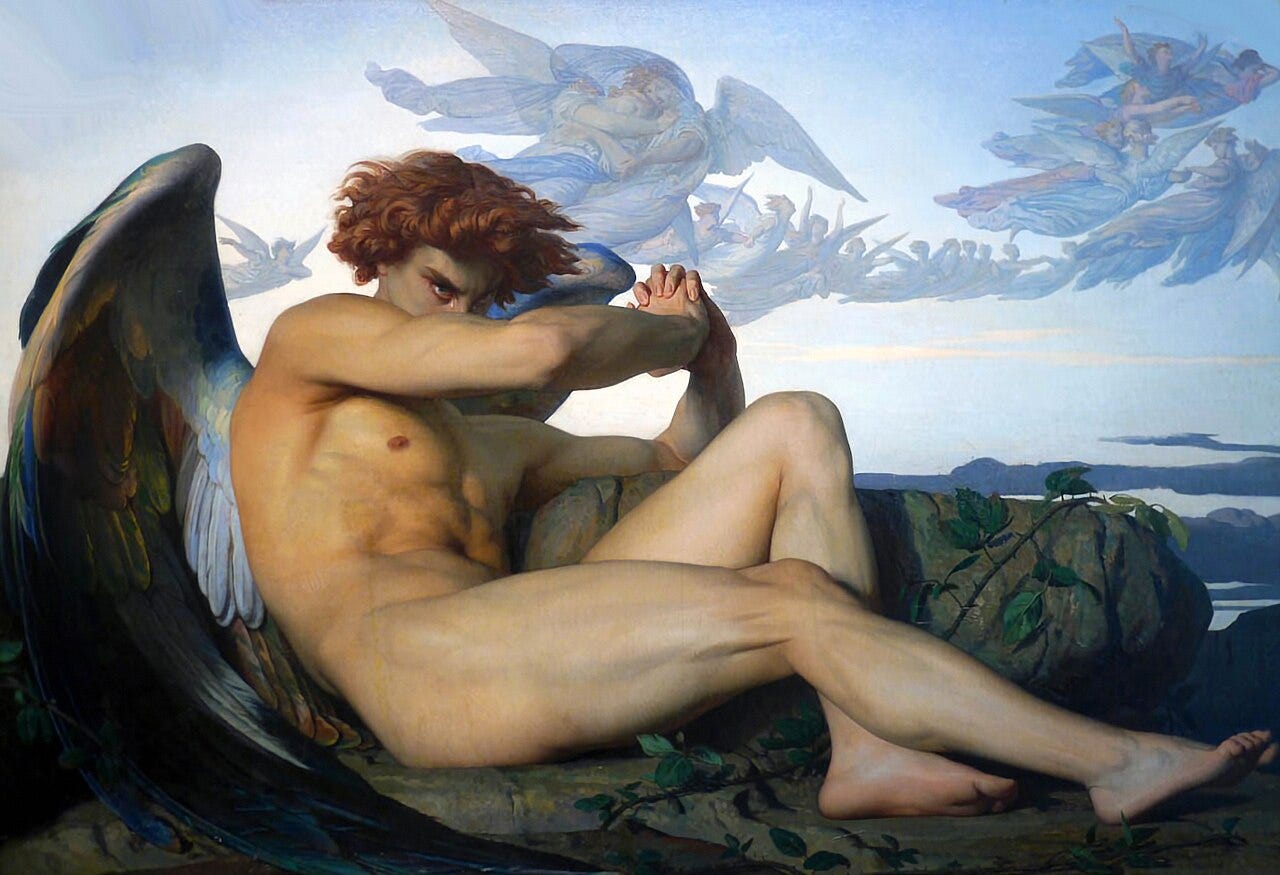
Lucifer’s fall, as it develops out of Isaiah and later theology, is not about pranks or tantrums. He is described as a brilliant, high-ranking being tied to the morning star. The language around his fall is about rank and ascent. “I will ascend to heaven. I will raise my throne above the stars of God.” This is a power struggle. He is not destroying anything. He is claiming a higher place in the hierarchy. That alone is enough to get him cast out. The crime is ambition. It is refusing a fixed position in a system built on unchallengeable authority.
Then the same structure shows up again in history, without gods or angels. Galileo builds a telescope and looks through it. He sees mountains on the moon, which means the heavens are not perfect and unchanging. He sees moons orbiting Jupiter, which means not everything revolves around Earth. He sees the phases of Venus, which only make sense if Venus orbits the sun. These are not opinions. They are observations. The Church reacts because heliocentrism quietly wrecks the authority structure of truth. If observation can override Scripture’s traditional interpretation, then institutional control over cosmology collapses. Galileo is ordered to stop teaching heliocentrism. He keeps going. He is put on trial by the Inquisition. He is threatened with torture. He recants publicly to avoid prison. The fight is not about telescopes. It is about who gets to decide what is real.
Put these stories next to each other and the pattern stops being subtle. Prometheus gives humans fire and gets tortured for it. Eve reaches for moral awareness and gets exiled for it. Lucifer challenges a fixed hierarchy and gets thrown out for it. Galileo follows evidence and gets silenced for it. In every case, the boundary that matters is not theft, sex, or blasphemy. It is unauthorized knowledge. That is why the punishments are always extreme. A rock and an eagle forever. Exile from paradise. Cast out of heaven. Forced recantation under threat of torture. These are not proportional responses to bad behavior.
This is where the thread from sacrifice becomes impossible to ignore. Order demands something bleed. Sometimes it is bodies. Sometimes it is truth. Sometimes it is the people who make others harder to rule. Sacrifice keeps the system standing. Knowledge threatens to pull it apart. Every civilization dresses this fear up differently. The rebel becomes a sinner. The light-bearer becomes a villain. The truth-teller becomes a heretic. The reflex underneath does not change.
This did not stay in myth. In the 20th and 21st centuries, people have been imprisoned, exiled, or erased for leaking state secrets, resisting authoritarian rule, or refusing to accept official versions of reality. Armenians were punished for insisting their genocide be named. Palestinians are punished for refusing to disappear quietly. Whistleblowers lose their careers. Research that threatens powerful interests disappears. Speech gets labeled dangerous when it disrupts official stories. The language is softer now. The logic is not.
The purpose of this article is not to praise rebellion. It is about noticing a pattern that keeps repeating because it is built into how power works. When people stop depending on you for survival, morality, or truth, your authority starts to wobble.
These stories teach people how to fear their own defiance. They tell you what happens to those who ask too much, know too much, or refuse to stay in their place.
And that brings the arc to its next turn. Up to now, rebellion has always pointed outward. Against gods. Against kings. Against churches. Against institutions. Against the stories that tell people where they belong. The next rebellion goes inward. Because once people stop trusting external authority to define truth, the question stops being, “Who should I obey?” It becomes, “Who am I?”
That shift changes everything. Because once rebellion turns inward, power loses its favorite weapon. You can punish bodies, silence mouths, and burn books. You cannot chain a question someone is asking inside their own mind.
If this series is helping you see belief, power, and meaning differently, subscribe to Culture Explorer newsletter. The next article drops there first, along with the rest of the Arc of Belief and Meaning.
And if you believe beauty, memory, and truth still matter in a world built to flatten them, share this with someone who is quietly asking the same questions.
