

When Does Breaking the Law Become Moral Courage?
What Separates Courage from Fanaticism

Thebes had barely finished burying one brother when Creon condemned the other to rot. Eteocles, who had died defending the city, would receive funeral rites, mourning, and honor. Polyneices, who had led the attack against it, would be left where he fell, outside the walls, exposed to dogs, vultures, heat, and dust. The order was public and brutal. No one was to touch the body, grieve over it, or throw even a handful of earth across it. Whoever disobeyed would die. In the world of Greek tragedy, that decree already felt monstrous. A body without burial was not simply unattended. It was cut off from reverence, from kinship, from the last human act owed to the dead. Sophocles begins there because he wants the audience to see the wound before they hear the arguments.
Antigone understands at once what Creon has done. She does not treat the decree as a matter of policy. She hears it as an outrage against her brother and against the order of humanity set forth by gods. She goes to Ismene in the dark and asks her to help. Ismene recoils. She knows Creon has power, guards, and the law on his side. She knows their family is already broken. Oedipus is gone. Jocasta is gone. Their brothers have slaughtered each other. She wants to survive what remains. Antigone cannot think in those terms. A brother’s body lies in the open. That fact governs everything. She decides to bury him because some duties are so important that delaying them already feels like betrayal.
To an ancient Greek audience, her decision would not have seemed strange in the way it can seem strange now. The dead had claims. They demanded rites, mourning, and burial. Homer had already taught that lesson with terrible force when Priam crossed into the Greek camp to beg Achilles for Hector’s body. Even Achilles, raging with grief and wrath, finally yielded. A father must be allowed to bury his son. Sophocles’ audience knew that world. They also knew the quarrel over Ajax, whose corpse became the center of another dispute over honor, disgrace, and burial. Antigone steps into that same field of moral urgency. She acts inside the ethics her audience would have recognized in their bones.
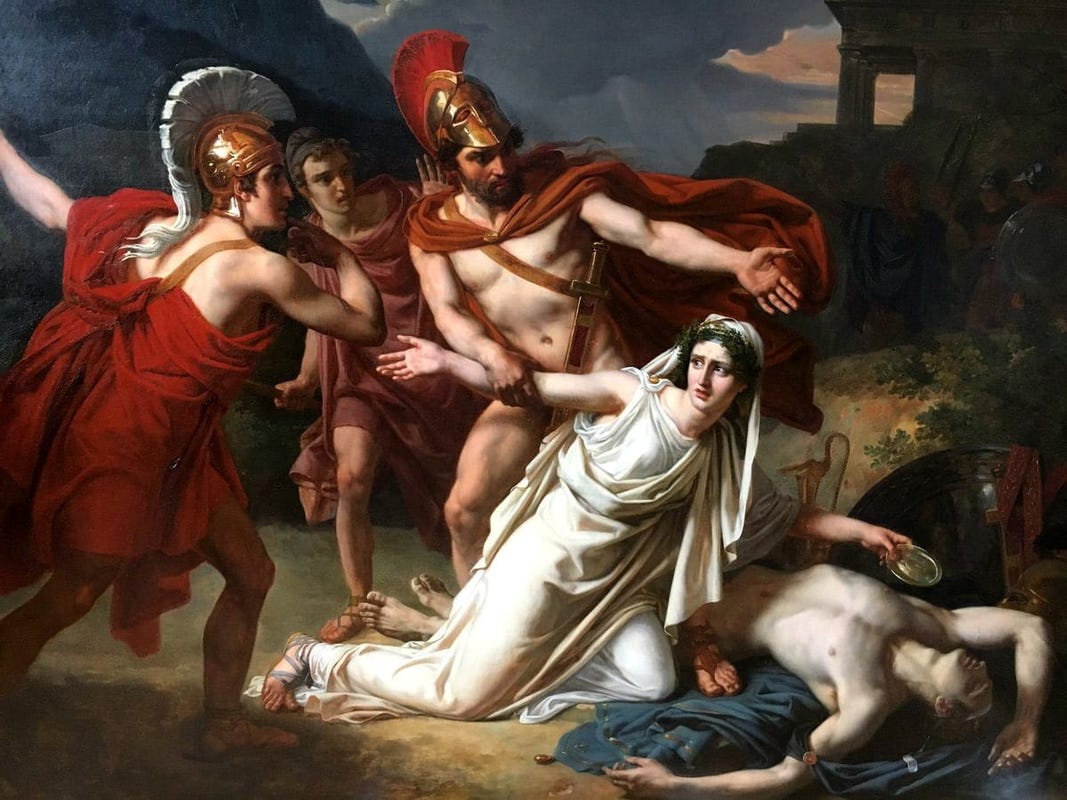
So, she goes out to Polyneices. She does what she can. The act itself is small, almost painfully small. A little dust, a few rites, and a gesture of honor over a violated body. Yet that small act carries enormous weight because it says Creon’s power stops here. The guards discover what she has done. They strip the earth away and watch. When she returns and repeats the burial, they seize her and drag her back. Sophocles stages the moment with cruel clarity. The king has the guards, the city, and the machinery of punishment. Antigone has a dead brother and a conscience that will not let go.
When she is brought before Creon, she does not come in like a swaggering rebel. She stands with her head lowered toward the ground, as if her body is still turned toward the dead even while she faces the throne. Then Creon questions her, and she answers with astonishing directness. Yes, she did it and she knew the decree. Yes, she broke it. But she refuses to grant his order final authority. Zeus did not make the order Creon had decreed. Justice did not write it. No king, in her view, can cancel duties that bind the living to the dead. In that moment the clash sharpens into its full shape. Creon speaks for the city as he understands it: rule, obedience, enemies, order. Antigone speaks for a law that is above all manmade laws, much older than Creon.
Creon hears danger in every word because he understands what is at stake. If Antigone stands, then his command meets a limit, and he is not master in the way he imagines. That is why he hardens. The decree becomes a test of his authority.
Haemon sees this before his father does. He tries persuasion first. The city, he says, is murmuring against this judgment. Antigone has done what many think honorable. Then he gives Creon the truth that rulers hate most when pride has taken hold of them: the city does not belong to one man. Creon cannot hear it. By then, the law has become personal.
That is what gives the story its force. Sophocles begins with a broken family, a corpse denied burial, a sister who cannot bear the sight of that dishonor, and a ruler who mistakes command for justice.
A secure ruler could have punished, relented, or found a way to preserve order without turning a burial into a contest of wills. Creon chooses the harsher path because he has started to hear disagreement as humiliation. He speaks as though the city were his possession, and Haemon answers him with the truth that should have broken the spell at once: no city belongs to one man. That line lands because it names the disease exactly. Creon still talks in the language of law, but pride has already colonized it.
Haemon is one of the most interesting figures in the play because he begins in restraint. He approaches his father carefully, as a son who knows he is speaking to a king. He reports what the city is saying in private, that Antigone’s act has won admiration rather than disgust. She covered a brother’s corpse. She honored the dead. She did what many in Thebes believe deserved praise, not death.
Haemon tries to save Creon from his own rigidity by appealing first to prudence and then to justice. He urges him to bend, to listen, to understand that a ruler who cannot hear anything but his own voice will eventually stand alone. Sophocles lets us watch the argument fail in real time. What destroys it is not logic. It is vanity. Creon would rather lose his son than surrender the image of command.
Then comes Tiresias, and with him the signs that the whole city has begun to sicken under Creon’s decree. The sacrifices no longer burn cleanly. The altars are fouled. Birds tear at the remains of Polyneices and scatter pollution through the city. What Creon tried to confine to one corpse has spread into the life of Thebes itself. This is one of Sophocles’ deepest insights. Desecration never stays contained. A law that violates something sacred does not simply wound one victim. It poisons the order around it.
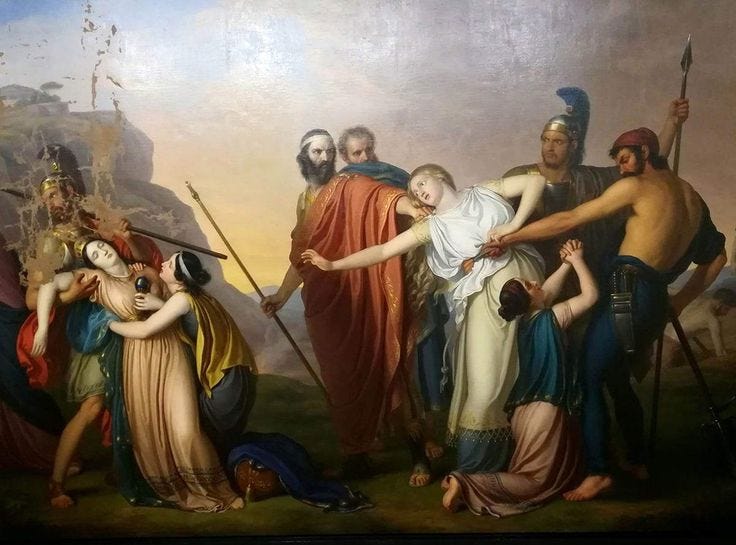
Tiresias tells Creon to bury the dead man and free the living woman. Creon answers the warning as proud rulers so often do. He accuses the prophet of corruption. Only when fear finally enters him does he move, and by then the rhythm of tragedy is irreversible. Antigone has hanged herself. Haemon dies beside her. Eurydice, Creon’s wife, dies after hearing what has happened. Creon survives, which in Greek tragedy is often the harsher fate, because survival means seeing clearly at last what pride has cost.
That is the ancient story. It gives us the clean shape of the problem. The modern world muddies it at once.
Northern Ireland asked the question again with batons, bridges, bombings, and prison cells. In January 1969, civil rights marchers at Burntollet Bridge were beaten and chased into the river by Protestant attackers. Dolours Price was there. That day pushed her towards the IRA, and she later refused the women’s auxiliary because she wanted a direct role, carrying messages and weapons and helping agents move past British soldiers.
Bernadette Devlin came through the same crisis by another road. At Queen’s University she helped build People’s Democracy, marched, organized, and then went into open politics. After the Battle of the Bogside in 1969, she served a prison sentence, entered Parliament, and used that platform to hammer the British government for its response to Northern Ireland. She could look at Harold Wilson and say that being prime minister gave him no right to waffle through the Commons while breaking promises. One woman took rage into speeches, elections, and public confrontation. The other took it into clandestine action.
Then the headline appeared. On 8 March 1973, Dolours Price led the Old Bailey bombing operation in London. Two bombs exploded. Two hundred and fifty-five people were injured. After prison came hunger strikes and violent force-feeding, scars that never really left her.
The point is not that one woman cared and the other did not. Both did. The point is where conviction went. Devlin kept turning grievance into speech, argument, and public accusation. Price reached the point where the cause could absorb the bodies of strangers into its price. That is the turn the question in the article is trying to catch. Antigone covers a brother’s body with dust and takes the punishment onto herself. The bomber reaches for scale, spectacle, and injury. One act says there is a line power must not cross. The other says the cause is now large enough to cross lines of its own.
Placed next to Antigone, that modern example clarifies rather than confuses. Antigone commits a forbidden act, but the act remains bounded. She buries a body. She accepts the danger herself. She does not expand the field of suffering to prove that she means what she says. Her defiance carries discipline within it.
Dolours Price shows what happens when a higher cause absorbs that discipline and replaces it with escalation. Both cases involve conviction. Both involve the claim that ordinary authority has failed. Only one preserves the dignity it seeks to defend. That difference is everything.
Greek tragedy had seen people call murder duty before. Agamemnon offered up Iphigenia. Orestes killed his mother. Medea killed her children. Antigone does something narrower and harder to dismiss. She buries her brother and takes the punishment herself.
The legal question becomes clearer from there. Law deserves obedience when it offers something more than force. It must be public enough to be known, clear enough to guide conduct, stable enough to be relied on, and impersonal enough not to shrink into the mood of one ruler. Once those qualities fail, the law begins to lose the authority that makes obedience honorable.
Creon’s decree fails in just that way. It is public, yes, but it has ceased to be impersonal. It serves less as a rule for the city than as an extension of one man’s injured will. That is why Antigone’s defiance still feels morally legible. She is not opposing law as such. She is confronting a command that has become morally diseased.
So, when does conscience outrank the law? Sophocles gives one answer in action rather than theory. Conscience outranks the law when law has crossed into grave injustice, when the act of resistance defends something fundamental to human dignity, and when the dissenter accepts the cost rather than passing it to the innocent.
Antigone stands inside those limits. Creon destroys them from above. Modern political violence destroys them from below. Between those two failures stands the narrow ground of moral courage, which is harder than obedience and rarer than rebellion.

Thought provoking and so pertinent to the now. Thank you!
Excellent. But here's an argument: Antigone and Polyneices had the attention of the city. Her selfless act was widely seen and acknowledged. Doulours Price, like many today who resist what they regard as unjust power, are obscure and little noticed unless they act to seize the public's attention. And that something may well entail violence.
I'm not defending Price. All I'm saying is that the two situations are not parallel. A better case to examine might be that of Luigi Mangione. He targeted someone that many of us could agree was a key figure in the ongoing and massive injustice of the US healthcare system. I'm not defending Mangione, either, but if he had turned himself in and pleaded guilty after the act, how would we characterize it?