

When Love Broke Epic
Apollonius Made Desire the Force That Reshaped Heroism

Apollonius of Rhodes took a genre built on force and made desire the power that decides the voyage.
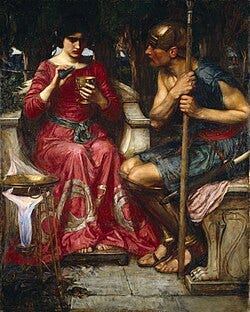
Greek epic usually moves through force. Apollonius drove it through desire. In The Voyage of Argo, Jason reaches the Golden Fleece because Medea falls in love, and that choice changes the meaning of heroism. The voyage still gives us kings, monsters, sea danger, divine pressure, and a prize waiting at the far edge of the world. But the force that decides the story comes from longing, persuasion, emotional exposure, and the wreckage that follows when desire takes command. Jason reaches the Fleece through Medea, and Medea acts because desire takes hold of her. From that moment, epic becomes more emotionally volatile and morally dangerous.
Apollonius prepares that change early. In Book 1, Jason goes to meet Hypsipyle on Lemnos carrying a cloak that recalls Achilles’ shield. Achilles arms himself for vengeance and returns to war. Jason shoulders a cloak and ends up in bed with a queen. Apollonius takes a Homeric emblem of martial glory and turns it toward desire. The symbolism is direct. From the start, he signals that this voyage will be governed by a different force.
The stop on Lemnos sharpens that law. The Argonauts linger there too long, absorbed by pleasure and forgetting the mission. Time itself loosens in the episode, as if desire has begun to dissolve heroic discipline. Heracles has to push them back toward purpose. That moment shows that attraction already has the power to delay the quest before Medea even appears. Apollonius wants the reader to feel that pleasure is not a side issue in this poem. It is already competing with glory for control of the voyage.
Paid subscribers get the full article, including how Medea becomes the emotional center of the poem, why Jason’s heroism depends on her desire, how love can have unintended consequences, and why Apollonius changed epic for everyone who came after him.
