

When Power Borrows God’s Name
How does identity become a weapon when power needs it?

The fight began with a question every empire fears: who gets to lead after the founder dies?
In 632, the Prophet Muhammad died, and the Muslim community faced a decision that could never stay small. That question did not stay in Medina. Centuries later, that same pattern still appears in places like Kurdistan, where leaders use sect, tribe, ethnicity, and fear to win loyalty. Then comes Sinjar, where the Yazidis paid the worst price: a small religious minority was marked by an old lie, abandoned by larger powers, and attacked by ISIS in 2014.
These are not three separate stories. They are one story told across time. First, sacred memory is formed. Then political leaders learn how to use it. Finally, vulnerable communities suffer when those labels become stronger than citizenship.
The easy version says this is a religious conflict. The harder version asks better questions. Who controls land? Who writes the textbooks? Who gets a seat in parliament? Who receives police protection when armed men arrive? Who is treated as a full citizen when the slogans fade?
That harder version tells the truth. Religion matters here because people live by sacred memory. Power matters because men with offices, weapons, budgets, and borders decide who survives the next crisis.
Centuries later, the damage can still be seen in Kurdistan and northern Iraq, where Shia, Sunni, and Yazidi communities share land, language, markets, memories, and graves. These communities have lived beside each other, traded with each other, feared each other, and buried their dead in the same soil. When politics hardens identity, the neighbor becomes a category before he remains a person.
That is why the Yazidi tragedy matters so deeply. Yazidis were a native Mesopotamian community long before most outsiders learned their name in 2014. They had sacred places, customs, family networks, and a history tied to Sinjar. Yet for generations, enemies described them through a false charge: devil worship. Once a community is given that label, its humanity becomes easier to deny. A lie becomes a permit, and rumor becomes a road to massacre.
The Split Began With Leadership, Then Became Memory
The Sunni-Shia split grew from the first leadership crisis after Muhammad’s death. Sunni tradition came to accept the first four “rightly guided caliphs”: Abu Bakr, Umar, Uthman, and Ali. Shia tradition placed Ali at the center from the beginning and held that leadership should continue through Ali and Fatima, the Prophet’s daughter. Even the word Shia comes from Shiat Ali, meaning the supporters of Ali.
From there, the conflict entered the world of armies. After Uthman was murdered, Ali became caliph in 656. He faced opposition from Aisha, the Prophet’s widow and Abu Bakr’s daughter, in the Battle of the Camel. Then came Muawiya, the governor of Damascus and Uthman’s kinsman, who challenged Ali’s rule.
At Siffin, Muawiya’s soldiers reportedly lifted Qur’an verses on their spears, and Ali’s fighters hesitated. That image still explains a political truth: sacred language can stop an army as quickly as steel. When scripture appears on a spear, the battlefield changes. The soldier now has to ask whether he is fighting a man, a rebellion, or God’s words raised in front of him.
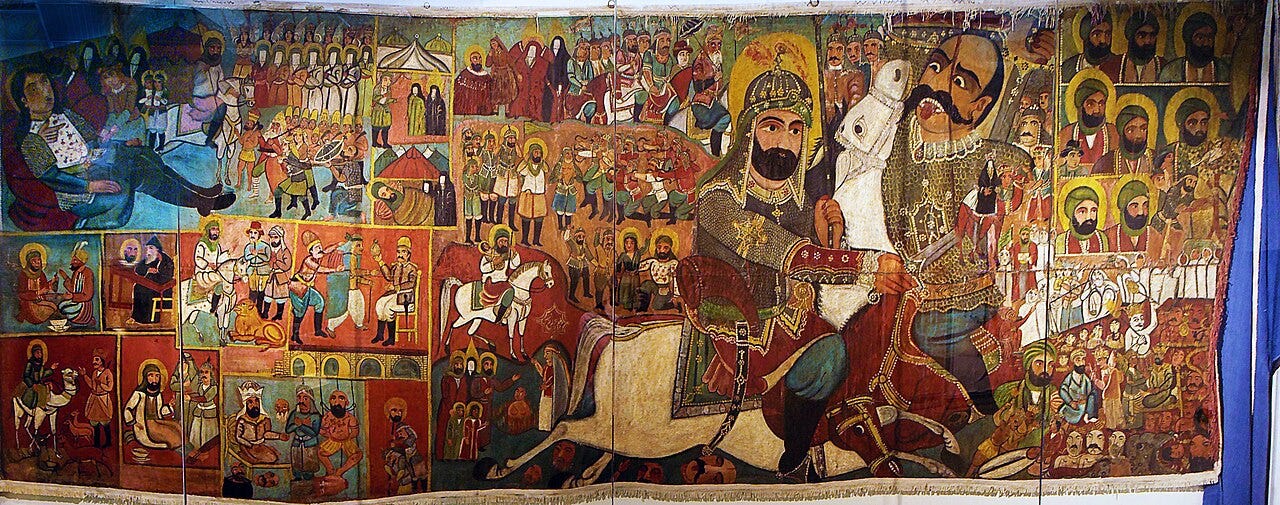
Ali was assassinated in 661. Muawiya took power. Ali’s elder son Hasan stepped back from the claim to rule. Then, in 680, Ali’s younger son Husayn refused to give allegiance to Yazid, Muawiya’s son. On the 10th of Muharram in 61 AH (680 AD), the day remembered as Ashura, Husayn and his small group were surrounded and killed at Karbala in modern Iraq.
For Shia Muslims, Karbala became the great wound. The killing of the Prophet’s grandson also became the moment when power looked at bloodline, piety, and protest, then chose the sword. Yazid won the field, but Husayn won the memory. That is why Karbala still carries more force than a normal battle. It became a moral story about what happens when a ruler loses restraint.
Karbala still shapes emotion. During Ashura, many Shia communities remember Husayn’s death with mourning, chest beating, public grief, and sermons about sacrifice. Some Shia Muslims pray with their forehead touching a small clay tablet associated with Karbala. That detail matters because it shows how history moves into the body. A battle from 680 becomes a gesture on a prayer mat.
Yet the split never erased the shared core of Islam. Sunnis and Shias affirm the Five Pillars and recognize each other as Muslims in many major scholarly traditions. In 1959, Sheikh Mahmood Shaltoot of Al-Azhar recognized the Ja’fari school of Shia law as valid to follow. That ruling cuts through the lie that Sunni and Shia difference must end in hatred. Real differences exist, and so does a shared foundation.
Kurdistan Shows What Happens When Identity Becomes a Political Tool
Kurdistan adds another layer because religion, ethnicity, tribe, language, and state power sit on top of each other. A person may be Kurdish and Sunni, another may be Kurdish and Shia, and another may be Kurdish and Yazidi. In daily life, these identities can share neighborhoods, markets, weddings, schoolyards, and funerals. During political stress, the same identities can become voting blocs, checkpoints, accusations, and borders inside the mind.
The Shia, Sunni, and Yazidi conflict in Kurdistan has often been political at its core, then framed in religious terms because religion moves people faster than policy. That claim fits the record. Rulers and parties rarely say, “We want more land, votes, money, and control.” They often say, “We are defending the faith.” The second line travels better. It reaches the mosque, the classroom, the family table, and the young man holding a weapon. Religion and politics are used as gimmicks and tools to serve the status quo.
Sectarian tension rises during elections. Old wounds are reopened when parties need votes. Communities that lived beside each other for years suddenly become suspicious because someone benefits from the suspicion.
One historian pointed to the Kurdish referendum of 2017 and the Shia Kurds of Khanaqin. He argued that Shia Kurds showed strong support for an independent Kurdistan, while political representation still favored Sunni party structures in many institutions. Peace does not come from speeches about harmony. It comes when a community votes, pays taxes, serves in public life, and still receives equal treatment.
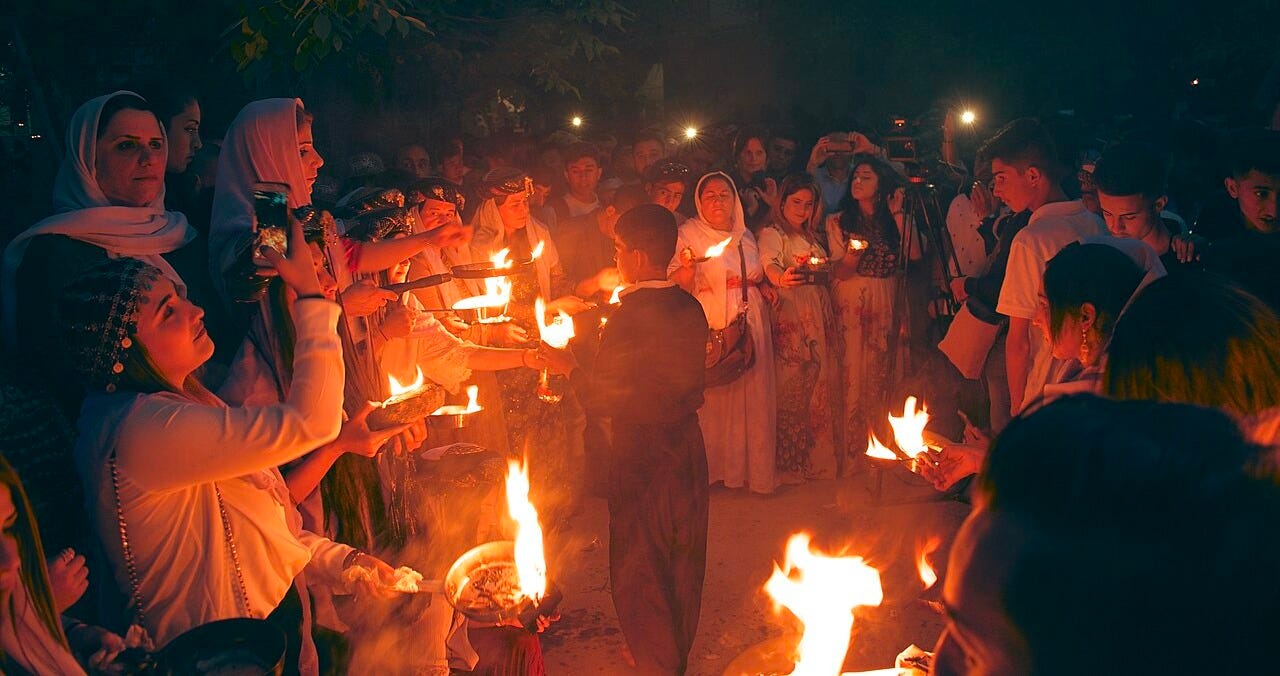
Sinjar is a district in northern Iraq, west of Mosul, with Mount Sinjar rising over the surrounding villages and plains. For Yazidis, Sinjar is homeland, memory, family, shrine, graveyard, and refuge. Sinjar gives the same lesson in a harsher form. Yazidis have said that when ISIS attacked in 2014, Kurdish forces failed to protect them. That accusation deserves a central place because security is the first test of citizenship. When a state, party, or militia asks for loyalty but disappears during danger, trust dies. The next peace conference then begins with a wound already in the room.
The Yazidi Wound: A False Accusation With a Long Knife
The Yazidis are a Kurdish religious minority with deep roots in northern Iraq. For Yazidis, a false religious label became a social weapon. Yazidis believe in God and honor Malak Tawus, the Peacock Angel. In Yazidi tradition, Malak Tawus refused to bow to anyone but God and was elevated, not condemned. Hostile outsiders twisted that belief into the devil-worship accusation. Once that accusation spread, it followed Yazidis into books, sermons, gossip, and policy.
This kind of harm begins before the killing. A community is described falsely for so long that its own testimony gets pushed aside. Yazidis told people who they were. Many neighbors, rulers, and outside writers preferred the easier lie. That lie did two kinds of damage. It put Yazidi bodies in danger, and it denied Yazidis the right to explain their own faith.
The Yazidis have suffered repeated genocides and persecutions over centuries. Whether one accepts every historical count or debates the number, the pattern remains clear: Yazidis have been targeted again and again because powerful groups found them small enough to attack and strange enough to slander. The slander made the violence easier to sell.
Then came August 3, 2014. ISIS swept across Sinjar. Men and older boys were separated from families. Women and girls were enslaved and sold. Boys were taken for training. The United Nations report on ISIS crimes against Yazidis carried a title from survivor testimony:
“They came to destroy.”
That title says more than a statistic. It names the intent.
The UN commission concluded that ISIS committed genocide against the Yazidis, describing killings, sexual slavery, forced conversion, torture, separation of families, and the transfer of children into ISIS control. It documented the machinery of that genocide and noted that the consequences continue through missing people, destroyed homes, stolen children, trauma, and the fear of return. Genocide does not end when the shooting stops.
The 2014 attack did not appear from empty air. ISIS used old accusations and old sectarian habits. The fighters arrived with modern weapons, but the story they used against the Yazidis had been prepared over centuries. That is why bad history can kill. A false lesson taught long enough can become a weapon in someone else’s hand.
Saddam, 2003, and the Return of Old Fears
Modern Iraq had added fuel to older wounds. Under Saddam Hussein, state power favored a narrow ruling circle and punished Shia political opposition with brutality. Kurds faced campaigns of repression, displacement, and chemical attack. Yazidis lived under pressure, neglect, and the constant danger that larger powers would speak for them or sacrifice them.
The state trained people to understand identity through fear. A citizen learned which name, village, sect, or language could make life dangerous. Under that kind of rule, politics enters the home. Families learn what to say in public, what to hide, who to trust, and when silence becomes safer than honesty.
After 2003, Saddam’s fall changed the balance. Shia parties gained power, often with Iranian support. Sunni communities feared revenge and exclusion. Kurdish leaders expanded their own political space. Yazidis remained exposed between larger forces. A new Iraq could have built a citizenship model stronger than sect, but ministries, militias, parties, and foreign patrons often turned identity into a share of power.
This is why theology alone will never explain the conflict. Theology matters because people live by sacred stories. Politics decides who gets weapons, offices, roads, budgets, textbooks, judges, and police. Social life decides who marries whom, who trusts whom, who shares a meal, and who receives help when danger comes. Religion gives meaning to life. Politics decides how much fear enters that life.
Kurdistan sits in the middle of bigger states and bigger ambitions: Iraq, Iran, Turkey, Syria, and the wider Middle East. Every outside power sees the Kurds through its own fears and uses internal divisions when useful. Divided Kurdistan becomes easier to pressure, while a united and fair Kurdistan becomes harder to manipulate. That is why local justice and regional strategy belong in the same conversation.
What Peace Would Actually Require
Peace in Kurdistan needs more than slogans. The first task is honest education. Children should learn the Sunni-Shia split with dates, names, decisions, and consequences. Students should learn Karbala without being trained to hate, and they should learn Yazidi belief from Yazidi sources rather than hostile rumors. A student should leave school knowing that Malak Tawus belongs to Yazidi faith, and that the devil-worship charge helped put people in danger.
The second task is equal law. A Yazidi, Shia, Sunni, Christian, Kaka’i, Yarsani, Sabian, or Assyrian citizen should receive protection and legal recognition without being forced through another community’s religious framework. Marriage, inheritance, worship, and representation should reflect the real diversity of the country. A legal system that treats one faith as the default citizen will keep producing second-class citizens.
The third task is public memory. Sinjar should be rebuilt, protected, and treated as a national wound. Khanaqin should be treated as a real political community, not as a convenient vote bank. Karbala should be understood as a sacred memory for Shia Muslims and a historical warning for everyone else: when power loses moral restraint, the victim’s blood can outlive the ruler’s throne.
The fourth task is political honesty. Leaders should stop waking up sectarian ghosts during elections and then pretending to be peacemakers after the votes are counted. Parties that use fear to win power should be judged by the damage they leave in neighborhoods. A campaign speech can burn trust faster than a militia if it tells one community that another community is a threat by birth.
The fifth task is contact. Many Muslims had never visited a Yazidi place of worship or met Yazidis in any meaningful way, while many Yazidis carried fear shaped by Muslim violence against them. People who never meet can be trained to fear each other. Visits, shared civic projects, school exchanges, survivor testimony, and local councils will never fix everything, but they can puncture the lie that the neighbor is a monster.
The Lesson
This history shows how a leadership dispute can become a memory system, how a false accusation can mark a people for violence, and how politicians can turn both into votes, borders, and silence.
The most dangerous conflicts are often the ones people inherit without understanding them. A child hears a story at home, a teacher repeats a biased lesson, a preacher adds heat, and a politician sees an opportunity. Years later, someone stands at a checkpoint or enters a village with a gun, convinced that he is acting on truth.
Security, courts, and diplomacy all matter. They will hold only when the stories people inherit are corrected. Peace begins when communities can say what happened without turning every fact into a weapon.
Kurdistan can become an example for the Middle East if it does the hard work: teach honest history, protect every community, rebuild Sinjar, represent Khanaqin fairly, and stop letting power hide behind God’s name.
The test is simple. A Yazidi child in Sinjar, a Shia voter in Khanaqin, and a Sunni student in Erbil should be able to learn the same history without being trained to fear each other.
Peace begins there, or it begins nowhere.
