

When the Gods Purify the World
Article 3 of The Arc of Belief and Meaning

I began the third article in the Arc of Belief and Meaning series with a question that would not leave me alone. Why do so many ancient cultures tell the same story about a world destroyed by water.
At first, I assumed this was coincidence. Floods happen. Rivers overflow. People tell stories. But the more I read, the more precise the pattern became. These were not just stories about bad weather. They were carefully structured narratives about moral collapse and renewal.
The earliest written version appears in Mesopotamia, around 1800 BC, in the Epic of Gilgamesh. The gods decide to drown humanity because people have become too loud and too numerous. The noise disturbs the divine order. The god Ea secretly warns Utnapishtim and tells him to build a massive boat. He seals it with pitch, brings his family and animals inside, and survives as the world disappears under water. After the flood, the boat rests on Mount Nisir. He releases birds to test the waters. He offers a sacrifice. The gods regret their decision.
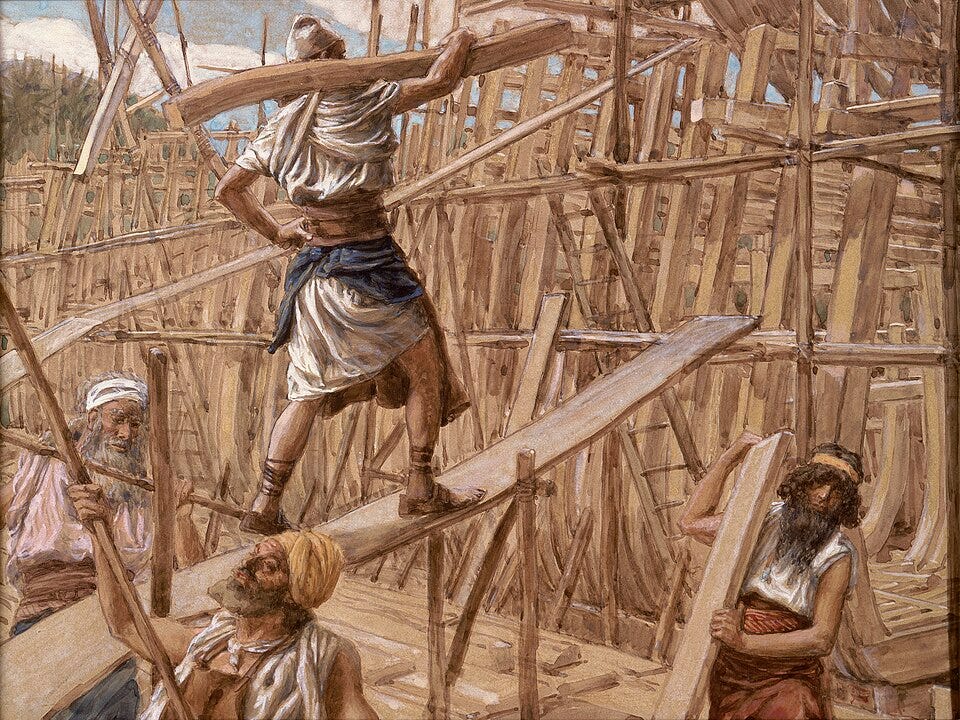
Centuries later, the same structure appears in the Hebrew Bible. The reason is no longer noise but violence. The earth is filled with bloodshed and corruption. God warns Noah and gives him exact measurements for the ark. Noah gathers his family and the animals. Rain falls for forty days. The waters remain for months. The ark comes to rest on the mountains of Ararat. Birds are sent out. A sacrifice is offered. This time, God makes a covenant and promises never to destroy the world by flood again.
In India, in the Shatapatha Brahmana, the story appears in another form. Manu is warned by a small fish that grows into Vishnu. He builds a boat. The flood covers the earth. The fish pulls the boat to safety. Manu becomes the ancestor of the new human race. But here the tone is different. This is not a final judgment. It is one reset in an endless cosmic cycle.
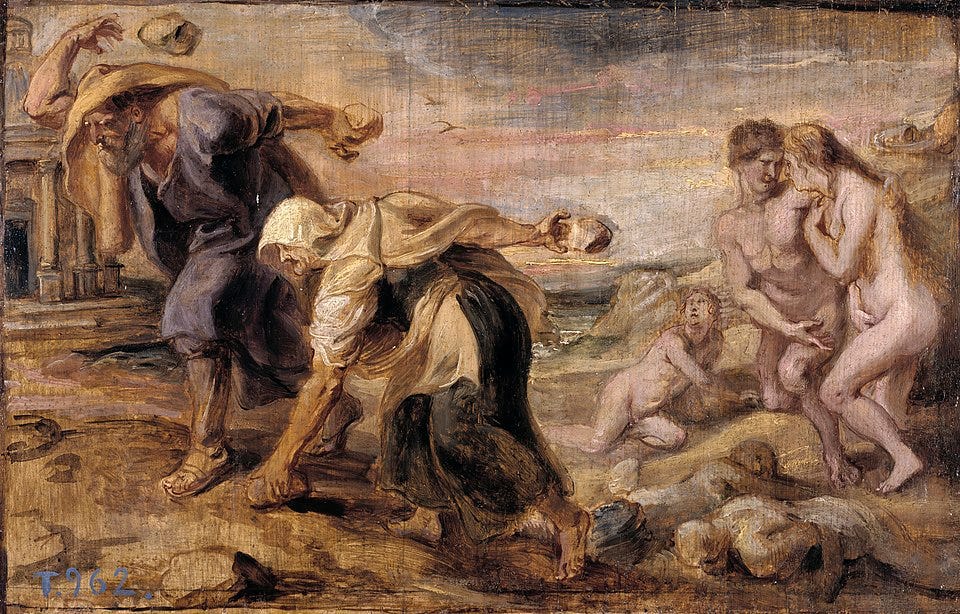
In Greece, Deucalion and Pyrrha survive a flood sent by Zeus to punish human corruption. Their boat lands on Mount Parnassus. They repopulate the world by throwing stones behind them that become men and women. In China, the memory of flood survives in another form. The Great Flood overwhelms the land, but Yu the Great does not escape by boat. He spends years dredging rivers and cutting channels, taming the waters through discipline and planning. Civilization begins not with survival, but with governance.
In the Americas, the pattern appears again. In the Popol Vuh, the first humans are destroyed by water because they forget their creators. New humans are made afterward with proper speech and memory.
By this point, the similarities were impossible to ignore. Warning. A chosen survivor. A vessel. Preservation of life. A mountain. A sacrifice. A new beginning.
At least thirty major flood traditions follow this same sequence.
That was the moment something unsettled me.
Floods are common in river civilizations, but this story was too precise to be only about natural disaster. It was not just about how the world ends. It was about why the world deserves to be ended.
When violence becomes normal.
When gratitude disappears.
When order collapses.
The world is washed clean.
For a long time, I thought I was writing an essay about floods. Then I realized the flood was only the first language of destruction. As I kept reading, I noticed that different cultures did not fear only water. They feared whatever had the power to erase their own world. And they imagined the gods using exactly that.
