

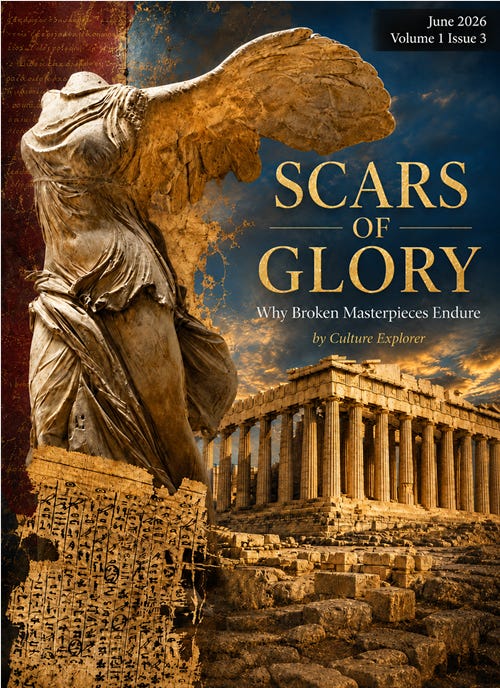
Why Broken Masterpieces Endure
The Inspiration Behind the eBook "Scars of Glory"

The most painful truth about beauty is that we often understand its value only after time has already wounded it.
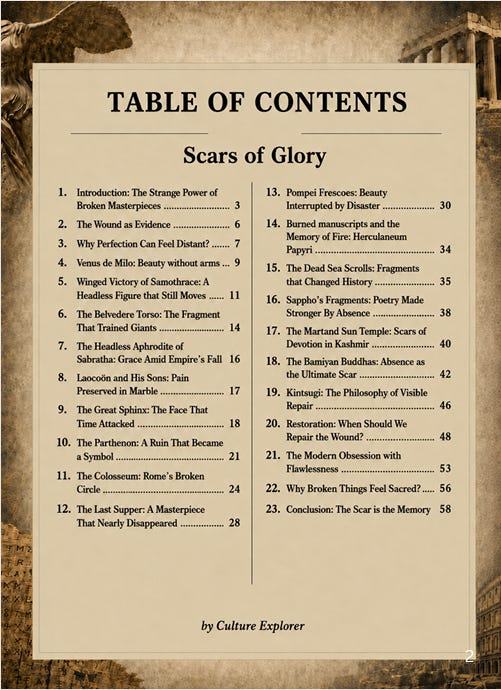
Scars of Glory explores broken masterpieces, but its deeper subject is survival. Why do damaged statues, ruined temples, burned manuscripts, and visibly repaired monuments often move us more deeply than pristine ones?
A perfect object impresses with skill and control. A scarred one makes a harder demand: What happened here? What was lost? Who believed it was still worth saving?
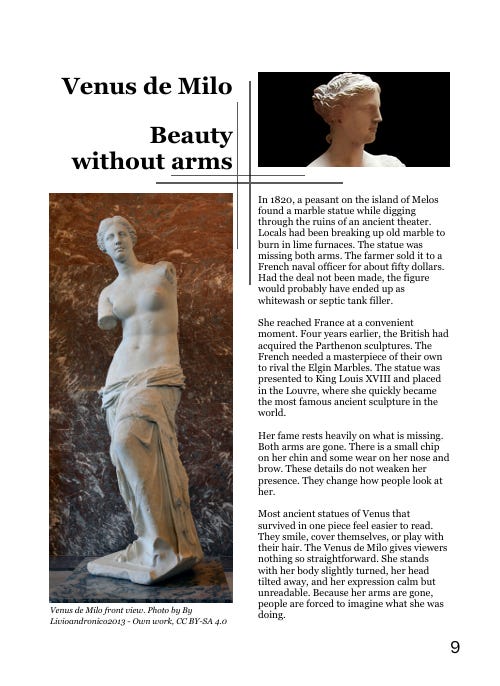
We linger before the broken thing. The armless Venus de Milo turns passive admiration into active imagination. Viewers still debate what she once held. The headless Winged Victory of Samothrace seems to arrive on a storm wind, her missing face making the motion more powerful, not less. A shattered temple or burned scroll fragment carries two stories: the one it was made to tell, and everything it endured afterward.
Damage turns the work from an object into evidence. It records war, neglect, accident, devotion, and time on its surface. The missing parts do not erase meaning; they redirect it. We stop looking for completion and begin to feel force, balance, gesture, mystery, and endurance.
This response to damage has deep roots. Renaissance artists studied broken ancient sculptures with unusual intensity. Michelangelo returned again and again to the Belvedere Torso, a headless, limbless trunk, because what remained was so concentrated. The fragment trained giants by forcing attention onto its strength and stored energy.
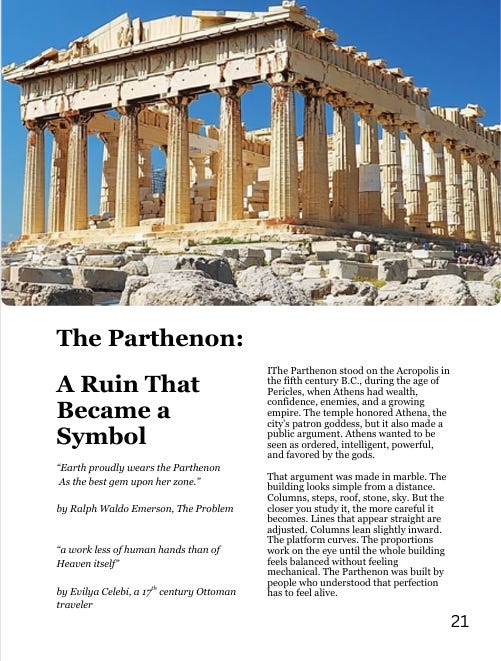
The same pattern appears in ruins and manuscripts. The Parthenon survived as a church, mosque, and gunpowder store before the 1687 explosion ripped it open. Pompeii’s frescoes were sealed by disaster, preserving private Roman rooms in a single catastrophic moment. Burned scrolls and desert fragments remind us how close civilization always stands to silence and how much a single surviving scrap can still say.
The eBook also asks when repair becomes rescue and when it becomes denial. Some wounds must be treated. Others deserve to remain visible because they tell the truth. Kintsugi, the Japanese practice of mending broken pottery with gold, treats the scar as part of the beauty. Modern culture often tries the opposite, smoothing every surface, editing every flaw, presenting life as if nothing has ever broken.
Scars of Glory pushes against that instinct. It argues that certain marks deserve reverence because they show what endured.
A perfect object asks us to admire it.
A damaged masterpiece asks why it is still here.
What survives the wound becomes more than beautiful.
It becomes a witness.
Download the eBook after the paywall.
Keep reading with a 7-day free trial
Subscribe to The Culture Explorer to keep reading this post and get 7 days of free access to the full post archives.