

Why Cappadocia Stays With You
What Living Inside Stone Revealed

I didn’t arrive in Cappadocia rested or inspired. I arrived exhausted. What was supposed to be a simple 1.5-hour flight from Istanbul turned into a 11-hour journey that felt endless. Delays piled up. Weather worsened. The plane diverted to Kayseri, but then made an unexpected stopover to refuel in Ankara. By the time I finally reached Cappadocia by bus from Kayseri, it was already the evening of January 1st, and I was running on fumes.
Oddly enough, that exhaustion turned out to be the perfect way to enter Cappadocia. Because Cappadocia doesn’t greet you with excitement. It absorbs you.
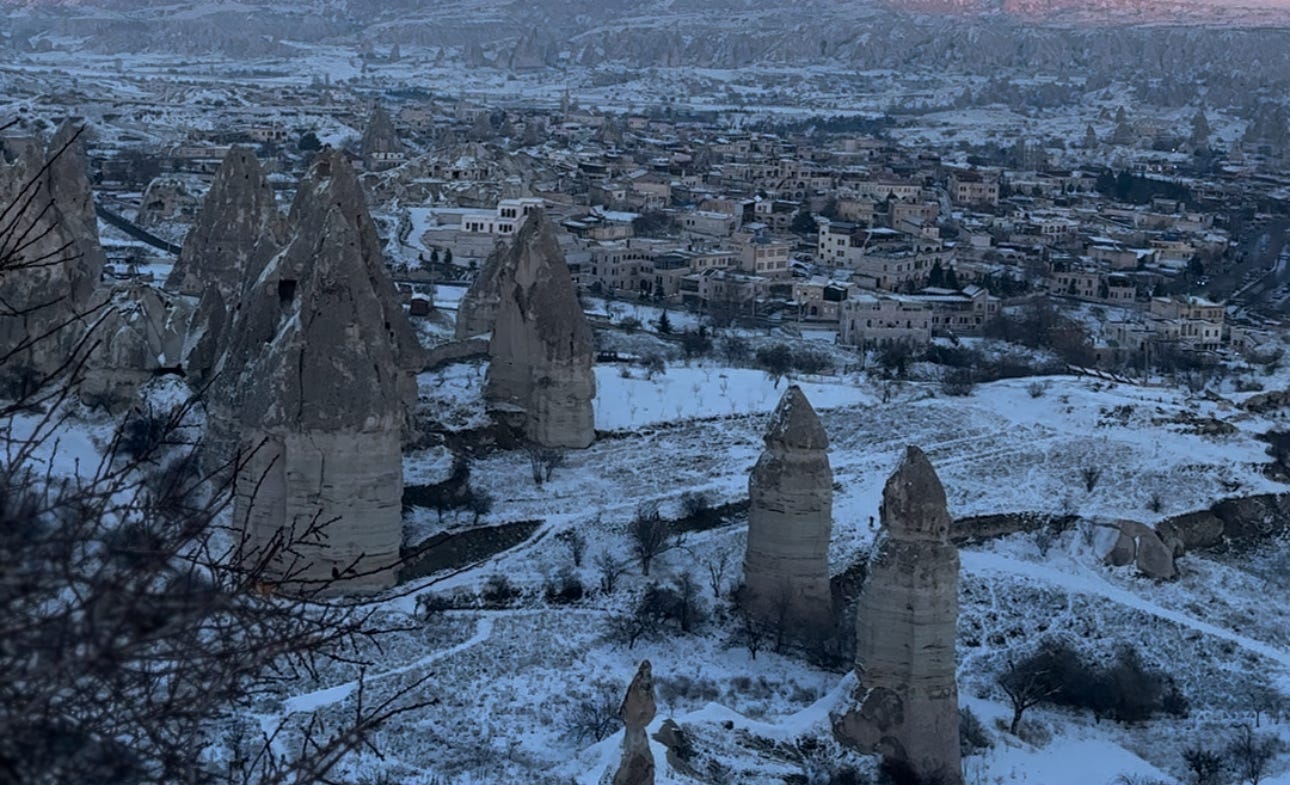
I checked into a cave hotel and stayed there until January 4th. The moment I stepped inside, something shifted. Outside, winter air cut through everything. Inside the cave, the temperature was perfect. Not cold. A little warm but cozy. Calm. After that long journey, it felt unreal. No hum of heating systems. No artificial blast of air. Just stone doing what it has done for centuries.
That was my first real lesson, and I hadn’t even started exploring yet.
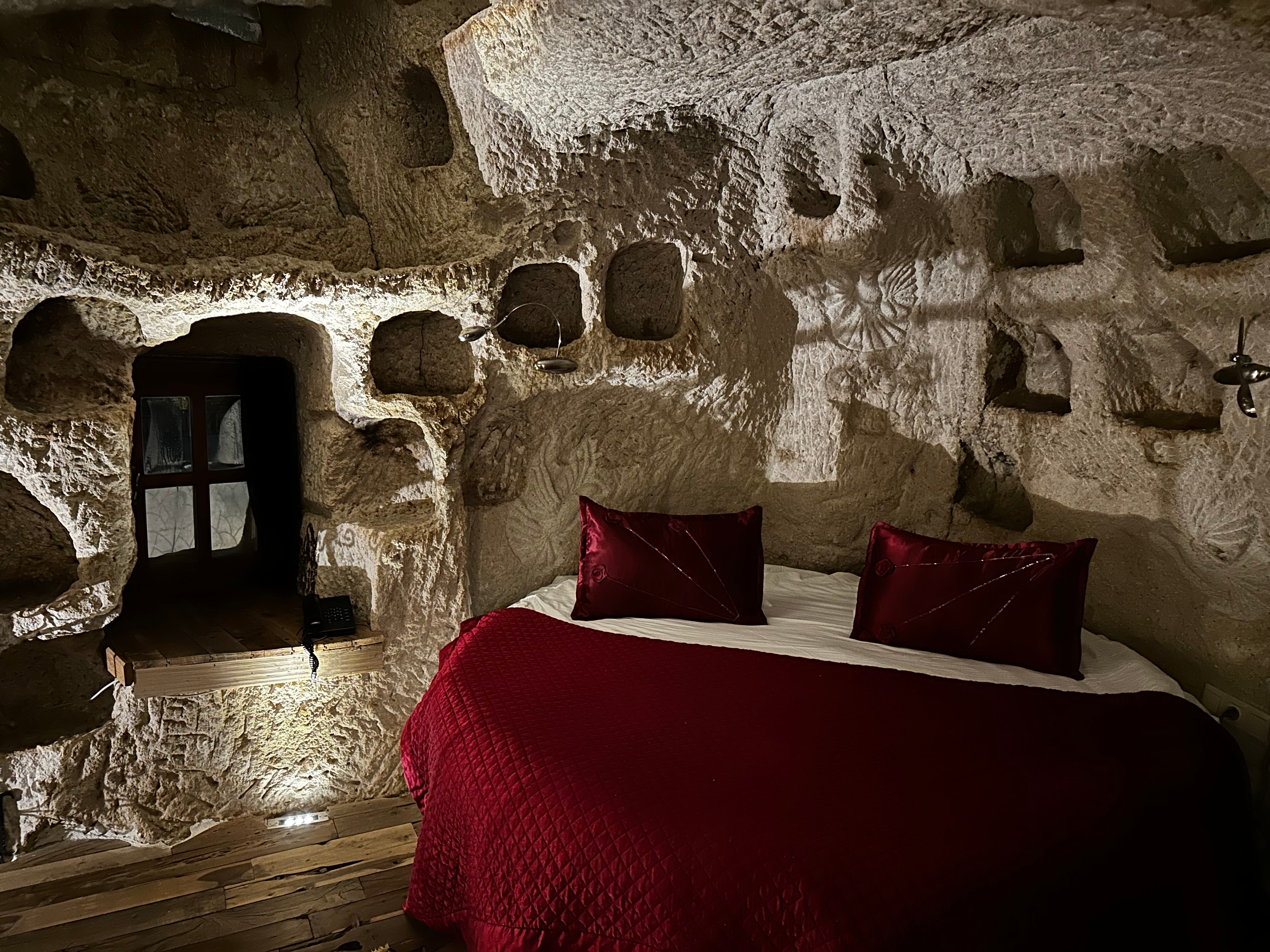
The caves weren’t built to impress. They were built to work. Volcanic ash, shaped by wind and rain, became rock soft enough to carve and strong enough to last. People didn’t try to conquer this land. They understood it. They went inward instead of upward. Sitting in that cave after such a chaotic journey, I felt the contrast sharply. Modern travel is loud, fragile, and dependent on systems breaking down. This place had been quietly functional for over a thousand years.
As I began learning more about Cappadocia, the landscape started to make sense. The fairy chimneys. The hollow hills. The valleys that look almost wounded. This land was shaped by volcanoes long before humans arrived, but humans figured out how to belong to it. They carved homes, storage rooms, kitchens, and places for animals straight into the rock. The temperature stayed stable year-round. Food kept longer. Life slowed down.
It made me think about how much energy we waste today just trying to recreate what these caves already did naturally.
Then I learned about the underground cities, and that’s where Cappadocia stopped feeling like a destination and started feeling like a lesson. Entire communities lived below the surface. Not briefly. Not in panic. But intentionally. Multiple levels deep, with ventilation shafts, wells that couldn’t be poisoned, heavy stone doors that could be rolled shut if danger came.
What struck me wasn’t the engineering. It was the trust.
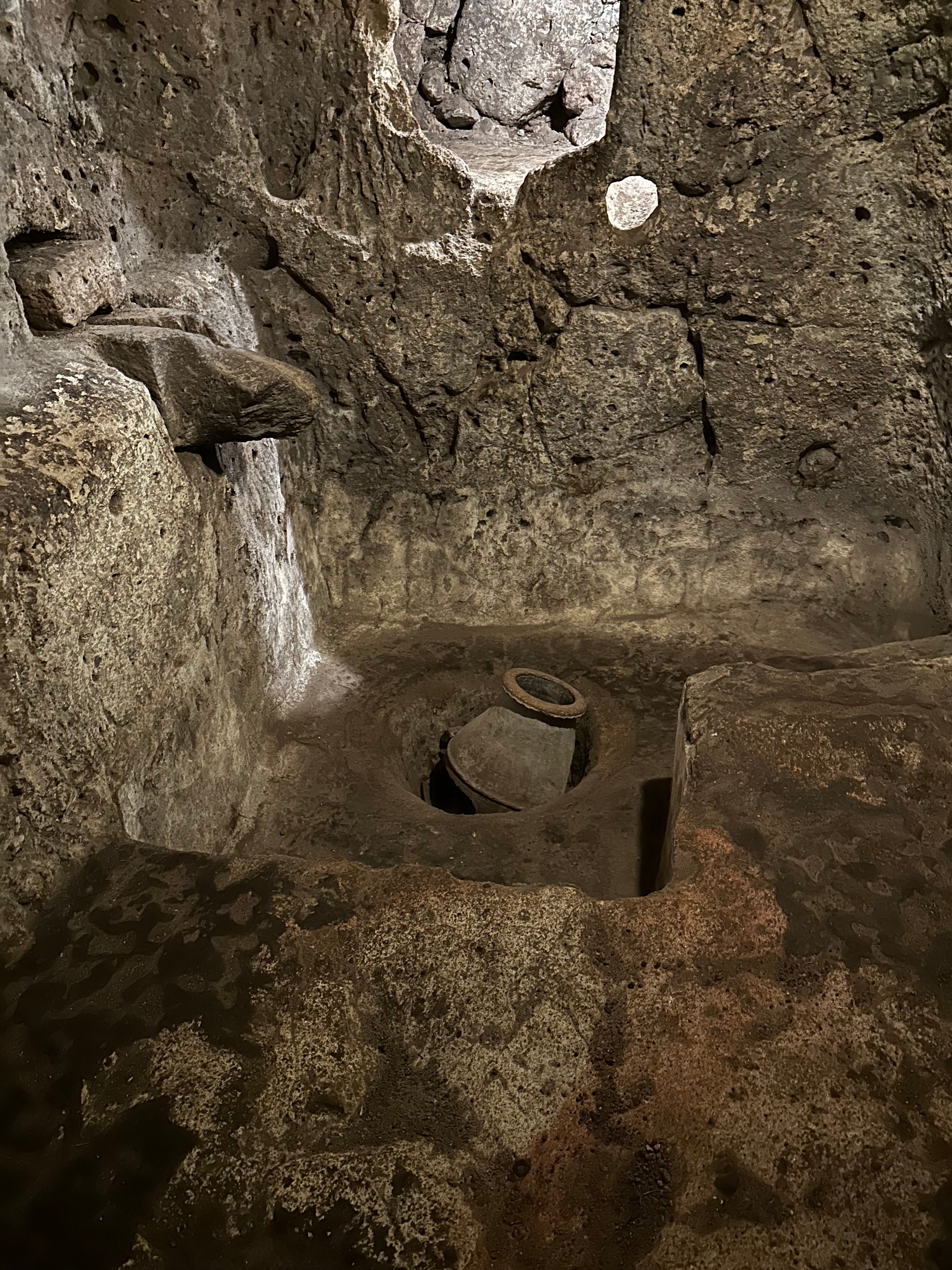
You can’t survive underground alone. You rely on others to keep passages clear, food shared, noise controlled. Individualism doesn’t work down there. Cooperation isn’t optional. Sitting in my quiet cave room at night, I kept thinking about how much modern life glorifies independence, while Cappadocia quietly proves that survival has always been collective.
Christian history added another layer that felt especially human. Early Christians didn’t come here to make statements or build monuments. They came because they needed safety. Faith moved into the rock. Churches were carved into caves. Walls were painted with stories for people who couldn’t read. These frescoes weren’t made to last forever. They were made because people needed meaning where they were.
That mattered to me. Faith here wasn’t loud. It wasn’t trying to convince anyone. It simply existed alongside daily life. Worship wasn’t separated from work or survival. It was woven into it.
For a long time, outsiders misunderstood this place. European travelers romanticized Cappadocia as a land of monks hiding from the world. The reality is far more grounded. Many of these rock-cut spaces were part of living villages. Families lived nearby. Work continued. Life went on. Cappadocia wasn’t a retreat from society. It was an alternative way of organizing it.
Even today some still choose to live in caves though many have use the tourism boom to convert their caves into hotels for economic benefit.
As trade routes passed through the region, that same mindset showed up again. Caravanserais offered shelter to travelers without question. Food, rest, and safety were provided because that was the rule. Hospitality wasn’t a brand. It was a duty. Even now, you feel it. Conversations aren’t rushed. Tea appears without being ordered. Time feels less aggressive here.
By the second day, I realized something else. Cappadocia doesn’t carry the ego of empire. Hittites, Persians, Romans, Byzantines, Seljuks, Ottomans all passed through. Most places are scarred by that. Cappadocia absorbed them. Each culture added something small, then moved on. Nothing erased what came before. Everything layered on top of it.
That layering may be the quiet genius of this place. New rooms were carved next to old ones. Frescoes were painted over earlier layers without destroying the wall beneath. History accumulated instead of being wiped clean. Standing in churches where paint from different centuries overlaps, you feel time behaving differently.
What stayed with me most during those four days was the restraint. Nothing here tries to overwhelm you. Spaces are human-sized. Built for use, not admiration. Even sacred spaces avoided excess. Meaning mattered more than scale. That restraint is probably why so much of it still exists.
When I left on January 4th, I wasn’t dazzled. I was unsettled in a good way.
Cappadocia challenged how I think about strength. It isn’t always loud. It isn’t always vertical. Sometimes strength means going inward. Sometimes it means adapting instead of dominating. Sometimes it means trusting others enough to build a life that depends on them.
After an 11-hour journey that should have taken 90 minutes, Cappadocia greeted me not with excitement, but with silence, stability, and patience. And maybe that’s the point. In a world obsessed with speed and spectacle, Cappadocia quietly asks a harder question.
What if the civilizations that last aren’t the ones that build the highest, but the ones that learn how to fit?
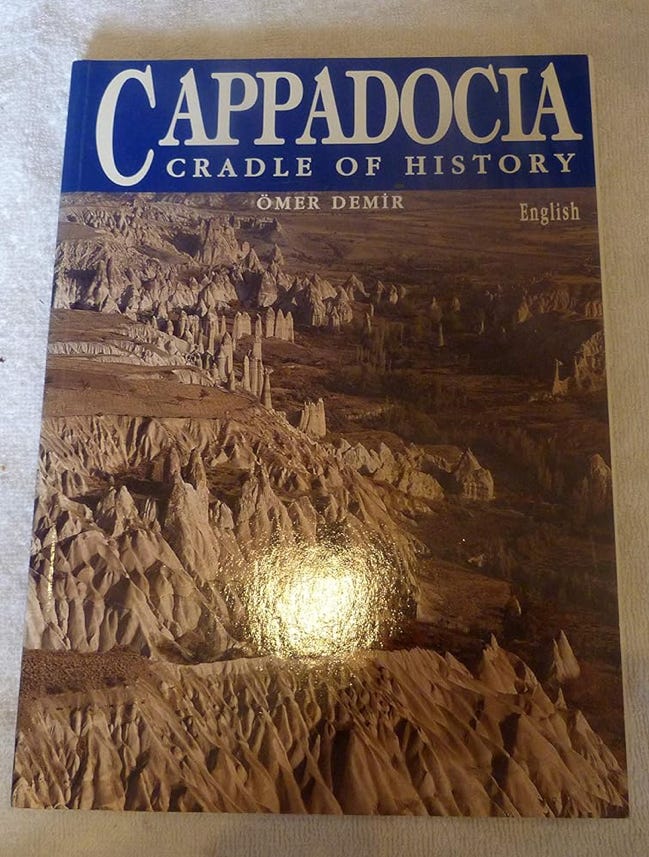
I will be going this year. Looking very much forward!
What a stunning place. I wish I could go, but I will read about it instead. Thank you for the book suggestion.