Why El Greco Distorted Reality
His elongated figures were deliberate choices, not defective vision.

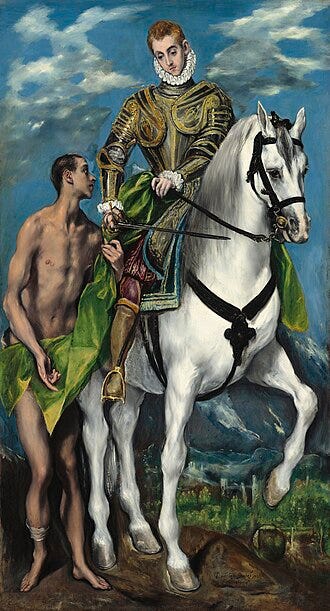
Look closely at an El Greco painting and something feels wrong. His saints are too tall. Their faces are narrow and severe. Fingers stretch far beyond ordinary proportions. Bodies seem to lose their weight. Clouds break open around figures caught somewhere between the physical world and a spiritual one.
For centuries, people have tried to explain this away. Perhaps El Greco had defective eyesight. Perhaps his strange bodies resulted from some physical abnormality. Perhaps he simply saw human beings differently.
There is a much more interesting possibility.
El Greco knew exactly what he was doing.
His distorted bodies were among the most radical artistic choices of the late Renaissance because they challenged an assumption at the heart of Renaissance painting: that greater fidelity to visible nature brought an artist closer to truth. El Greco increasingly pursued another possibility. What if visible reality could actually limit what a painter wanted to express?
The man we call El Greco was born Doménikos Theotokópoulos on Crete. He grew up within the Byzantine icon tradition before encountering the Renaissance art of Venice and Italy and eventually settling in Toledo.

In 1930, art historian Joseph Pijoan made a forceful argument about what happened next. A contemporary of El Greco had once written that “Crete gave him life, Toledo, his brushes.” Pijoan reversed it. Crete gave El Greco his brushes, he argued, while Toledo gave him his artistic life. El Greco arrived in Spain as an accomplished painter. In Toledo, he became El Greco.
The city proved decisive.
Soon after his arrival, El Greco received major commissions. The cathedral chapter and Philip II ordered large paintings from him. His relationships with patrons could become contentious, but Spain continued to make room for his increasingly unusual art.
Pijoan points to something even more revealing. El Greco’s paintings remained in Spanish churches and palaces through later periods when artistic fashion had moved far away from him. Priests, nuns and ordinary worshippers continued praying before those strange figures.
Spain seems to have understood something later observers struggled to understand.
El Greco’s elongated figures eventually became a problem people wanted to solve.