

How to Read Dante Like a Gothic Cathedral
A Practical Guide to Reading the Divine Comedy

The first time I tried to read Dante seriously, I expected a kind of medieval thriller. I had heard about Hell, demons, punishments, strange monsters, the whole grim spectacle. And for a while, it delivers exactly that. But somewhere along the way, I noticed something that made the poem feel less like fantasy and more like engineering. Everything was arranged. Every descent had a reason, every punishment had a shape, and every movement felt measured, almost architectural.
That’s the moment you start to understand why so many people stop reading Dante. We try to read him like a modern novelist, when he’s doing something closer to what Gothic cathedral builders were doing: constructing a universe you can walk through.
In her dissertation, Gothic Cathedral as Theology and Literature1, Mary E. Wilson makes the argument bluntly: medieval sacred architecture and medieval sacred literature were shaped by the same mental framework. The same worldview produced Gothic cathedrals also shaped writers like Robert Grosseteste, Chaucer, and Dante.
That worldview was built around sacred geometry, number symbolism, and the metaphysics of light. Once you keep that in mind, Dante stops feeling like a difficult poet and starts feeling like a master builder.
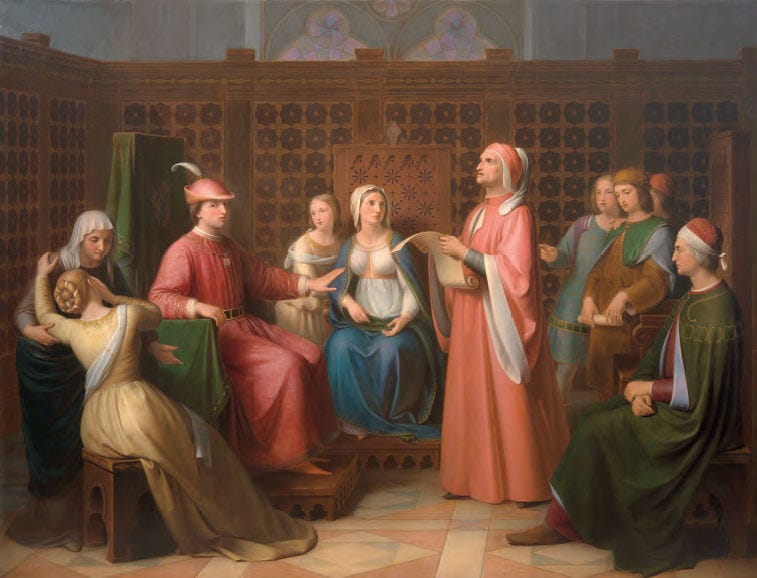
One of the most important things to understand about medieval Europe is that it didn’t divide life into clean modern categories. We live in a world where architecture belongs to architects, theology belongs to priests, literature belongs to writers, and mathematics belongs to scientists. Medieval people didn’t think that way. Even their systems of education, like the Trivium and Quadrivium, were meant to show how knowledge connected, not how it separated.
That’s why a cathedral was never just a building. It was a physical argument about reality and a structured image of the universe. It was theology turned into space.
If you want proof that this wasn’t vague symbolism but actual design practice, look at how medieval cathedrals were planned. Builders used proportional systems called ad quadratum and ad triangulum, methods based on squares and triangles that allowed architects to scale a structure while preserving harmony.
This kept the building stable while also building it in accordance with cosmic order. Geometry was seen as part of the structure of creation itself. And medieval people treated it seriously enough to hire mathematicians when a design wasn’t working.
The Cathedral of Milan is a perfect example of this. It was originally planned using ad quadratum proportions, but the angles were judged too steep. In September 1391, a mathematician was hired to convert the cathedral plan from ad quadratum to ad triangulum proportions. Then in May 1392, it was modified again to reduce the steepness even further.
Read more on this in our premium article, “The Man Who Saved a Cathedral with a Triangle.”
That one detail should change your image of the Middle Ages. These were builders working with geometry as a serious intellectual discipline. Now hold that image in your mind: a cathedral being recalculated like a mathematical problem.
Then turn back to Dante. Because Dante is doing something similar.
