


The most important lesson of the 1950s is that Americans accepted stronger expectations about how to live because the country gave millions of them something tangible in return: rising incomes, affordable homes, useful work, functioning institutions, and a believable path into adulthood. If another period of reconstruction follows the present crisis, its success will depend on whether America can offer a comparable exchange under radically different conditions.
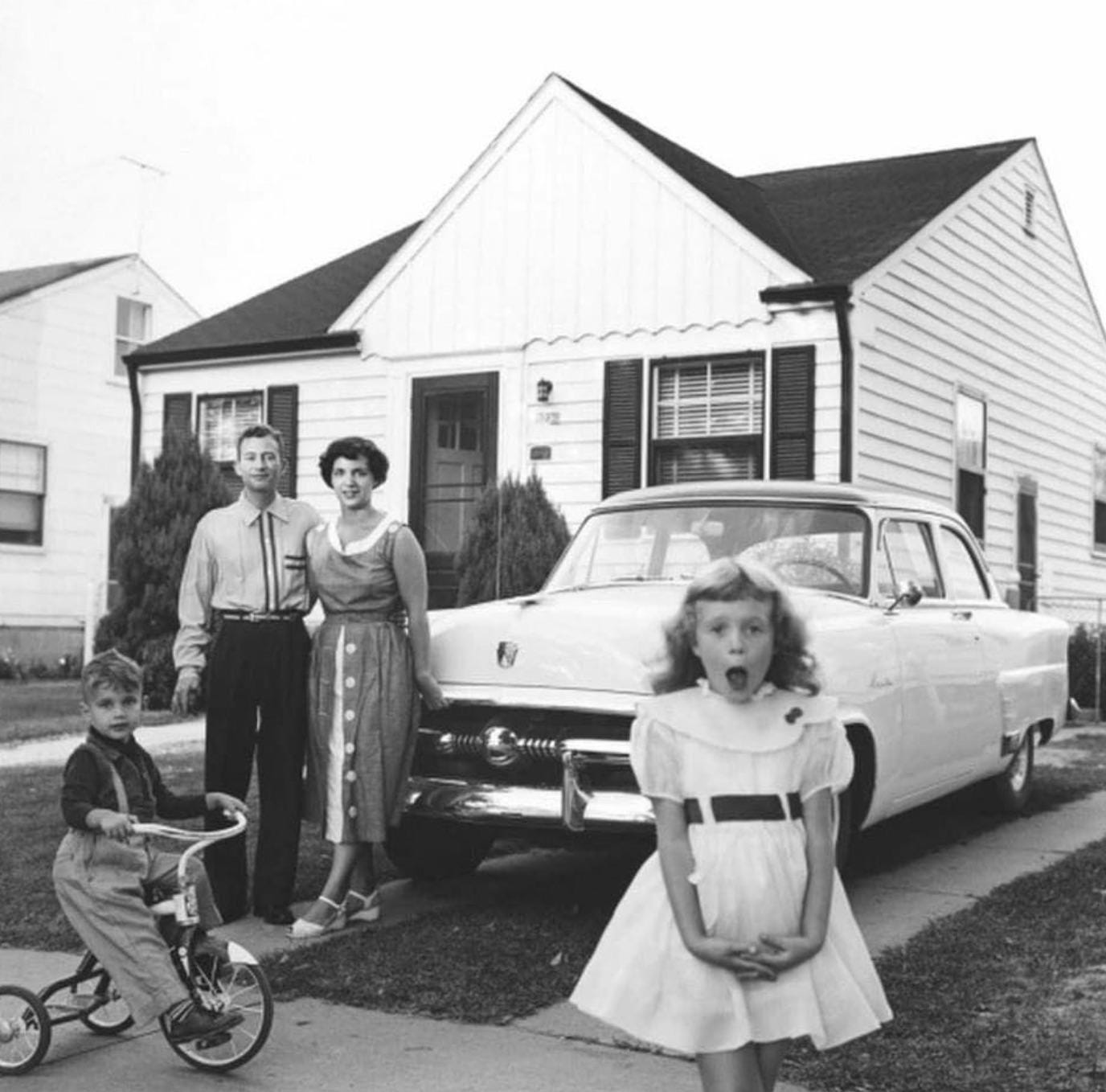
There is a photograph of America that has become almost impossible to separate from the 1950s.
A new house on a suburban street. A Chevrolet in the driveway. The father at work, the mother managing the home, children nearby. A television in the living room. Appliances their grandparents could scarcely have imagined. Highways, schools, and houses rising at a speed that still looks astonishing.
That America existed. Treating it as the whole story makes the decade almost impossible to understand. It also makes it a dangerous template for whatever comes next.
The same years contained Joseph McCarthy, nuclear drills, legal segregation, Rosa Parks, Rebel Without a Cause, Chuck Berry, Elvis Presley, the Beats, and teenagers discovering that they were becoming both a market and a culture. Prosperity existed beside poverty. Public language about equality existed beside racism and rigid expectations for women. The historian Martin Halliwell has described the decade as a period of extraordinary contradictions: optimism and nuclear fear, prosperity and poverty, conformity and growing dissent.
The useful question is not whether America will look like that photograph again. It is what Americans received after decades of crisis, what made the settlement possible, and which parts of it can travel.
People wanted ordinary life because ordinary life had become precious
An American who turned forty in 1950 had been born in 1910. By middle age that person had lived through World War I, the influenza pandemic, the Great Depression, and World War II. Someone born in 1920 entered adulthood during the Depression and was twenty-one when Pearl Harbor was attacked.
Millions had spent years thinking about unemployment, ration books, military service, death, and whether the next year would be better than the last. When the war ended, their desires were not mysterious. They wanted houses, children, jobs, cars, vacations, refrigerators, schools, safe neighborhoods, and a Tuesday that behaved roughly as Monday had.
Americans wanted predictability and reliability because both provided security after enormous disruption. A gray flannel suit looks different if the man wearing it remembers unemployment. A suburban house looks different if its owner remembers barracks. A refrigerator looks different to parents who grew up during the Depression.
The appetite for stability came from experience. Desire alone does not explain the 1950s. America also had money, unused productive capacity, and institutions capable of turning private hopes into millions of houses, degrees, roads, and jobs.
The High was built from surplus
The circumstances after 1945 were exceptional. The United States emerged from the war with its industrial base intact and greatly expanded. Years of wartime restriction had created pent-up demand. Returning servicemen wanted homes, education, and work. Policy helped them obtain all three.
The GI Bill became one of the largest engines of social mobility in American history. About 7.8 million World War II veterans received education or training under its original provisions. In 1947, at the peak, veterans accounted for nearly half of American college enrollment. By the early 1950s the government had already backed more than two million home loans for World War II veterans.
The effect reached far beyond those who served. College expanded. Construction expanded. Consumer demand expanded. Families formed. In 1950, 55 percent of American households owned their homes. By 1960 the figure had reached 61.9 percent.
Then came the children those houses were built to hold. In 1957 about 4.3 million babies were born in the United States, and the birth rate reached 25.3 births per 1,000 people. Those children needed bedrooms, schools, playgrounds, pediatricians, and eventually universities. America built for them.
Cars remade the map. Americans bought about 6.1 million domestically produced cars in 1953 and nearly 7.9 million in 1955. Congress authorized the Interstate Highway System in 1956, reorganizing work, shopping, and residence around the automobile.
None of this was only a rediscovery of family values. The country constructed an economic environment in which millions of people could act on those values. Culture and material conditions reinforced each other.
The wage structure mattered as much as the mortgage. Union membership was high by later standards. Income gaps were compressed compared with the 1920s or with our own time. A manufacturing job could, for a large share of households, support a family on one paycheck. That is the condition nostalgia most often leaves out, and it is the condition least available to copy.
Television taught the country what the settlement looked like
A new medium entered millions of living rooms and supplied pictures of the life Americans were building. By the end of the 1950s the overwhelming majority of households had at least one television set. People in different states watched the same families, advertisements, news broadcasts, and entertainers.
*The Adventures of Ozzie and Harriet* offered one version of the ideal: a reasonably affluent white household, an organized homemaker, a father with remarkable free time, two clean-cut sons. *Father Knows Best* presented another. The lesson extended beyond any single program. Finish school. Find work. Marry. Buy a house. Raise children. Join something. Own things that demonstrated progress.
For millions of Americans, private ambition and public expectation pointed in roughly the same direction. That alignment gave the culture enormous power. It also defined who belonged comfortably inside it.

