

5 Russian Novels That Will Change How You See the World
The Five Essential Novels of Russian Literature

Few literary traditions have asked more difficult questions about human existence than Russian literature.
Its great writers treated the novelist as something more than a storyteller. By the nineteenth century, the Russian writer had come to occupy the role of a “master of mind,” someone expected to confront the moral questions facing society. This helped produce the vast Russian novel, a form capable of examining nearly every dimension of life through characters forced to confront faith, suffering, love, guilt, freedom, death, and responsibility.
If you want to understand why Russian literature has had such lasting power, five novels offer an extraordinary place to begin: Crime and Punishment, Fathers and Sons, Anna Karenina, War and Peace, and The Brothers Karamazov. Let us begin…

1. Crime and Punishment by Fyodor Dostoyevsky
Few novels force you to spend so much time inside the mind of someone who has committed a terrible crime as Fyodor Dostoevsky’s Crime and Punishment. Rodion Raskolnikov is an impoverished former student in St. Petersburg who convinces himself that humanity can be divided between ordinary people, who must obey moral laws, and extraordinary people, who may violate them in pursuit of a higher purpose. Napoleon becomes his model. Raskolnikov decides to test the theory by murdering an elderly pawnbroker whom he regards as worthless and using her money for supposedly better ends. The murder therefore becomes an experiment: can intelligence, conviction, and a noble justification place a person above ordinary morality?
Dostoevsky gives us the answer through Raskolnikov’s mind. He escapes immediate arrest, yet almost immediately begins to collapse under the psychological weight of what he has done. Guilt, paranoia, fever, pride, and fear begin competing with his desperate attempts to defend his theory. This is why Crime and Punishment works so well as a psychological novel. The central suspense comes from watching Raskolnikov argue with himself while the investigator Porfiry Petrovich gradually closes in on him. Around him, Dostoevsky creates characters who test different answers to suffering: Razumikhin through friendship, Sonya through love and faith, Svidrigailov through moral abandonment, and Raskolnikov through intellectual pride. The novel’s grim St. Petersburg atmosphere strengthens this sense of guilt, concealment, and suffering.
What makes Crime and Punishment essential reading is that Dostoevsky refuses to leave the question at the level of abstract philosophy. Raskolnikov must live inside the consequences of his idea. He discovers that proving himself “extraordinary” requires treating another human life as material for an experiment, and his own conscience refuses to cooperate. Sonya eventually offers him another path through confession, suffering, love, and the possibility of moral renewal. More than 150 years after its publication, the novel still asks a disturbing question: If you become convinced that your intelligence and your cause justify breaking ordinary moral rules, what remains to stop you?

2. Fathers and Sons by Ivan Turgenev
Every generation believes it has seen through the illusions of the generation before it. Ivan Turgenev’s Fathers and Sons, published in 1862, turns that recurring conflict into one of the defining novels of Russian literature. Arkady Kirsanov returns home from university accompanied by his friend Yevgeny Bazarov, a fiercely intelligent young man who calls himself a nihilist. Bazarov rejects established authority, inherited tradition, romantic sentiment, religion, and ideas that cannot withstand rational examination. His confidence immediately puts him at odds with Arkady’s father, Nikolai, and especially his aristocratic uncle Pavel. Through their arguments, Turgenev captures a Russia in transition, where an older social order faces a younger generation convinced that much of what came before deserves to be discarded.
Bazarov makes the novel memorable because Turgenev allows his philosophy to confront actual life. Nihilism appears powerful when Bazarov is debating politics, criticizing aristocrats, or mocking romantic ideals. It becomes harder to sustain when he encounters love, friendship, family, pride, and mortality. His relationship with Anna Odintsova exposes emotions that refuse to obey his theories, while his aging parents reveal something even more difficult for him to dismiss unconditional parental love. Arkady undergoes a different transformation. He begins the novel echoing Bazarov’s ideas but gradually discovers that his friend’s philosophy does not fully describe the life he wants. The conflict between fathers and sons therefore becomes a larger question about what happens when a generation tries to build its identity by rejecting what it inherited.
At roughly 200 pages, Fathers and Sons offers one of the most accessible entrances into nineteenth-century Russian literature. Its ideas also feel remarkably current. Every period produces young people convinced that inherited institutions and beliefs have failed, alongside parents struggling to understand why their children reject values they once assumed would endure. Turgenev neither dismisses the young nor romanticizes the old. He gives Bazarov enormous intelligence and courage while allowing experience to test the limits of his certainty. That makes the novel’s central question difficult to leave behind: When a generation decides that the beliefs of its parents should be torn down, what should it preserve in their place?

3. Anna Karenina by Leo Tolstoy
Anna Karenina begins with a marriage in crisis and expands into one of the most complete studies of love, family, desire, faith, and social judgment ever written. Tolstoy follows two very different relationships: Anna’s affair with Count Vronsky and Levin’s developing relationship with Kitty. Anna is intelligent, emotionally intense, and trapped inside a social world that punishes her far more severely than it punishes the men around her. Levin, by contrast, struggles with marriage, work, faith, and the question of how to live a meaningful life. The novel’s power comes from placing these lives beside each other and asking what kind of love can actually sustain a person.
Tolstoy is especially strong at showing how private emotions become moral and social problems. Anna’s passion for Vronsky initially feels liberating, but the consequences gradually close around her. Jealousy, isolation, public shame, dependence, and fear begin reshaping her inner life. Levin follows a different path. His relationship with Kitty grows through disappointment, reconciliation, marriage, family, and ordinary responsibility. Their story is quieter, but it gives the novel much of its philosophical depth. Through both couples, Tolstoy asks what separates desire from commitment, what marriage requires after romance fades, and whether happiness can survive without duty, forgiveness, and a larger sense of purpose.
What makes Anna Karenina essential is the precision with which Tolstoy understands human psychology. Characters contradict themselves, misread one another, act from mixed motives, and often understand their own feelings only after they have already made irreversible decisions. That makes the novel feel strikingly modern despite its setting in nineteenth-century Russia. The Rosamund Bartlett translation is also a strong choice for English readers because of its smooth, readable prose and its ability to preserve the novel’s psychological movement without making it feel stiff. At its center, Anna Karenina leaves you with one of literature’s hardest questions: Is love enough to build a good life, or does love itself require duty, restraint, faith, and responsibility to endure?
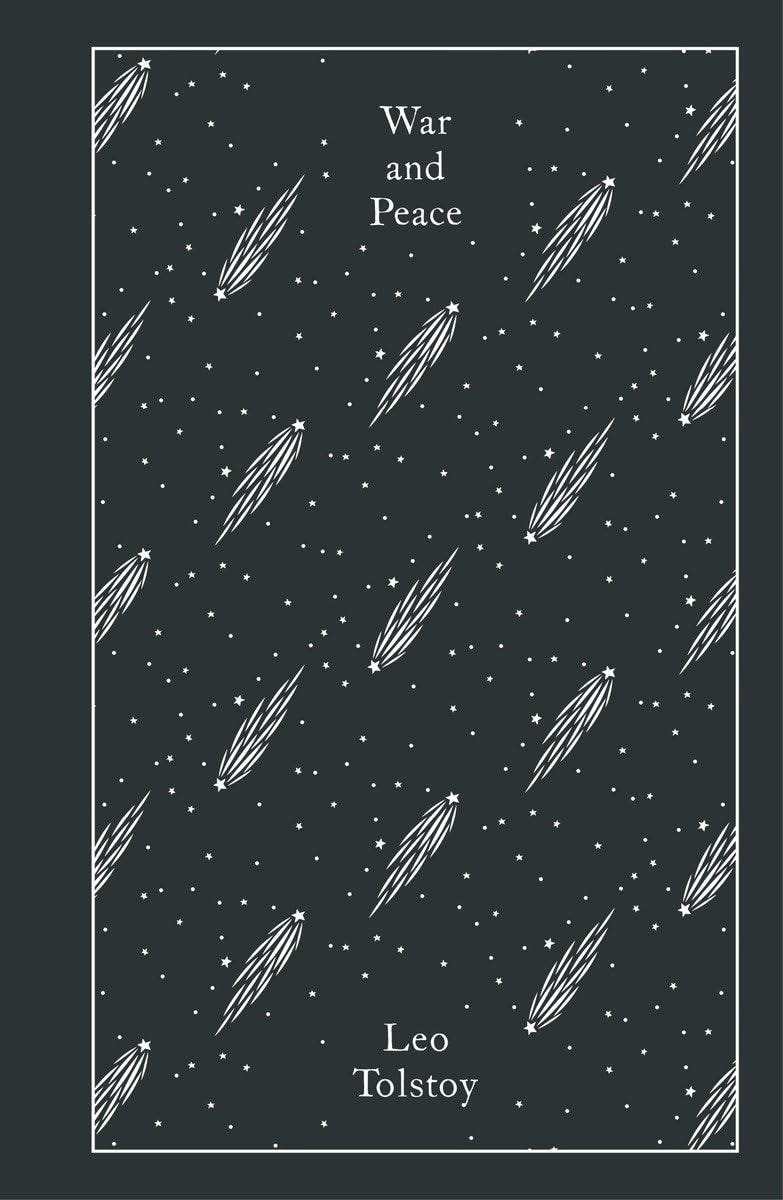
4. War and Peace by Leo Tolstoy
War and Peace is intimidating because of its length, but Tolstoy quickly makes its scale feel necessary. The novel moves through aristocratic drawing rooms, military campaigns, family estates, courtships, deaths, and political upheaval while following characters such as Pierre Bezukhov, Natasha Rostova, and Prince Andrei Bolkonsky. Their lives unfold against the Napoleonic Wars, yet Tolstoy wants to know how people understand themselves when history, love, ambition, and suffering place pressure on every assumption they hold. The result is a novel that feels immense because it tries to account for nearly every part of human life.
The heart of the novel lies in the different ways its central characters search for meaning. Pierre moves through wealth, confusion, ideology, marriage, war, captivity, and spiritual questioning. Prince Andrei pursues glory and distinction, only to discover how fragile those ambitions become when confronted by injury, loss, and death. Natasha begins with youth and spontaneity, then matures through love, betrayal, grief, and responsibility. Tolstoy gives these personal stories the same weight as armies and emperors. That choice supports one of the novel’s most important ideas: history may appear to be driven by great men, but actual life unfolds through countless individual decisions, accidents, fears, loyalties, and desires.
What makes War and Peace essential is the way Tolstoy joins the private and the historical without reducing either one. The battle scenes matter because people are transformed inside them. The philosophical passages challenge easy explanations of power, leadership, freedom, and historical causation. Even at more than a thousand pages, the novel keeps returning to questions that feel immediate: What gives a life meaning? How much control do we really have over events? What remains when ambition fails? And how should a person live when history refuses to move according to plan? That is why War and Peace is one of literature’s most serious attempts to understand how human beings live inside forces much larger than themselves.

5. The Brothers Karamazov by Fyodor Dostoyevsky
Few novels ask more difficult questions about God, freedom, evil, and human responsibility than Fyodor Dostoevsky’s The Brothers Karamazov. At its center is a deeply dysfunctional family dominated by Fyodor Karamazov and his sons, each of whom approaches life differently. Dmitri is driven by passion and appetite. Ivan is the intellectual skeptic who cannot reconcile belief in a good God with the suffering of innocent people. Alyosha approaches the world through faith, compassion, and love. Smerdyakov carries resentment and nihilism toward their darkest consequences. When their father is murdered, these competing ways of understanding life suddenly face a concrete test. The philosophical arguments become inseparable from the question of who bears responsibility for what happened.
Ivan gives the novel some of its most difficult and memorable arguments. His challenge to religious faith reaches its height in “Rebellion” and “The Grand Inquisitor,” where Dostoevsky confronts the suffering of children, the existence of evil, human freedom, and the temptation to surrender freedom in exchange for security and certainty. Yet Dostoevsky allows these arguments to face serious opposition through Alyosha, Father Zosima, and the events that follow. Dmitri’s passions, Ivan’s ideas, Alyosha’s faith, and Smerdyakov’s actions begin affecting one another in ways none of them can fully control. The murder therefore raises a deeper question than legal guilt: can someone bear moral responsibility for an act he never physically committed but helped make possible through his ideas, indifference, or example?
That is what makes The Brothers Karamazov such an extraordinary conclusion to Dostoevsky’s career. It combines a murder mystery, courtroom drama, family tragedy, theological argument, and psychological study while refusing to give easy answers to its largest questions. The religious and philosophical discussions can demand patience, but their importance becomes clearer as the story develops and abstract ideas acquire consequences in the lives of the characters. By the end, Dostoevsky has forced faith, reason, freedom, suffering, guilt, and redemption into direct confrontation. The novel ultimately leaves you with a question that extends far beyond the Karamazov family: How responsible are we for the actions of others when our ideas, choices, and failures helped make those actions possible?
These five novels reward the time they demand because their characters rarely remain safely inside their ideas. The settings belong to nineteenth-century Russia, but the people feel remarkably familiar. They love badly, judge too quickly, defend ideas they cannot always live by, search for meaning, hurt people they care about, and sometimes change. That may be the strongest reason to read these five books: more than a century later, you can still recognize yourself and the people around you in them.
Can Intelligence Justify Evil?

Raskolnikov decides to commit murder only after convincing himself that killing the pawnbroker would be an act of justice.
How War and Peace Turns the Struggles of Life into a Theology of Love

How War and Peace Turns the Struggles of Life into a Theology of Love

The Tale of Genji Is the First Psychological Novel

You can watch a man climb the heights of power, seduce the most beautiful women, and master the rituals of a golden court and still feel that he is emotionally hollow.
Wonderful summary for contemporary readers of five of the greatest novels ever written. My doctoral dissertation explored Tolstoy's early ideas about nonviolence in War and Peace.
Crime and Punishment saved my life in many ways.
Looks like I might need to add Fathers and Sons to my list.